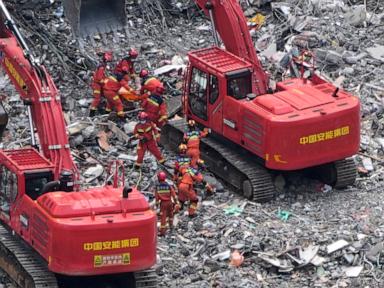
Eleven bodies have been pulled from the mud in Pengshui County, a scenic stretch of Chongqing in southwestern China, while fifty people remain unaccounted for after a massive section of a mountainside collapsed onto a cluster of riverside homes. Ten others were rushed to regional medical centers with severe injuries. The July 17 slope failure wiped out entire residential blocks and local storefronts, leaving emergency response crews to detonate heavy boulders with explosives in a desperate, late-stage attempt to reach buried structures beneath hundreds of thousands of tons of fallen rock.
State officials declared on July 23 that life-detection tools no longer register signs of survivors beneath the massive debris field, shifting the operation into a recovery phase. The incident is the latest in a relentless sequence of deadly geological failures striking China’s mountainous hinterlands. While official coverage treats these events as tragic acts of nature, civil engineers, meteorologists, and disaster response experts recognize a far more dangerous pattern unfolding across the region.
When Mountains Give Way
The immediate catalyst in Pengshui County was a prolonged, unrelenting deluge that saturated fragile karst terrain. Water forced its way into micro-fractures along steep limestone cliffs, building up immense hydrostatic pressure until the friction holding the rock matrix together simply vanished. When the structural boundary failed, the mountainside gave way in seconds, cascading down upon a riverside community nestled along the valley floor.
Disaster sites in southwestern China present brutal operational challenges for heavy machinery. Narrow valley roads restrict access for multi-ton earthmoving equipment. The sheer weight of dropped monoliths—some larger than two-story residential homes—forces rescue workers to deploy controlled explosive blasts merely to fragment individual boulders before excavators can clear the rubble.
This is not an isolated catastrophe. Over the past decade, hundreds of Chinese citizens have lost their lives in major mountain failures spanning Sichuan, Yunnan, Guizhou, and Chongqing. The geology of the southwest features steep topographical gradients, deeply weathered bedrock, and high seismic activity. It is a region naturally prone to slope instability. Yet the accelerating frequency and growing lethality of these events point to human vectors compounding natural hazard.
The Lethal Intersection of Monsoon Shifts and Slope Alteration
Climate data across East Asia shows a pronounced shift in weather patterns over the last two decades. Precipitation is no longer distributed evenly across traditional monsoon months. Instead, atmospheric rivers deposit concentrated, hyper-localized volumes of water over short durations. Rainfall totals that used to accumulate over four weeks now dump onto mountain catchments in less than forty-eight hours, instantly overwhelming the natural drainage capacities of high-altitude watersheds.
At the same time, regional economic expansion has driven intense infrastructure development deep into steep river valleys. Highway cut-outs, terrace construction, and residential building projects regularly trim the natural "toes" of unstable slopes. When civil engineering crews cut into the base of a hill to widen a roadway or clear land for apartment foundations, they remove the structural support holding millions of tons of overhead earth in place.
Under normal conditions, engineered retaining walls and soil nails can stabilize these modified cuts. Under extreme saturation, however, groundwater pressure undermines engineered supports from behind. The soil loses shear strength entirely, behaving like a dense fluid rather than solid earth. When these hydro-geological limits are breached, disaster becomes inevitable.
The Mechanics of Mass Wasting
- Hydraulic Saturation: Sustained rainfall fills pore spaces within rock and soil layers, increasing pore water pressure and drastically weakening frictional resistance.
- Basal Undercutting: Road construction or riverbed erosion removes physical mass at the foot of a slope, leaving overhead rock structures unbuttressed.
- Internal Shearing: Fractures deep within the bedrock expand as water freezes, thaws, or exerts pressure, causing a distinct failure plane to form.
- Catastrophic Failure: Overburden weight exceeds friction along the failure plane, accelerating thousands of tons of earth downhill within seconds.
Early Warning Limits in High-Risk Zones
China has invested heavily in disaster monitoring technology, placing satellite-linked tilt sensors, synthetic aperture radar (SAR), and automated rain gauges across thousands of high-risk mountain faces. These systems measure microscopic land shifts long before visible cracks open up on the surface.
The technology works well on slow-moving earthen slides. It struggles against sudden, catastrophic rock collapses.
Hard-rock cliff faces often display zero detectable movement prior to sudden failure. Micro-cracks can develop inside a mountain mass without altering the surface topography enough for satellite radar to catch. By the time surface sensors register an anomaly, the failure cascade is already under way, leaving residents in the valley below mere seconds to escape.
Furthermore, deploying ground-based sensors across millions of square kilometers of rugged terrain remains economically and logistically impossible. Thousands of small towns across Chongqing, Sichuan, and Yunnan sit beneath unmonitored slopes that have never undergone rigorous geotechnical survey.
The Political Economy of Rural Valley Settlements
Understanding why communities live directly in the path of known landslide hazards requires looking at geography and economics. Land in southwestern China is defined by extreme vertical topography. Flat ground is extraordinarily rare, commanding premium valuations in urban centers like central Chongqing.
For rural populations, county towns, and small commercial hubs, the only buildable space often lies along narrow river corridors bounded by towering cliffs. Moving these settlements out of harm's way would require relocating tens of millions of people and building massive new urban centers on leveled mountain plateaus—an undertaking that exceeds the financial capacity of local municipal governments already burdened with heavy debt loads.
As a result, local authorities rely heavily on post-disaster emergency response rather than preventative relocation. When disaster strikes, state media broadcasts images of thousands of military personnel and emergency crews rushing to the scene. The bravery of frontline rescuers is highlighted, while the systematic policy failures that allowed high-density housing beneath unreinforced cliffs remain unaddressed.
Engineering Standards Must Change Before the Next Monsoon
Relying on post-disaster rescue in deep valley terrain is a losing strategy. Once a mountain collapses onto a residential settlement, survival rates drop near zero within minutes.
Preventing future tragedies in southwestern China requires a fundamental overhaul of regional land-use zoning and structural monitoring:
- Mandatory Slope Inspections: Comprehensive geotechnical surveys must be legally required prior to any residential or industrial construction within 500 meters of cliff bases.
- Continuous Drone Scanning: Local emergency bureaus need to deploy LiDAR-equipped drones to conduct weekly structural scans of high-risk cliffs during peak rain months.
- Strict Evacuation Triggers: Localities must establish automatic evacuation thresholds based on cumulative 24-hour rainfall metrics rather than waiting for physical ground shifts.
- Resettlement Subsidies: Regional authorities must allocate direct funding to move vulnerable valley communities into safer, lower-gradient zones.
As climate volatility drives heavier monsoon seasons across Asia, the line between natural disaster and structural neglect grows thinner by the day. The eleven confirmed dead in Chongqing represent another painful warning written into the mud. Without immediate, aggressive changes to rural zoning laws and slope management, the fifty people buried beneath Pengshui's rubble will not be the last.