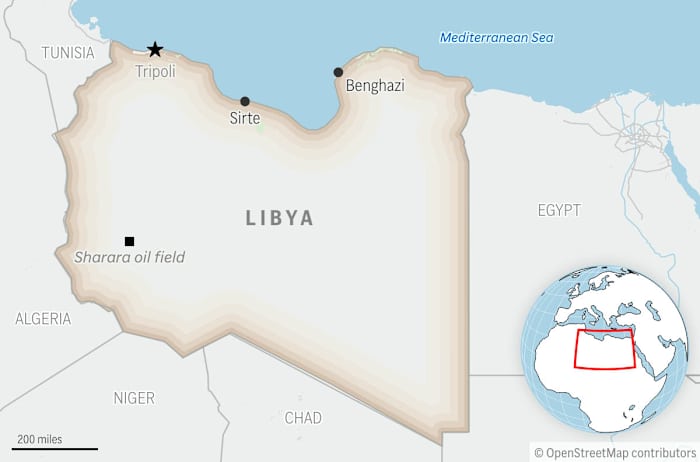
Fifty dead or missing. Another wooden boat splintered into the Mediterranean. Another round of predictable, copy-paste hand-wringing from the international press.
The media follows a precise, tired script every time a tragedy occurs off the coast of Tripoli or Zawiya. The narrative is always the same: desperate migrants, ruthless smugglers, passive European onlookers, and the self-evident "solution" of more search-and-rescue vessels. It is a story of pure victimhood and systemic neglect.
It is also a dangerous oversimplification that guarantees more people will drown next week.
If you want to understand why the central Mediterranean remains a graveyard, you have to look past the superficial morality play. The hard, counter-intuitive truth is that the current framework of humanitarian "rescue" has been priced into the business model of human trafficking. By treating the symptoms of this crisis with a combination of guilt and short-term naval band-aids, we have created a lethal feedback loop.
To stop the drowning, we must dismantle the moral hazard we helped create.
The Economics of a Maritime Tragedy
The conventional view blames shipwrecks entirely on the callousness of smugglers. While smugglers are undeniably brutal criminals, they do not operate in a vacuum. They operate in a market. And like any market, theirs is shaped by incentives.
In the early 2010s, smuggling required seaworthy vessels. Traffickers needed wooden fishing trawlers capable of navigating the entire 300-mile journey from Tripoli to Lampedusa or Sicily. These boats were expensive, requiring skilled captains and substantial fuel reserves.
Then came the deployment of European search-and-rescue (SAR) assets closer to the Libyan territorial waters—first through state-led missions like Italy's Mare Nostrum, and later via a flotilla of non-governmental organization (NGO) vessels.
The smugglers adapted instantly.
[Old Model: High-Cost Trawlers] ---> [300-Mile Journey to Italy] ---> [High Capital Expense for Smugglers]
                                                vs.
[New Model: Cheap Inflatables]   ---> [12-Mile Run to International Waters] ---> [NGO/State Rescue Asset] ---> [Zero Capital Retention]
Why buy an expensive, reusable wooden boat when a cheap, unseaworthy Chinese-made inflatable dinghy will do? The business model shifted. Smugglers now only need to pack 120 people onto a rubber toy, fill the outboard motor with just enough gasoline to clear Libya's 12-nautical-mile territorial sea limit, and hand a migrant a satellite phone to call for rescue.
The rescue is no longer an emergency contingency; it is the second leg of the transit ticket.
When NGO and state vessels patrol right on the edge of Libyan waters, they unwittingly act as a free shuttle service for organized crime. The smugglers’ overhead costs plummeted, their profit margins soared, and the physical risk was transferred entirely onto the migrants and the rescue crews. By lowering the logistical bar for a "successful" departure, we dramatically increased the volume of unsafe departures.
Dismantling the Premise of "The Push Factor"
Academia and NGO press releases love to talk about "push factors"—war, climate change, poverty. They argue that people are fleeing such desperate conditions that no border policy or maritime risk will deter them.
This is a flat-out lie.
Migration flows are highly sensitive to price, probability of success, and perceived safety. I have spent years tracking migration logistics and speaking with analysts who monitor these routes. When the probability of reaching Europe rises, the volume of attempts surges. When the Libyan Coast Guard increases interceptions, or when Italy restricts NGO port access, the smuggling networks face a bottleneck.
To argue that deterrence does not work is to ignore basic human behavior. People do not pay thousands of dollars to smugglers for a guaranteed ticket to a watery grave; they pay because they believe the odds of making it to Europe are high enough to justify the risk.
When we advertise a permanent, de facto safety net just outside Libyan waters, we artificially inflate those odds. We convince families in sub-Saharan Africa and Bangladesh to pool their life savings to put a teenager on a rubber raft that was never designed to survive a three-foot wave.
The Failed Logic of "Safe and Legal Routes"
Whenever a tragedy like this happens, the immediate consensus cry from center-left politicians and human rights organizations is: "We need safe and legal pathways to seek asylum."
It sounds noble. In practice, it is completely detached from demographic and economic reality.
Let’s look at the numbers. The population of Africa is projected to double to 2.5 billion by 2050. The economic disparity between the Global South and Europe is an engine of historic proportions. There is no politically, economically, or socially viable "legal pathway" that can accommodate the tens of millions of people who wish to migrate for better economic opportunities.
- Asylum is not an economic mobility program. Technically and legally, asylum is reserved for individuals fleeing targeted persecution based on specific categories (race, religion, nationality, membership of a particular social group, or political opinion).
- The vast majority of migrants crossing the Mediterranean are economic migrants. They are fleeing poverty and lack of opportunity, not active warfare.
- Conflating the two destroys the asylum system. It clogs European administrative courts with meritless claims, taking resources away from genuine refugees who are languishing in camps near actual conflict zones.
Promising "legal pathways" as a solution to the Mediterranean crossing is a form of political cowardice. It allows politicians to signal virtue without ever defining the limits of who they would actually admit.
The Brutal Reality of the Libyan Coast Guard
The other target of easy moral outrage is the Libyan Coast Guard (LCG). European governments, particularly Italy, have funded and trained the LCG to intercept migrant boats and return them to Libya.
Critics rightly point out that Libyan detention centers are horrific places. Torture, extortion, and forced labor are well-documented. Returning migrants to these facilities is a violation of the principle of non-refoulement under international law.
This is the darkest trade-off of the current system, and one that proponents of deterrence must acknowledge. It is a brutal, cynical policy.
But let’s look at the alternative. If Europe completely stops cooperating with Libya and ceases interceptions, the Mediterranean route becomes completely open. The volume of crossings would easily scale back to the peak levels of 2015, when over one million people arrived.
If we assume a steady mortality rate of roughly 1.5% to 2% on these crossings, a massive surge in departures inevitably means a massive surge in absolute deaths.
[Scenario A: High Interception] ---> Low departures, high abuse in detention camps, fewer total deaths at sea.
[Scenario B: Open Rescue]       ---> Massive departures, lower percentage mortality, higher absolute deaths at sea.
Which outcome is more humanitarian? Is it better to have 10,000 people suffer in Libyan detention centers, or to have 5,000 people drown in the deep ocean?
This is the horrific calculation that policymakers face behind closed doors, even as they tweet platitudes about human rights. The current hybrid policy—funding the Libyans to stop boats while NGOs try to rescue them—is the worst of both worlds. It maintains the detention abuses while failing to stop the deaths.
Stop Rescuing, Start Return-to-Sender
If we want to stop the deaths, we must stop the incentive. And to stop the incentive, we must change the destination of the rescue.
Under current maritime law (specifically the SAR Convention), rescued persons must be delivered to a "place of safety." European courts have ruled that Libya is not a place of safety. Therefore, any boat rescued by an NGO or an EU state vessel must be brought to Europe—usually Italy, Malta, or Greece.
This single rule is the golden ticket for smugglers. Once a migrant steps onto a European-flagged rescue vessel, they have effectively reached Europe. Even if their asylum claim is eventually rejected years later, the deportation rate from the EU is abysmally low (fewer than 20% of rejected applicants are actually returned).
To break this cycle, we must establish offshore processing centers in third countries that are safe, but are not inside the European Union.
Imagine a scenario where any migrant boat intercepted or rescued in international waters is immediately taken to a modern, fully-funded, secure processing facility in a cooperating non-EU country—such as Albania, Tunisia, or a stabilized pocket of North Africa.
At this facility:
- Migrants are provided food, medical care, and shelter.
- Their identity and claims are processed rapidly.
- Those with genuine asylum claims are resettled globally.
- Those without claims are immediately repatriated to their countries of origin.
If a migrant knows that stepping onto a smuggler's boat in Tripoli will land them in a secure processing center in Albania or Tunisia rather than a processing center in Rome, the economic calculation changes instantly. The smuggler's product becomes worthless. The market collapses. The boats stop launching. The drowning stops.
The Morality of Hard Borders
We must abandon the childish notion that open seas and infinite compassion can coexist with a stable global order.
The tragedy off the coast of Libya is not a failure of rescue capacity. It is a failure of will. By refusing to secure the maritime border and by allowing the asylum system to be hijacked by smuggling cartels, European nations have outsourced their border policy to the most ruthless criminals on the planet.
Continuing to patrol the Libyan coast with the goal of bringing everyone to Europe is not humanitarianism. It is a subsidized transit system paid for in human lives. The most compassionate policy is the one that convinces a young man in Dakar or Dhaka that the sea route is closed, his money will be wasted, and he should stay at home.
Anything less is just performance art written in blood.