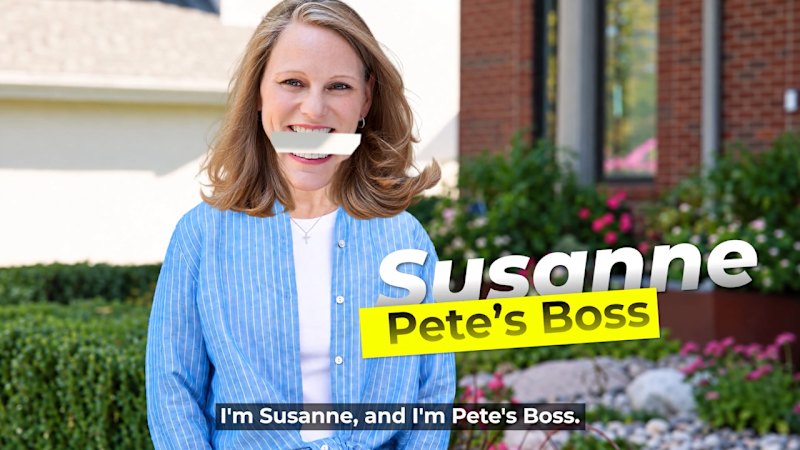
Independent Senate candidate Dan Osborn has started using custom animated attack ads to mock incumbent Republican Senator Pete Ricketts, trading traditional campaign smear spots for satirical cartoons aimed at breaking through voter fatigue in Nebraska. By portraying Ricketts as an out-of-touch billionaire caricature, Osborn is trying to replicate the outsider momentum that nearly toppled Deb Fischer in 2024 while neutralizing the massive financial advantage Ricketts holds in the 2026 Senate race.
It looks like a stunt. It isn't.
When a former industrial mechanic and union leader goes up against one of the wealthiest men in Congress, standard political rules stop working. You cannot outspend a candidate whose family owns the Chicago Cubs and built the TD Ameritrade fortune. If you buy standard thirty-second television spots featuring grainy black-and-white photos of your opponent and an ominous voiceover, voters change the channel. They have seen that exact commercial ten thousand times. Animation changes the visual texture of a commercial break immediately. It forces eyes back to the screen, even if only for five seconds, and in modern political media, five seconds of genuine attention is worth more than a million dollars in background noise.
The Economics of Asymmetric Political Warfare
To understand why Osborn is paying animators instead of traditional media buyers, you have to look at the balance sheet of a Nebraska Senate race. Pete Ricketts does not need to spend his mornings dial-mining wealthy donors in Omaha or Lincoln. He has the personal liquidity to self-fund a campaign into oblivion, backed by a deeply entrenched state Republican apparatus that he spent years building while serving as governor.
Osborn operates in a completely different financial reality. Although his surprise 2024 run against Deb Fischer—where he lost by roughly seven points in a deeply red state—proved he can raise significant grassroots money from national donors eager to see a populist independent win in the Midwest, he will always be outgunned on raw airtime.
When you cannot buy frequency, you have to buy memorability.
Traditional political consulting firms hate animation. I have watched media strategists argue against it for thirty years because it carries risk. A bad cartoon looks cheap, childish, or desperate. If the humor misses, the candidate looks unserious. Yet when animation works, it bypasses the partisan defense mechanisms voters automatically raise when they hear a standard attack ad. People expect a politician to call another politician corrupt. They do not expect to see a stylized caricature of their senator acting like a cartoon villain, and that surprise creates a brief window where the message actually lands.
Deconstructing the Billionaire Caricature
The core narrative of Osborn's animated spots relies on a simple, brutal contrast. Osborn frames himself as the guy who fixed industrial machinery at the Kellogg's plant in Omaha and led a major strike, while painting Ricketts as an aristocratic heir playing at public service.
Cartoon exaggeration makes that contrast easier to sell without sounding bitter. If Osborn stands in front of a camera and complains that Ricketts is rich, he risks sounding resentful—a fatal flaw in a state that generally respects business success. Put that exact same critique into an animated format, where Ricketts is depicted floating above the problems of regular Nebraskans, and the attack becomes comedic rather than whiney. Humor allows a challenger to punch up without looking small.
The visual shorthand is deliberate. Animation lets the campaign compress complex policy grievances—such as Ricketts' voting record on corporate tax cuts, labor protections, or agricultural subsidies—into a single visual gag. You do not need to explain the mechanics of a tax loophole if you can draw a character stuffing oversized bags of cash into a vault while ordinary workers struggle to pay property taxes. Whether that depiction is entirely fair to Ricketts' actual legislative record is beside the point; in campaign communications, simplicity always beats nuance.
Why the 2024 Playbook Needed an Upgrade
Osborn's 2024 campaign against Deb Fischer succeeded in becoming a national story because nobody saw it coming. Fischer ran a textbook establishment campaign, assuming her party registration and incumbency would carry her effortlessly across the finish line. By the time national Republicans realized Osborn was actually polling within striking distance, they had to dump millions of dollars into a state they thought was locked down.
Pete Ricketts is not making Deb Fischer's mistake.
Ricketts entered the 2026 cycle fully aware of the threat an independent populist poses in Nebraska. Unlike Fischer, who spent years largely out of the national spotlight, Ricketts has spent a decade cultivating universal name recognition across every county from Scottsbluff to Falls City. He has aggressive rapid-response teams, an established donor network, and a clear line of attack against Osborn: painting him as a Democrat in disguise who refuses to admit he would caucus with Chuck Schumer if elected.
Because Ricketts is ready for the standard independent pitch, Osborn had to evolve. Repeating the exact same blue-collar biographical ads from 2024 would yield diminishing returns. Voters already know who Dan Osborn is. They know he wears Carhartt jackets, they know he led the Kellogg's strike, and they know he refuses party labels. Introducing animation is an attempt to keep the campaign unpredictable and prevent Ricketts from defining the race solely around national partisan control of the Senate.
The Risk of Turning a Senate Race Into a Cartoon
There is a massive downside to this strategy, and Ricketts' strategists are undoubtedly praying Osborn leans too far into it. Voters might enjoy a clever cartoon on their phone screen while scrolling social media, yet pause when deciding whether to hand the creator of that cartoon a six-year term in the United States Senate.
The presidency and the Senate carry a specific weight in the minds of older, high-propensity voters—the exact demographic that decides midterm elections in Nebraska. If an animated campaign becomes too snarky, too online, or too focused on mocking Ricketts' appearance and wealth, it can alienate moderate Republicans and conservative independents who are willing to split their tickets for a serious populist, not a comedian.
Consider a hypothetical scenario involving an undecided voter in Grand Island. This voter might be frustrated with Washington gridlock and skeptical of Ricketts' vast wealth, making them open to Osborn's independent message. If that voter sees an animated ad that sharply highlights a specific policy failure—say, rising healthcare costs or struggles facing family farms—the humor reinforces a substantive point. Conversely, if the ad feels like mean-spirited mockery devoid of policy substance, that same voter might conclude Osborn lacks the temperament for the upper chamber and default back to the familiar Republican incumbent.
Ricketts has spent years cultivating an image of sober, executive competence. Even his critics acknowledge he knows how state budgets work and understands the mechanics of governance. To beat someone with that profile, Osborn has to prove he is more than just an entertaining outsider. The cartoons can open the door, but serious policy answers have to walk through it.
Digital Virality Versus Nebraska Reality
Another factor driving Osborn's animated pivot is the shifting economics of political media distribution. Television ad rates in Omaha and Lincoln skyrocket during election years, eating up campaign war chests at an alarming pace. Social media platforms, however, reward content that generates immediate engagement—shares, comments, and watch time.
A standard political ad posted to X, Facebook, or Instagram dies instantly. Nobody shares a thirty-second clip of a candidate standing in a cornfield talking about inflation. People do share funny, well-produced animations that roast a sitting senator. Every organic share acts as free earned media, stretching Osborn's grassroots fundraising dollars further than traditional media buys ever could.
Yet digital metrics often lie to campaign managers. High engagement online does not always translate into votes in rural Nebraska. A clever cartoon might rack up hundreds of thousands of views from political junkies in New York, California, and Washington D.C.—people who might even chip in five dollars to Osborn's ActBlue or independent donation page—while barely registering with a cattle rancher in Cherry County who gets their news from local farm radio and the evening broadcast.
Osborn's team has to walk a tightrope between creating viral moments that fuel national small-dollar fundraising and maintaining the authentic, grounded Nebraska identity that made him viable in the first place. The moment his campaign feels like it is performing for an internet audience rather than talking to neighbors in North Platte or Norfolk, the magic evaporates.
How Ricketts Counter-Punches
Pete Ricketts does not need to respond with his own cartoons, and he almost certainly will not. Entering a comedy battle with a populist challenger plays directly into the challenger's hands. Instead, Ricketts' optimal counter-strategy is to let Osborn play the entertainer while Ricketts plays the statesman.
Expect Ricketts to continue hammering the structural reality of the Senate. In a closely divided chamber, an independent candidate cannot remain truly independent once they take the oath of office. Committee assignments, judicial confirmations, and leadership votes force every senator to pick a side. Ricketts' team will relentlessly argue that a vote for Osborn is functionally a vote for the Democratic agenda, regardless of what label appears next to his name on the ballot or how clever his commercials are.
Furthermore, Ricketts can use Osborn's animated attacks as evidence of unseriousness. By contrasting his own ads—focused on border security, agricultural exports, and inflation—against Osborn's satirical cartoons, Ricketts can frame the race as a choice between substantive conservative leadership and political theater.
The Verdict on the Animated Gambit
Campaign innovation usually comes from desperation or necessity. Challengers who lack the money, institutional backing, or party machinery of an incumbent have no choice but to break the mold. Dan Osborn's decision to animate Pete Ricketts is a calculated gamble designed to solve a very specific problem: how to make a billion-dollar incumbent look small without sounding bitter, and how to capture voter attention without spending millions of dollars he does not have.
It is a smart tactical move for the middle stages of a tough campaign, guaranteeing media coverage and energizing a grassroots base that loves seeing the establishment mocked. Whether it moves enough actual ballots in November depends entirely on whether voters view those cartoons as sharp political truth or just another distraction from the hard work of governing.