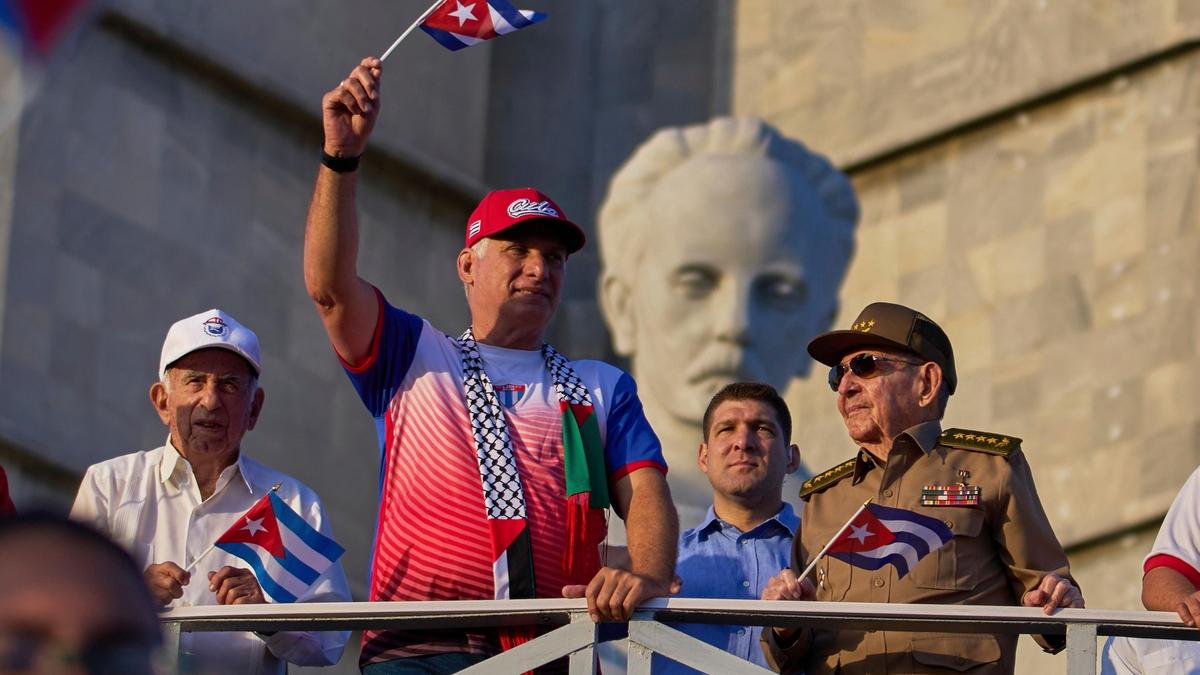
The rhetoric coming out of Havana isn't just loud; it's calculated. Cuba’s President Miguel Díaz-Canel recently made it clear that any attempt by the United States to subvert his government or stage an intervention would be met with fierce resistance. This isn't a new script, but the timing matters. With the island facing its worst economic crisis in decades, the leadership is leaning heavily on the "external enemy" narrative to keep the internal ranks tight. You've heard this before, but you haven't seen it play out under these specific, high-pressure conditions.
The Warning from Havana
Díaz-Canel didn't mince words during his recent address. He characterized U.S. policy as a persistent effort to "suffocate" the Cuban people through sanctions and covert operations. He warned that the island is prepared to defend its sovereignty at any cost. To understand why he's saying this now, you have to look at the ground reality. Food shortages are rampant. Power outages last for hours. Inflation has wiped out the purchasing power of the average state salary. When people get hungry, they get angry. The government knows this. By framing the struggle as a David vs. Goliath battle against Washington, Díaz-Canel is trying to redirect that internal frustration outward.
It’s a classic move in the geopolitical playbook. If you can convince your citizens that their suffering is solely the fault of a foreign superpower trying to depose you, you can justify almost any level of domestic control. But it's not all just talk. The Cuban military remains one of the most organized institutions on the island. They aren't just soldiers; they run the hotels, the export businesses, and the logistics chains. An attack on the government is an attack on the entire economic structure that sustains the ruling class.
Why the US Strategy Isn't Shifting
Washington has kept Cuba on the State Sponsors of Terrorism list, a move that effectively shuts the island out of much of the global financial system. If you're a bank in Europe or Asia, you don't want to touch Cuban transactions and risk the wrath of the U.S. Treasury Department. This financial freeze is the real "attack" Havana fears most. It isn't about boots on the ground or missiles in the air. It’s about the slow grind of economic isolation.
The Biden-Harris administration has maintained most of the Trump-era "maximum pressure" tactics, despite some minor tweaks to remittances and travel rules. Why? Because the domestic political cost of "being soft on Cuba" is too high in Florida. In the 2024 and 2026 cycles, the Cuban-American vote remains a heavy weight on the scale. For the White House, keeping the status quo is safer than a bold diplomatic opening that would likely blow up in their faces.
The Propaganda War and Digital Streets
The battlefield has shifted from the Sierra Maestra mountains to Telegram and WhatsApp. The Cuban government blames the U.S. for "digital subversion," claiming that social media campaigns funded by Washington are designed to incite riots like those seen on July 11, 2021. Those protests caught the leadership off guard. They were the largest since the 1959 revolution.
Díaz-Canel’s warning is specifically aimed at these "soft power" tactics. He’s telling the U.S. to stop funding activists and independent journalists, whom he labels as mercenaries. If you look at the new Penal Code passed in Cuba, it’s designed to crush this exact type of dissent. Anything that can be construed as "endangering the socialist state" can land someone in prison for years.
The Reality of Sovereignty vs. Survival
Cuba’s President argues that the U.S. wants to turn the island back into a "colony." That’s a powerful word in Latin American politics. It taps into a century of resentment over the Platt Amendment and the Cold War. But the irony is that while Havana warns against U.S. intervention, it’s becoming increasingly dependent on Russia and China for survival.
Russia has started shipping oil again, and China is helping with the telecommunications infrastructure. You’re seeing a new kind of "triangulation" where Cuba uses its proximity to the U.S. as a bargaining chip for these rival superpowers. For Putin or Xi, a foothold ninety miles from Florida is a cheap way to annoy Washington.
Misconceptions About the Embargo
Many people think the "blockade" (as the Cubans call it) stops all trade. That's wrong. The U.S. is actually one of Cuba's largest suppliers of chicken and agricultural products. But everything has to be paid for in cash, upfront. No credit. This is what Díaz-Canel means when he talks about "asymmetric warfare." He’s not worried about a Navy SEAL team landing in Havana; he’s worried about the fact that he can't get a line of credit to fix a broken power plant in Matanzas.
The rhetoric about "deposing" the government serves a dual purpose. It justifies the crackdown on internal dissent and it signals to the international community that Cuba won't be bullied into democratic reforms in exchange for sanctions relief. It’s a stalemate that has lasted over sixty years, and neither side seems ready to blink.
What This Means for Global Security
If the situation in Cuba continues to deteriorate, we won't see a war, but we will see a mass migration event. We already are. Hundreds of thousands of Cubans have left for the U.S. border in the last two years. This is the real "intervention" that affects American domestic policy. A destabilized Cuba is a headache for the U.S. Coast Guard and the Department of Homeland Security.
Díaz-Canel knows this migration is a pressure valve. By letting the most frustrated people leave, he removes potential revolutionaries from the island. But it also drains the country of its best and brightest. Doctors, engineers, and teachers are all packing their bags. You can't run a country on warnings and rhetoric alone if there’s no one left to turn on the lights.
Don't expect the tension to drop anytime soon. As long as the U.S. sees Cuba as a threat to regional stability—and as long as Cuba sees the U.S. as an existential threat to its system—the cycle of warnings and sanctions will continue. The real people caught in the middle are the eleven million Cubans who just want to know when the next shipment of bread is coming.
If you want to track how this evolves, keep a close eye on the shipping lanes from Russia and the rhetoric coming out of the U.S. State Department regarding the "terrorism" list designation. Those are the only two dials that actually change the temperature in Havana. Everything else is just theatre for the cameras.