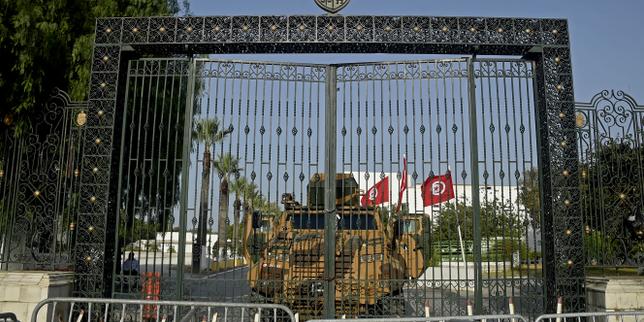
When the Tunisian Ministry of National Defense issues a late-night statement that departs from its rigid, bureaucratic tradition, the entire Mediterranean takes notice. A recent, highly irregular communique from the ministry has sent shockwaves through Tunis, leaving citizens and regional analysts scrambling to decode its hidden meaning. At its core, this public friction is not a mere public relations misstep. It represents an unprecedented public fracturing of the unspoken pact between the Tunisian military establishment and the presidency under Kais Saied.
For decades, the Tunisian armed forces maintained a strict doctrine of political neutrality. They stayed in the barracks during the 2011 revolution, acting as a neutral arbiter rather than a regime enforcer. However, as President Saied continues to consolidate absolute authority, the military finds itself pulled directly into the political arena. This latest rhetorical salvo from the defense ministry signals a deep internal resistance to being used as a political cudgel, exposing structural fault lines that could redefine North African stability.
Decoding the Ministry of Defense Silence and Signals
Military communication in Tunisia is historically sparse, vetted, and predictable. When a message breaks that mold, the deviation itself is the story. The text in question bypassed the usual triumphalist state media channels, utilizing language that was intentionally ambiguous yet structurally defensive.
To understand the gravity, one must look at the timing. The communique followed a series of unannounced presidential visits to military installations, where Saied delivered highly politicized speeches targeting domestic opponents, judges, and independent journalists. By delivering political diatribes while flanked by high-ranking generals, the presidency effectively attempted to coat its partisan agenda in the armor of military legitimacy.
The defense ministry’s response was a masterclass in bureaucratic passive-aggression. While nominally reaffirming loyalty to the state, the text emphasized the constitutional boundaries governing the armed forces. It was a polite, yet steel-fringed reminder that the military serves the republic, not the personal ambitions of whoever occupies Carthage Palace.
This subtle pushback reveals a growing anxiety within the officer corps. The leadership is acutely aware of how regional neighbors view military intervention in politics. They have watched Egypt’s economic entrapment under a military regime and Algeria’s opaque junta system. Tunisia’s generals have no desire to inherit a collapsing economy or to face international sanctions for enabling an autocracy.
The Presidential Appetite for Absolute Alignment
Since his July 2021 power grab, Kais Saied has systematically dismantled the democratic architecture built after the Arab Spring. He dissolved parliament, rewritten the constitution, and stripped the judiciary of its independence. Throughout this process, the presidency has relied heavily on the security apparatus to enforce its decrees.
Initially, this reliance focused primarily on the Ministry of Interior and the police forces, institutions with a historical precedent for domestic repression. But as domestic discontent grows over skyrocketing inflation, basic food shortages, and systemic unemployment, the police alone are no longer enough to guarantee stability. Carthage needs the moral weight of the military.
Tunisian Power Dynamics: A Shifting Equilibrium

[The Presidency] ──(Seeks Political Legitimacy)──> [The Military]
       │                                                 │
(Direct Commands)                                 (Institutional Resistance)
       ▼                                                 ▼
[Ministry of Interior] ──(Active Enforcer)───> [The Public / Opposition]
The strategy is clear. By embedding military figures into civilian administration and utilizing military courts to try civilian political dissidents, the presidency is attempting to compromise the army's neutrality. If the military is complicit in the crackdown, it cannot act as a counterweight.
The defense ministry's enigmatic statement suggests that this strategy is hitting a wall of institutional inertia. The high command understands that public trust is their currency. Once an army loses its reputation as an objective protector of the nation, it cannot easily reclaim it.
Economic Decay as the Catalyst for Institutional Friction
An army marches on its stomach, but it also functions on state credit. Tunisia’s macroeconomic indicators are catastrophic. Debt-to-GDP ratios are unsustainable, foreign reserves are dwindling, and negotiations with international lenders remain frozen due to presidential intransigence.
This economic reality directly affects the defense budget. While the presidency demands heightened readiness and increased internal surveillance from the troops, the state is struggling to fund basic modernization and maintenance. Soldiers live in the same economic reality as the civilian population; their families suffer from the same shortages of sugar, flour, and medicine.
- Subsidies: The gradual erosion of state subsidies reduces the purchasing power of lower-ranking enlisted personnel.
- Procurement: Reliance on foreign military aid, particularly from the United States and European partners, comes with democratic benchmarks that presidential policies actively violate.
- Operational Strain: Increased deployment along the porous border with Libya and the militarization of southern mining regions have exhausted personnel without a corresponding increase in logistical support.
When the Ministry of Defense issues a cryptic warning, it is also signaling economic distress. The leadership knows that an underfunded military tasked with policing an impoverished, angry population is a recipe for internal mutiny or systemic collapse.
The Dangerous Weaponization of Military Justice
Perhaps the most alarming symptom of this institutional tug-of-war is the skyrocketing frequency of civilian trials in military courts. Activists, bloggers, and politicians are routinely dragged before military tribunals under archaic charges of "insulting the army" or "harming high morale."
This mechanism serves a dual purpose for the presidency. First, it guarantees swift, harsh sentencing free from the procedural delays of a civilian judiciary that is still fighting for its independence. Second, it shifts the blame. When an opposition figure is jailed by a military judge, the public animosity is directed at the armed forces, not just the political leadership.
The Backlash Within the Ranks
This politicization of justice has created profound discomfort among military legal scholars and senior officers. The military justice system was designed to maintain internal discipline, handle desertion, and prosecute treason during wartime. Forcing it to act as a correctional facility for political bloggers degrades its professional standing.
Furthermore, international allies are watching closely. Western defense cooperation, which includes crucial counter-terrorism training and intelligence sharing, is legally tied to human rights metrics. By allowing military courts to become tools of political retribution, Tunisia risks alienating the very partners that secure its borders against regional jihadist networks.
Regional Ramifications of a Fractured Tunisia
Tunisia does not exist in a vacuum. Its stability is a matter of national security for the European Union, particularly Italy and France, which view the country as a vital bulwark against irregular migration and a buffer against the chaos of Libya.
Algeria, Tunisia’s powerful western neighbor, views the situation through an entirely different lens. Algiers prefers a stable, predictable autocracy next door over a volatile democracy. However, the Algerian leadership is equally terrified of a chaotic Tunisian collapse that could destabilize their shared border. If the Tunisian military splits or loses control, the security vacuum would instantly be exploited by human trafficking syndicates and remnants of Al-Qaeda in the Islamic Maghreb.
The cryptic communique from Tunis was read with intense scrutiny in foreign ministries across Paris, Rome, Washington, and Algiers. It served as a warning shot that the apparent monolithic unity of the Tunisian state is an illusion.
The Limits of Silence
The Tunisian Ministry of Defense will likely try to smooth over this public rift with boilerplate statements about unity and discipline in the coming weeks. The underlying structural friction remains unresolved.
The military cannot remain entirely neutral while the civilian state around it is systematically dismantled. The presidency cannot govern indefinitely without the implicit backing of the bayonets. This ambiguous communique was not an isolated incident. It was a symptom of a deep, systemic negotiation over the limits of presidential power and the boundaries of military obedience.
As the economic crisis deepens and the political opposition finds its footing, the military high command will face harder choices than issuing cryptic statements. They will have to decide whether their allegiance belongs to the constitutional order of the republic or to the shifting decrees of a single ruler. The defense ministry has fired its warning shot across the bow of the presidency. Carthage would be wise to listen.