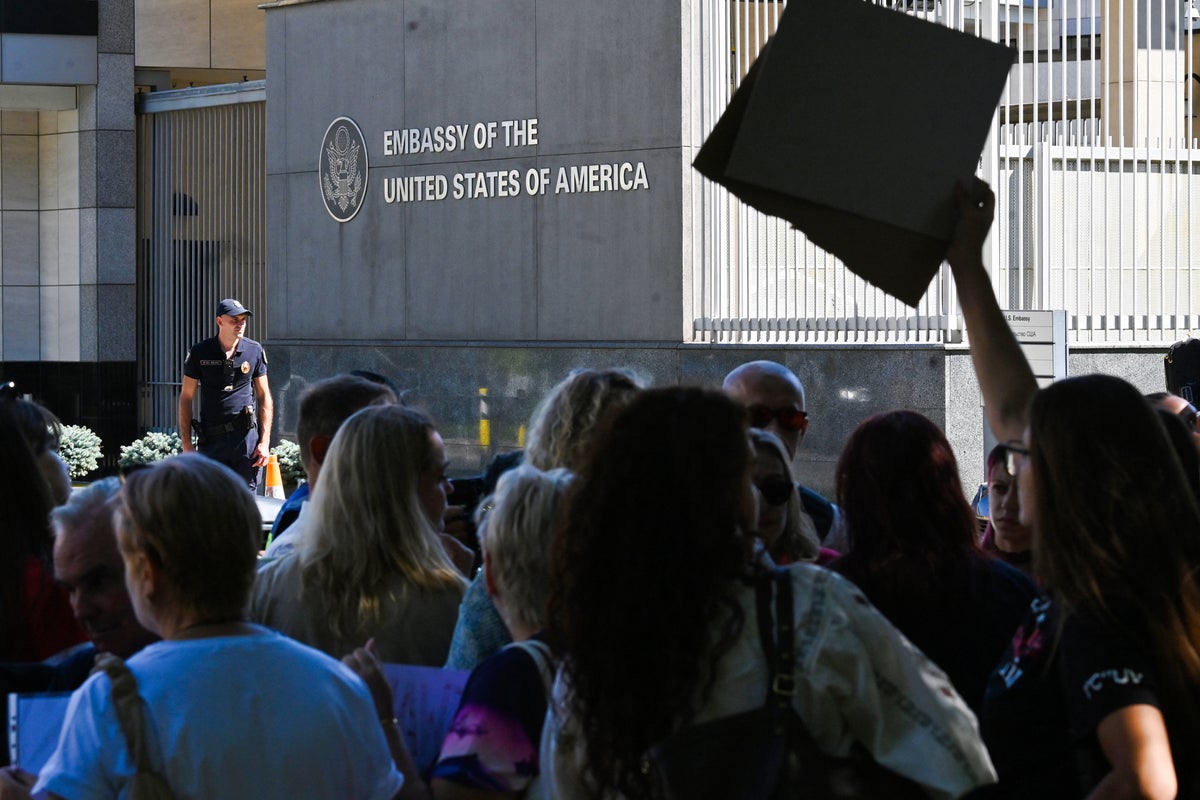
Mainstream media outlets spent weeks hand-wringing over the optics of American diplomats packing their bags and fleeing Kyiv. They parsed State Department press releases like ancient runes, asking whether the evacuation "sparks new questions" about Western commitment.
They are asking the wrong questions.
The mass departure of diplomatic personnel wasn't a calculated tactical pivot or a savvy security maneuver. It was a glaring symptom of a deeper, systemic rot within modern Western statecraft: the total capitalization of foreign policy by risk-management bureaucrats. By pulling diplomats out at the exact moment their physical presence mattered most, Washington didn't protect its assets. It liquidated its geopolitical leverage.
For decades, the physical presence of a superpower’s embassy served as a hard line. It was the ultimate tripwire. Moving those chess pieces off the board under the guise of "abundance of caution" signals to adversaries that the West values administrative compliance over strategic deterrence.
We need to dismantle the lazy consensus that evacuation equals prudence. It doesn't. It equals a failure of nerve.
The Myth of the Virtual Embassy
The prevailing defense of these diplomatic retreats relies on a comforting, tech-bro delusion: the idea that statecraft can be seamlessly digitized. The narrative claims that as long as diplomats have secure laptops, encrypted satellite phones, and a solid internet connection in Poland or western Ukraine, the mission continues uninterrupted.
This is absolute nonsense. Anyone who has ever negotiated a trade deal, managed an international crisis, or tried to read the room in a foreign ministry knows that diplomacy is an inherently physical act.
Diplomacy happens in the margins. It is the unrecorded conversation in a hallway. It is the ability to look a foreign counterpart in the eye and gauge their resolve. It is the psychological reassurance offered to a besieged population by the mere sight of an American flag flying over a compound in their capital city.
When you close the gates and run, you lose access to the ground truth. You become entirely dependent on signals intelligence and second-hand reports. You trade granular, human-level insights for sanitized briefings filtered through multiple layers of bureaucratic self-preservation. Virtual diplomacy is an oxymoron. It is an administrative placeholder disguised as statecraft.
The Financial and Strategic Cost of False Prudence
Let’s look at the cold mechanics of how these decisions are actually made. Having watched government agencies burn through millions of dollars on arbitrary security protocols, the pattern is agonizingly predictable.
Decisions to evacuate are rarely driven by ironclad intelligence of an imminent threat to life. Instead, they are driven by the fear of accountability. No bureaucratic manager wants to be the one holding the pen on a memo if something goes wrong. The incentive structure inside the State Department doesn't reward calculated bravery; it rewards flawless liability mitigation.
Consider the sheer operational friction introduced by moving an entire diplomatic mission on short notice:
| Operational Metric | Standard On-Site Operation | Evacuated / Remote Operation |
|---|---|---|
| Intelligence Gathering | Direct, real-time human networks | Filtered, delayed electronic feeds |
| Local Government Access | Immediate, face-to-face consultation | Scheduled, secure video conferences |
| Symbolic Deterrence | High (Physical presence of superpower) | Zero (Signifies retreat and vulnerability) |
| Logistical Overhead | Stabilized, predictable maintenance | Massive, ad-hoc relocation costs |
This institutional cowardice carries a massive strategic price tag. When the United States signals that its diplomats will flee at the first hint of serious kinetic escalation, it hands its opponents an incredibly cheap tool for manipulation. To neutralize American diplomatic pressure, an adversary no longer needs to win a war. They just need to generate enough noise, move enough troops near a border, or launch enough cyberattacks to trigger the State Department’s internal risk-assessment algorithms.
We have effectively gamified our own retreat.
Dismantling the People Also Ask Nonsense
If you look at public forums and search trends, the questions surrounding these events reveal how deeply the public has been misled by sanitized corporate journalism.
Did the evacuation protect American lives?
This is the shield behind which every bureaucrat hides. Of course, it reduced the immediate physical risk to those specific individuals. But foreign service officers are not tourists. They are instruments of national power who volunteered for a profession that historically carries inherent risks.
When we prioritize absolute safety over the execution of the mission, we render the mission impossible. If the primary goal of the State Department is to ensure that no diplomat ever faces danger, we should close every embassy on earth and run the entire apparatus out of a business park in Virginia.
Was the retreat coordinated with allies to show unity?
The media loves the word "unity." It sounds comforting. In reality, the frantic American departure frequently blindsides host nations and forces allies into agonizing dilemmas.
When the heavyweight in the room bolts for the exit, it triggers a chain reaction of panic. Smaller nations, who cannot afford the logistical luxury of setting up a temporary government-in-exile, are left holding the bag. It doesn't demonstrate unity; it demonstrates a fragmented, every-nation-for-itself approach to collective security.
The Downside No One Wants to Admit
To be entirely fair, maintaining a permanent diplomatic presence in a high-threat environment is an brutal, unforgiving task. If a compound is struck and personnel are killed, the domestic political fallout is catastrophic. Congressional investigations will launch. Careers will be destroyed overnight. The ghost of past diplomatic tragedies haunts every decision-maker in Washington.
But leadership requires choosing between bad options and worse options. The alternative to risking personnel is the systematic erosion of American credibility.
Imagine a scenario where a corporate CEO pulls all sales teams out of a major market because a competitor threatened a aggressive price war. The board would fire them before the week was out for cowardice and abandoning the field. Yet, in global politics, we treat the identical behavior as a masterclass in prudence.
The Hard Reality of Modern Deterrence
We have entered an era where gray-zone warfare, hybrid threats, and localized conflicts are the norm, not the exception. If the playbook for this era dictates that American diplomacy packs up and leaves whenever the temperature rises, then the American century is functionally over.
The fix isn't complicated, but it requires a cultural overhaul that the current crop of risk-averse managers will despise.
Stop treating embassies as high-security fortresses detached from the realities of the host nation. Stop letting insurance-style risk assessments dictate geopolitical posture. If you wear the title of diplomat, your job description includes standing your ground when the artillery starts getting close.
The next time an adversary rattles a saber, the correct response isn't a fleet of SUVs speeding toward the nearest border crossing. It is doubling down on your physical presence, keeping the lights on, and making it clear that if you want to alter the geopolitical landscape, you will have to look the world’s superpower in the eye while you do it. Anything less is just administrative theater.


:background_color(FFFFFF):format(jpeg)/images/library/12375/mri-t1-axial-carpal-tunnel_portuguese.jpg)