The air inside the semiconductor fabrication plant in Phoenix, Arizona, smells faintly of burnt sugar and static electricity. It is a sterile, hyper-filtered environment where a single speck of dust can ruin a million dollars worth of silicon. For Zhang Wei, a senior process engineer who moved from Shanghai to the American Southwest five years ago, the cleanroom is a sanctuary of absolute logic. Light reflects off the polished yellow floors, casting a pale glow on rows of multi-million-dollar lithography machines.
On his monitor, a subtle calibration error flashes. It is a tiny variance, a fraction of a nanometer. To fix it, Wei needs to consult a proprietary software patch developed by a team based in Shenzhen. Five years ago, this would have taken a quick, informal Slack message. Today, because of expanding export controls and national security protocols, that simple data transfer requires three layers of legal compliance review.
Wei stares at the blinking cursor. He feels the friction of a hardening border cutting directly through his daily workflow. He is an American citizen now, but his parents still live within walking distance of the Bund. He embodies the exact nerve center of the modern world. If Washington and Beijing completely sever their ties, the machines he tends will fall silent.
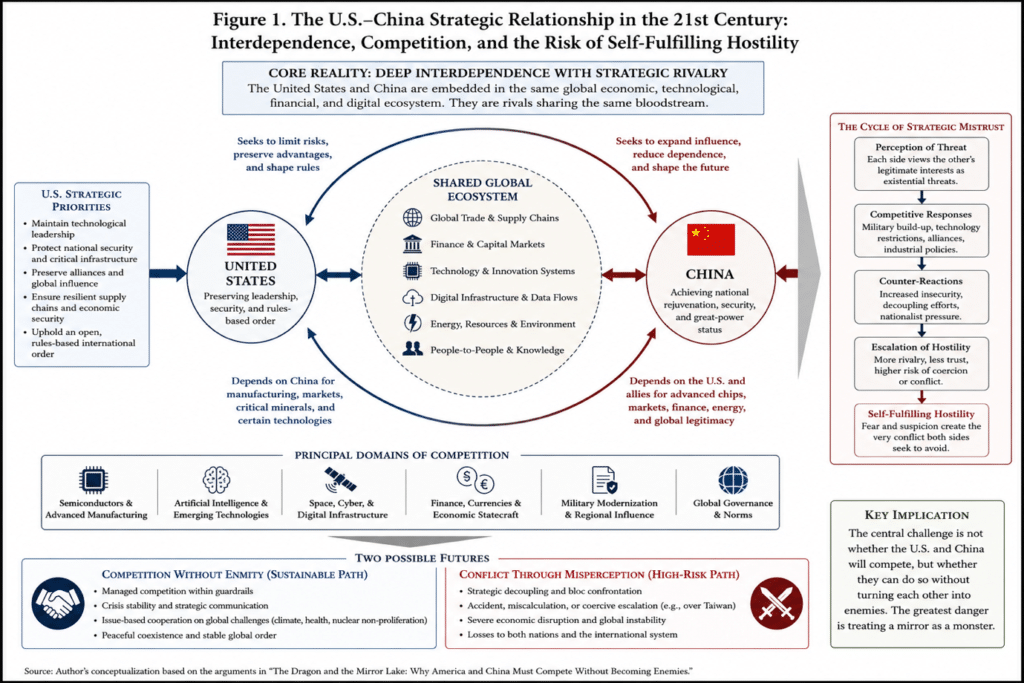
This is not a abstract debate about trade deficits or GDP projections. It is a tangible, high-stakes friction felt by real people every day. The current narrative driving global politics suggests that the United States and China are locked in an inevitable, zero-sum conflict—a new Cold War where one side must break for the other to survive. But this view gets the fundamental mechanics of the modern world completely backward. Total economic decoupling is an illusion. Mutual destruction is a guarantee. The challenge of our century is learning how to fiercely compete without crossing the line into catastrophic enmity.
The Illusion of the Clean Break
Consider what happens if the world's two largest economies attempt to pull apart entirely.
To understand the sheer scale of the integration, we have to look past the political rhetoric and examine the literal plumbing of global commerce. A standard smartphone is not made in one country. Its design might originate in California. Its rare earth elements are mined and processed in Inner Mongolia. Its advanced logic chips are manufactured in Taiwan using Dutch machinery, packaged in Malaysia, and assembled in Henan province before shipping back across the Pacific.
Metaphorically, America and China are like two mountain climbers tied to the same rope on a treacherous ice face. If one slips, the other does not win. They both fall.
The economic data backs up this structural reality. Even at the height of recent tariff implementations and political posturing, bilateral trade between the two nations has repeatedly hit historic highs, hovering near $700 billion annually. American farmers in Iowa rely on Chinese consumers to buy over half of their soy crops. Meanwhile, Chinese tech firms rely on American capital and foundational software architectures to power their consumer apps.
The idea that either nation can cleanly untangle its economy from the other is a fantasy. A forced separation would not result in a tidy division of spheres of influence. It would trigger a global depression, fracturing supply chains, spiking inflation, and leaving vital industries stranded without parts or markets.
When Competition Becomes an Existential Guardrail
There is a distinct difference between a rival and an enemy. A rival pushes you to run faster, build better, and think harder. An enemy wants to destroy you.
The tech sector provides the clearest example of how intense rivalry actually drives progress. Right now, the race for artificial intelligence supremacy is fierce. Chinese tech giants are pouring billions into large language models, computer vision, and autonomous driving. In Silicon Valley, OpenAI, Google, and a legion of startups are doing the same.
This competition is intense, but it is also a powerful motivator. It forces American companies to innovate rather than rest on their monopolies. It forces Chinese enterprises to move up the value chain from mere manufacturing to deep, foundational research.
But the real problem lies elsewhere. If this race is viewed through the lens of pure enmity, the guardrails disappear. In a healthy competitive ecosystem, both sides observe basic rules of intellectual property and market access, even if they bend them. In a state of soft warfare, those rules vanish. Cyber espionage turns into active infrastructure sabotage. The open exchange of scientific research—the very foundation of modern technological leaps—grinds to a halt.
We have seen this pattern throughout history. When two great powers refuse to communicate or establish shared boundaries for competition, the result is never a stable stalemate. It is an accidental escalation. A minor naval skirmish in the South China Sea or a misunderstood cyberattack on a power grid could spark a hot conflict that neither side actually wants, but neither side can back down from without losing face.
The True Cost of Total Isolation
Let us look at a hypothetical scenario based on current geopolitical trajectories. Imagine the United States succeeds in completely blocking all advanced semiconductor sales to China, while Beijing responds by choking off the export of lithium and rare earth minerals essential for the American electric vehicle and defense industries.
On the surface, both sides claim a patriotic victory. But step inside a midwestern automotive plant.
Without Chinese neodymium, the assembly lines for electric truck motors stop. Thousands of workers face immediate furloughs. Prices for consumer electronics double overnight. Across the ocean, in a tech incubator in Hangzhou, a generation of brilliant software engineers finds themselves cut off from the global open-source community, forced to reinvent the wheel using fragmented, localized code bases.
The cost is not just measured in dollars or yuan. It is measured in lost human potential.
The greatest challenges facing our species over the next fifty years do not care about national borders. Climate change, pandemic prevention, and the ethical governance of artificial intelligence cannot be solved by one nation acting alone. If the world’s two scientific superpowers treat each other as existential threats, global progress on these fronts becomes impossible. A carbon atom emitted in Shanghai warms the air over Seattle just as easily. A virus mutating in a crowded transport hub does not stop for customs inspections.
Constructing the Mirror Lake
The title of the competitor’s original analysis referenced the "Mirror Lake"—an ancient metaphor for a surface that reflects back exactly what you bring to it. If you approach it with a clenched fist, you see an enemy staring back. If you approach it with a clear, steady gaze, you see a reflection of your own vulnerabilities and strengths.
Achieving a stable peace does not require friendship. It does not require America to ignore China's human rights record, nor does it require China to accept American naval dominance in its backyard. It requires a hard-nosed, pragmatic framework that recognizes where interests diverge and where they lock together.
This framework relies on three pillars:
- Managed Strategic Emulation: Acknowledging that both systems have distinct strengths. America excels at disruptive innovation and attracting global talent; China excels at large-scale execution, infrastructure deployment, and industrial mobilization.
- Red Lines and Open Channels: Establishing permanent, un-severable communication links between military commanders and economic policymakers to prevent miscalculations from turning into catastrophes.
- Bounded Cooperation: Explicitly carving out areas—like climate tech and global health monitoring—where cooperation is mandatory for survival, even while fighting fiercely for market share in commerce and AI.
The goal is not a grand bargain or a utopian friendship. The goal is a sustainable friction.
The View from the Cleanroom
Back in Phoenix, the legal team clears the software patch. The compliance protocols have been satisfied, the digital logs signed, and the encryption keys verified.
Wei inputs the code. On his screen, the nanometer variance smoothes out into a perfect, flat line. The multi-million-dollar machine resumes its rhythmic, silent pulsing, carving microscopic pathways into a disc of pure silicon.
He takes off his protective goggles and rubs his eyes. Outside the tinted glass of the fabrication plant, the desert sun is setting, casting long, purple shadows across the Arizona landscape. The chips being made here today will end up in devices used all over the world, perhaps even in the hands of his cousins in Shanghai.
The machines keep running because, for now, the connection remains intact. The fragile equilibrium holds. The two giants remain locked in their tense, necessary embrace, balanced on the edge of the knife, knowing that to let go is to fall together into the dark.