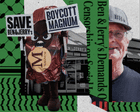
When Ben Cohen and Jerry Greenfield sold their counter-culture ice cream empire to Unilever in the year 2000, they wrote a unique governance agreement into the acquisition. They believed they had engineered a corporate parachute. The deal preserved an independent board of directors tasked specifically with protecting the brand's social mission and progressive activism. It was an unprecedented structural shield in modern capitalism.
That shield has cracked completely.
The ongoing friction between the multinational consumer goods giant and the activist-founded subsidiary has escalated from a polite boardroom disagreement into a bitter, multi-front corporate war. At the heart of this conflict is a fundamental contradiction. You cannot successfully merge radical progressive politics with the relentless, quarter-by-quarter wealth extraction demanded by London and Rotterdam shareholders.
The story of the Ben and Jerry's independence battle is not merely about ice cream. It is a cautionary blueprint for every founder who believes a legal clause can permanently protect a brand's soul after the check clears.
The Architectural Flaw of the 2000 Acquisition
To understand why the current legal battles are happening, we have to look back at the original paperwork. When Unilever acquired the company for 326 million dollars, the transaction structure was unlike any standard consumer goods buyout.
A unique independent board was created. This board retained authority over the social mission and brand integrity of Ben and Jerry's. For years, the arrangement functioned as a tolerated anomaly within a massive corporate portfolio. Unilever focused on global supply chains, distribution scale, and margin optimization. Meanwhile, the Vermont-based board occasionally released progressive flavors, championed criminal justice reform, and took public stances on geopolitical issues.
The system worked only as long as the activism remained relatively abstract.
The breaking point arrived when the independent board attempted to translate its progressive mandate into concrete, high-stakes foreign policy stances. When the brand announced plans to halt product sales in the occupied Palestinian territories, the friction stopped being theoretical. It became an international regulatory and financial liability for Unilever.
The Mechanics of Corporate Control
Multinational conglomerates do not tolerate subsidiaries that create existential threats to their broader stock value. Unilever’s leadership viewed the independent board's actions not as moral leadership, but as a direct breach of commercial fiduciary duty to parent shareholders.
This tension exposed the core weakness of the original 2000 agreement. While the independent board possessed theoretical authority over social missions, Unilever controlled the manufacturing infrastructure, the distribution networks, and the global capital allocation.
The Litigation Battleground
The conflict eventually spilled out of the boardroom and into federal court. Ben and Jerry’s sued its parent company, alleging that Unilever violated the acquisition agreement by silencing the brand on political issues and attempting to undermine the independent board's authority.
The lawsuit laid bare the stark reality of corporate acquisitions. When a multi-billion-dollar enterprise owns the factories, the patents, and the global logistics lines, moral clauses function primarily as public relations battlegrounds rather than absolute legal walls. Unilever responded by asserting its overarching corporate governance responsibilities, signaling that no subsidiary board possesses the right to jeopardize the financial health of the entire corporate ecosystem.
Financial analysts watched the litigation unfold with grim predictability. Publicly traded corporations are legally bound to maximize shareholder returns. When a subsidiary engages in actions that depress market valuation or trigger investor boycotts, parent executives face immense pressure to neutralize the threat.
The Sinking Ship of Corporate Activism
The broader market has watched this experiment in stakeholder capitalism founder. Critics on Wall Street point to the Ben and Jerry's saga as definitive proof that corporate activism is an inherently flawed business model.
When a brand builds its entire equity on anti-corporate, anti-capitalist rhetoric while being owned by one of the largest consumer goods conglomerates on earth, cognitive dissonance eventually destroys consumer trust. Regular consumers notice the irony. They see progressive social justice messaging printed on cardboard pints while the profits funnel directly into a massive Anglo-Dutch multinational corporation.
This authenticity gap widens every single year. The independent board fights valiantly to maintain its radical roots, but those roots were severed the moment the founding shareholders cashed out twenty-six years ago. You cannot lease your integrity to a multinational balance sheet and expect to keep the title.
The Human Cost in Vermont
Back in Burlington, the atmosphere is heavy with disillusionment. Employees who joined the company believing they were part of an alternative business model now find themselves caught in the gears of traditional corporate restructuring.
Production targets have tightened. Supply chain efficiencies have replaced quirky local sourcing initiatives in certain product lines. The corporate parent exerts subtle, persistent pressure to harmonize operations with the rest of the Unilever ice cream division, which includes brands like Magnum and Klondike.
The distinct culture that made the company a household name in the late twentieth century is being systematically professionalized. Every time a corporate efficiency expert reviews a Vermont ledger, another vestige of the original counter-culture ethos disappears.
The Unresolved Horizon
As the legal maneuvers continue, the broader implications for socially conscious entrepreneurship remain grim. Founders watching this battle unfold are learning a hard lesson about legacy.
If you build a mission-driven company, selling to a global conglomerate is the ultimate betrayal of that mission, regardless of what governance clauses you write into the contract. Capital ultimately flows where power resides. And power in the modern economy belongs to those who own the distribution networks and the voting shares, not those who write mission statements on the back of a pint container.
The bitter fight to free Ben and Jerry's will likely end not with a triumphant return to independence, but with a quiet settlement that further neuters the independent board. The corporate machine always wins in the end. It digests the rebellion, repackages the aesthetic, and sells it back to the public at a higher margin.