The air in Times Square is a thick soup of diesel exhaust, roasted nuts, and the electric hum of forty million LED pixels screaming for attention. It is the last place on Earth where you expect to hear the rhythmic, hollow strike of a horseshoe against asphalt. But when that sound breaks through the cacophony of yellow cabs and tourist chatter, the world shifts. It stops being a modern metropolis and becomes something primal.
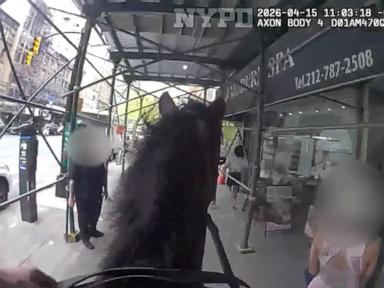
Officer Kaimer was high above the crowd, seated on a thousand pounds of muscle and instinct named Sampson. From the saddle of a police horse, the perspective of New York City changes. You aren't just in the street; you are an island in a sea of humanity. You see the tops of heads, the nervous twitch of a shoplifter’s hands, and the way the traffic flow ripples blocks away.
Then came the shout.
A man had snatched something—a cell phone, a wallet, the usual debris of a midtown hustle—and bolted. On foot, a suspect in Times Square is like a ghost. They can melt into the subway stairs, duck behind a hot dog stand, or disappear into the dense thicket of people waiting for a Broadway matinee.
Sampson didn't need a siren.
The Physics of the Pursuit
When a horse begins to gallop on city streets, physics takes over. There is a terrifying beauty to it. Imagine a creature that weighs as much as a small car, capable of accelerating to thirty miles per hour, navigating a space designed for pedestrians. The suspect looked back, expecting a blue uniform on foot or perhaps a patrol car stuck behind a delivery truck. Instead, he saw the towering chest of a horse.
The chase wasn't just a sprint. It was a navigation of obstacles. Sampson’s hooves sparked against the pavement—not a metaphor, but literal sparks from the friction of steel shoes meeting the unforgiving road. The officer steered with a lightness that belied the tension of the moment. One wrong slip on a metal utility cover could mean a shattered leg for the animal and a catastrophic fall for the rider.
The suspect darted between a row of parked cars. He was fast. He was desperate. But he was fighting against an evolutionary masterpiece. A horse’s peripheral vision spans nearly 350 degrees. Sampson could see the suspect even when the man thought he had tucked himself out of the line of sight.
Crowds parted. It was as if a zipper was being pulled through the center of Manhattan. People dropped their shopping bags and froze. The sound was the most jarring part—the heavy, rhythmic thud-thud-thud of the horse’s breathing, a wet, powerful snort that cut through the city's artificial noise.
The Invisible Bond
To understand why this works, you have to understand the partnership. This wasn't a machine being operated. It was a conversation between two species. Officer Kaimer wasn't just pulling on reins; he was leaning his weight, using his calves to signal a shift in intent, and trusting Sampson to find his footing on the slick grease of 42nd Street.
This is the NYPD Mounted Unit. They are often dismissed as a tourist attraction, a vestige of the 19th century kept around for photo ops. Critics point to the cost of stables and the logistical nightmare of hauling trailers into the busiest zip codes in America. They ask why we use animals when we have high-definition cameras and drones.
The answer became clear at the intersection of 45th and Broadway.
A drone cannot pin a suspect against a wall. A camera cannot exert a physical presence that commands immediate, stunned compliance. As Sampson closed the distance, the suspect’s bravado evaporated. The sheer scale of the horse—the height, the heat radiating off its flanks, the looming shadow—ended the fight before a single hand was laid on the man.
He stopped. He gave up. The chase was over in seconds.
Why the Old Ways Hold the Line
We live in an age where we believe technology has solved the problem of the human element. We think that if we can just map enough data points, we can predict crime or manage crowds with algorithms. But there is a psychological weight to a mounted officer that no patrol car can replicate.
A car is a box of metal and glass. It is an "other." It separates the officer from the people. A horse is an invitation. It draws people in. On a normal day, a mounted officer handles more "positive contacts" than any other member of the force. Children who are terrified of the badge will walk up to pet Sampson’s velvet nose. In that moment, the barrier between the law and the community dissolves.
But when things go sideways, that same animal becomes a mountain. In crowd control, one horse is worth ten officers on the ground. People will push against a line of riot shields, but they will not push against a horse. There is an ancient, hard-coded respect for the animal that lingers in our DNA.
The suspect was handcuffed while Sampson stood perfectly still, his ears twitching back toward his rider. The adrenaline was still high, but the discipline was higher. The officer patted the horse’s neck—a quiet, private "good boy" in a city that never shuts up.
The Cost of the Modern World
We often trade the soul of a thing for efficiency. We trade the neighborhood butcher for a self-checkout kiosk. We trade the beat cop for a surveillance network. In doing so, we lose the nuance of the street.
The Mounted Unit is expensive. It’s messy. It requires a level of training that takes years to perfect. It is, by every modern business metric, a "legacy system" that should have been phased out with the steam engine. Yet, when a man runs through a crowd with stolen property, the legacy system is the only thing that can catch him without firing a shot or causing a pile-up.
There is a vulnerability in it, too. These horses feel the cold. They get spooked by the sudden hiss of a bus’s air brakes. They require a level of care that reminds the city of its own fragility. If we can make room for Sampson in the middle of the most artificial environment on the planet, perhaps there is still room for the rest of us.
The suspect was led away, and the crowd slowly began to move again. The zipper closed. The LED screens continued to flash their neon promises of wealth and beauty. Officer Kaimer adjusted his seat, gave a gentle command, and Sampson began to walk.
The "clack-clack-clack" of the hooves returned to its steady rhythm. It is a heartbeat for a city that often forgets it has one. As they disappeared into the shadow of the skyscrapers, the only evidence of the chase was a few scuff marks on the asphalt and the lingering scent of hay and sweat in the Manhattan breeze.
The horse wasn't just a tool of the law. He was a reminder that even in a world of glass and steel, the most powerful force is still the one that breathes.