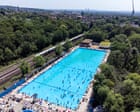
The water in a disused lido does not look like water. It looks like oil, then like soup, and finally, after a decade of neglect, like a floor. Green scum thickens into a carpet of duckweed. Willowherbs sprout through the cracked mosaic tiles of the shallow end.
If you stand outside the rusted chain-link fence of the old Grange-over-Sands lido, or the crumbling remains of Broomhill in Sheffield, you can hear something strange. Nothing. Just the wind whistling through the empty changing cubicles where three generations of British families once shivered into woollen swimming trunks while eating sandy sandwiches.
Britain has a habit of burying its joys.
During the 1930s, the country underwent a quiet, blue revolution. Nearly Roman in ambition, councils built over 160 outdoor swimming pools—lidos—across the nation. They were monuments to fresh air, physical fitness, and working-class leisure. They were cheap, grand, and beautiful. Today, the vast majority are gone, filled in with rubble, paved over for car parks, or left to rot behind corrugated iron.
But a cross-party coalition of Labour MPs is currently trying to wake these sleeping giants. They are aiming their sights directly at the balance sheets of Britain’s private water companies.
The Boy on the Concrete Edge
To understand why this matters, we have to look past the political briefings and the dry corporate asset registers. We have to look at Arthur.
Arthur is eighty-two. His knees are shot, and his memory slips gears like an old bicycle, but he remembers the summer of 1947 with terrifying clarity. That was the year of the great heatwave. He lived in a terrace house in a northern industrial town where the air tasted of coal dust and sulfur.
"The lido was our seaside," Arthur says, squinting at the space where the local pool used to be. It is now a budget supermarket parking lot. "For sixpence, you got three hours of pure, freezing freedom. The water was so cold it took your breath away, but once you were in, you were king of the world. Everyone went. The factory managers, the dockers, the kids from the estates. You couldn't tell who was rich and who was poor when everyone was in their trunks."
This is the invisible stake. A lido is not just a hole in the ground filled with chlorinated water. It is a social engine. It is one of the few remaining spaces where human beings encounter one another across class lines, completely exposed to the elements and to each other.
When we lost the lidos, we didn't just lose a place to swim. We lost a place to belong.
The decline was slow, then remarkably fast. The arrival of cheap package holidays in the 1970s flew millions of Britons to the guaranteed sunshine of Spain and Greece. Local councils, pinched for cash and facing rising maintenance costs, looked at these massive, leaking outdoor pools and saw liabilities rather than assets. One by one, the valves were turned, the plugs were pulled, and the concrete was left to bake and crack in the sun.
The Great Water Paradox
Now, the argument has shifted from nostalgia to accountability. A growing group of politicians is asking a uncomfortable question: why should communities foot the bill for restoring these public health assets when private water firms are extracting billions in dividends while pumping raw sewage into our rivers and seas?
Consider the math of the modern British summer.
If you want to swim outdoors in Britain today, your options are increasingly grim. The rivers are frequently choked with effluent from storm overflows. The beaches are subject to regular pollution alerts. The wild swimming boom, born out of a desperate desire to reconnect with nature, has collided head-on with a water infrastructure crisis that feels deeply third-world.
It is a bizarre paradox. We are an island nation surrounded by water, crisscrossed by rivers, and famous for our rain, yet we have nowhere safe to swim.
The MPs leading the charge argue that water companies have a moral, if not statutory, obligation to invest in the communities they serve. The proposal is simple: use a fraction of the industry's profits to establish a national Lido Restoration Fund. This fund would target the "lost lidos"—the dozens of derelict sites that sit waiting for a second chance.
But the water companies are already buried under a mountain of debt, public fury, and regulatory scrutiny. They counter that every spare penny must go into fixing the Victorian pipe networks and upgrading treatment plants to stop the sewage crisis.
The debate boils down to a fundamental disagreement about what a utility company actually owes the public. Is it merely a plumbing service, or is it a custodian of the nation's blue infrastructure?
The High Cost of Cold Water
Rebuilding a lido is not a matter of turning on a tap. It is an engineering nightmare.
An Olympic-sized outdoor pool holds roughly 2.5 million liters of water. If the concrete shell has cracked due to decades of frost and ground movement, it must be completely excavated or relined with modern polymers. The filtration systems required to keep that volume of water clean without creating an ecological hazard are massive, complex, and expensive.
Then there is the heating question. The purists argue for unheated water—the true, bracing British experience that jump-starts the heart and turns the skin pink. The accountants argue for heating, noting that a heated pool can stay open nine months a year instead of three, drastically improving the financial viability of the site.
But heating 2.5 million liters of water in the middle of a climate crisis using traditional gas boilers is madness. The new wave of lido restorations must rely on green technology.
Take the successful restoration of Jubilee Pool in Penzance. It is a stunning Art Deco jewel that juts out into the Atlantic. It survived structural collapse and freak storms, but its real triumph was geopolitical and technical. They drilled a geothermal well 1.4 kilometers into the earth to tap into natural underground heat. Now, a section of the pool is maintained at a tropical 35 degrees Celsius using zero-carbon energy.
It proved that heritage preservation and futuristic engineering can dance together. But that project cost millions, raised through a combination of community shares, EU grants, and local government funding. Most towns do not have access to that kind of capital.
That is where the argument for corporate funding becomes undeniable. The money exists; it is simply flowing into the wrong pockets.
What Happens When the Water Returns
To see what happens when a town gets its water back, you have to visit Hackney in East London.
The London Fields Lido was closed for nearly twenty years. It was derelict, vandalized, and scheduled for demolition. The local community fought a bitter, decades-long campaign to save it. When it finally reopened, something extraordinary happened.
It didn't just attract the hipsters and the wealthy newcomers moving into the borough. It became the heart of the community. On any given morning, you can see seventy-year-old women from the nearby housing estates swimming alongside city lawyers and toddlers taking their first splashes.
The mental health benefits of outdoor swimming are no longer a matter of folklore; the science has caught up. Cold-water immersion triggers a flood of dopamine, lowers cortisol levels, and significantly reduces inflammation. In an era where the National Health Service is buckling under the weight of mental health crises and obesity, a lido is not a luxury. It is preventative medicine.
But the real magic of the lido is social. It is a place of forced humility.
In a world increasingly segregated by algorithms, wealth, and politics, the lido remains stubbornly democratic. You cannot bring your phone into the water. You cannot wear your status symbols. Everyone is just a human body moving through the blue, trying to stay warm, trying to keep afloat.
The Choice Before the Concrete Sets
We are at a strange crossroads in British history. The romanticism of the past is colliding with the stark realities of corporate failure and infrastructure decay.
The campaign by Labour MPs to force water companies to fund these restorations is more than a policy initiative. It is a test of imagination. It asks whether we are content to let our public spaces remain as ghosts, or whether we have the courage to reclaim them.
The derelict pools are still there, hiding in plain sight in coastal towns and urban parks across Britain. They are sleeping, covered in moss and graffiti, waiting for the water to return.
If you look closely at the cracked bottom of an abandoned lido, you can still see the faint white lines painted on the concrete to guide the swimmers of 1935. Those lines haven't faded completely. They are waiting for the next generation to dive in, to shatter the green surface, and to remind themselves of what it feels like to be alive, cold, and entirely together in the open air.