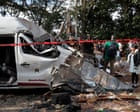
The crater on the Pan-American Highway near Cajibío is more than a structural ruin; it is a jagged, smoking hole in the central promise of the current administration. On Saturday, an explosive device obliterated a section of the road at El Túnel, killing at least 21 people and leaving dozens more mangled in the wreckage of buses and private cars. This was not a random tragedy. It was a calculated, high-signature strike by FARC dissidents aimed directly at the heart of the May 31 presidential election. While the government scrambles to frame this as a desperate act by cornered narco-terrorists, the reality is far more chilling: the state is losing control of the periphery, and the armed groups know it.
The Geography of a Massacre
The attack occurred in the Cauca department, a region where the geography of the Andes meets the lucrative logistics of the cocaine trade. Assailants reportedly forced traffic to a standstill by blocking the road with a bus before detonating the main charge. The force of the blast was sufficient to flip multiple vehicles and carve a deep void into the asphalt, turning a routine transit corridor into a kill zone. You might also find this connected coverage interesting: Diplomatic Signaling and the Metrics of Sovereign Parity.
Cauca has long been a pressure cooker. It serves as a vital artery for both legitimate commerce and the movement of coca base toward the Pacific coast. When the original FARC disbanded in 2016, a vacuum was left behind. That vacuum was not filled by schools or paved secondary roads, but by the "Estado Mayor Central" (EMC), a federation of dissident factions led by Néstor Gregorio Vera Fernández, known as Iván Mordisco.
The victims included at least five minors. This indiscriminate slaughter of civilians marks a departure from the tactical skirmishes seen earlier in the year. It signals a shift toward urban-style terrorism intended to demoralize the electorate and dictate the terms of the political conversation in Bogotá. As discussed in latest articles by Reuters, the results are worth noting.
A Weekend of Coordinated Fire
Saturday’s highway bombing was the centerpiece of a much larger, coordinated offensive. General Hugo Alejandro López Barreto, Commander of the Military Forces, confirmed that 26 distinct attacks occurred across the Cauca and Valle del Cauca departments over a single 48-hour window.
- Cali military base: A Friday night strike on a base in the country’s third-largest city signaled that the rebels are no longer content to stay in the mountains.
- Drone warfare: Emerging reports indicate the use of weaponized commercial drones in several rural outposts, a cheap but effective evolution in rebel tactics.
- Towns under siege: Incidents were reported in El Tambo, Caloto, and Miranda, effectively paralyzing the southwestern quadrant of the country.
This surge in violence comes at a moment of extreme political sensitivity. The assassination of conservative frontrunner Miguel Uribe Turbay last year already proved that the "peace" achieved in 2016 was a fragile veneer. Now, with the presidential vote just weeks away, the armed groups are using blood as a bargaining chip.
The Leverage Game
Why now? Political risk analysts argue that Iván Mordisco is not trying to win a war; he is trying to win a seat at the next table. By demonstrating the ability to shut down the Pan-American Highway—the nation’s most important land link—the EMC is signaling its "credibility" to whoever wins in May.
The current administration's "Total Peace" policy has been criticized for being high on rhetoric and low on enforcement. By offering ceasefires to groups that have no intention of surrendering their lucrative illegal mining and drug routes, the government inadvertently allowed these factions to rearm and consolidate power. The dissidents used the periods of reduced military pressure to recruit, often forcibly, from indigenous and Afro-Colombian communities.
The Candidates in the Crosshairs
The security crisis has fundamentally reshaped the electoral map. Senator Iván Cepeda, often seen as the ideological successor to the current "Total Peace" strategy, now finds himself defending a policy that looks increasingly disconnected from the carnage on the ground. Meanwhile, hard-line candidates like Abelardo de la Espriella and Paloma Valencia are gaining traction by promising a return to the "Democratic Security" era of the early 2000s.
The threat is not limited to the ballot box. All three leading candidates are now campaigning under massive security details, following credible death threats from the EMC and the ELN. Campaigning in the "deep Colombia" of the rural south has become an impossibility for most, effectively disenfranchising thousands of voters who are too terrified to attend rallies or show up at polling stations.
A State of Permanent Insurgency
Colombia is grappling with a mutation of its decades-old conflict. This is no longer a Marxist insurgency seeking to overthow the central government. It is a fragmented, profit-driven network of criminal franchises that use revolutionary language as a shield for narco-trafficking.
The government has responded by deploying additional troops to Cauca, but the military presence is often reactive. Soldiers arrive after the bomb has gone off, after the bus has been burned, and after the civilians have been buried. The institutional presence needed to displace the rebels—prosecutors, judges, and land title officers—remains absent from the most volatile regions.
The carnage at El Túnel is a grim reminder that in the contest between the ballot and the bullet, the bullet still has a terrifying reach. If the state cannot secure its primary highways, the legitimacy of the upcoming election remains in deep peril. The smoking crater in Cauca is a warning: the war is not over; it has simply changed its face.
Military intervention alone will not solve this. Until the government can offer the people of Cauca an economy more stable than coca and a security more reliable than the whims of a warlord, the Pan-American Highway will remain a road to nowhere. The coming weeks will determine if Colombia can hold its breath long enough to vote, or if the country is destined to return to the darkest days of its recent history.