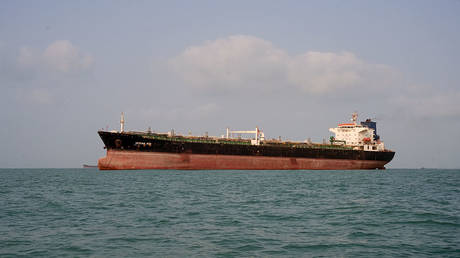
The air in the control room of a supertanker crawling through the Strait of Hormuz always tastes like old coffee and quiet panic.
You cannot smell the crude oil floating in the dark steel belly beneath your feet until the ventilation stutters, but you can feel the weight of it. Twenty-one miles wide at its narrowest point. That is the entire safety margin. On your port side, the jagged, burnt-orange mountains of Oman rise like ancient teeth. On your starboard side, the coastline of Iran watches you with binoculars you cannot see.
When you stand on that bridge, you understand a terrifying truth that economists in air-conditioned skyscrapers love to forget: the modern world runs on a very thin, very fragile string of water.
Right now, that string is vibrating until it hums.
The Arithmetic of Isolation
Listen to the rhetoric coming out of Tehran lately and you hear a singular, terrifying absolute. Not a single drop.
That was the vow. If the region bends to American planning, if the architecture of regional shipping and security aligns with Washington's blueprint, the valve gets slammed shut.
To understand what that means, you have to strip away the geopolitical jargon and look at the raw geography. Every single day, roughly a fifth of the world's petroleum consumption squeezes through this narrow maritime bottleneck. It is the jugular vein of global energy. When officials talk about Iran vowing that not a single drop of oil will leave the Gulf, they are not talking about a routine trade dispute. They are talking about putting a tourniquet on the planet's economic wrist.
Imagine a power plant in Seoul idling because the tankers stopped moving. Imagine a farmer in Iowa watching the price of diesel triple overnight because refining feedstock vanished from the global ledger. This is the invisible architecture of globalization. We build our lives on the assumption that ships will always sail, that oil will always flow, and that distant straits will remain open simply because they have always been open.
They stay open only as long as convenience outweighs catastrophe.
When Diplomacy Breaks Down
To watch this crisis unfold from the outside is to watch two freight trains accelerating toward each other on a single track, both conductors convinced the other will blink.
The United States and its regional partners draft their security architectures with a specific goal in mind: keeping trade routes clear, protecting allies, and hedging against a nuclear-armed Tehran. But every strategic deployment of a carrier strike group, every announcement of a new maritime coalition, is read in Iran not as a protective measure, but as a tightening noose.
Action. Reaction. Escalation.
When you back a nation with a crippled economy into a corner using sanctions as a daily instrument of statecraft, you alter its calculus. You remove its incentive to play by the rules of the international order. If your economy is already being systematically strangled by external decrees, the threat of closing the Gulf ceases to be a loss and becomes a weapon. It is a scorched-earth strategy written in crude oil.
I remember talking to an old mariner in a dusty port café in Fujairah years ago. He had spent four decades navigating these waters, dodging mines during the Iran-Iraq war, watching tensions rise and fall like a sickening tide. He pointed at a tanker steaming toward the horizon and shook his head.
"People think oil is a commodity," he said. "It is not. It is oxygen. And nobody negotiates rationally when you are squeezing their windpipe."
The Ripple Effect
The consequences of a closed Gulf do not arrive with dramatic explosions. They arrive in silence.
They arrive at the gas pump. They arrive in the inflation reports that dictate whether a young family can afford a mortgage. They arrive in the frantic emergency meetings of central banks trying to figure out how to stave off stagflation when the price of Brent crude breaches triple digits in a matter of hours.
Financial markets are remarkably good at pricing in risk, right up until the moment the risk becomes reality. Then they freeze. We have built a global economic engine that requires absolute continuity. A disruption in the Strait of Hormuz does not just cause a delay; it induces a systemic shock that cascades through manufacturing, agriculture, transport, and heating.
And that is why the current standoff is so uniquely dangerous. It is a game of chicken played with supertankers.
The Iranian leadership knows the stakes. They know that threatening the oil flow is the ultimate asymmetric weapon. They do not need to match the United States ship for ship or missile for missile. They only need to convince the world that the cost of crossing their path is too high to bear.
The Anatomy of a Choke Point
Look at a map of the Middle East. Find the Persian Gulf. Follow it down to the narrow pinch point where it meets the Gulf of Oman.
That is the Strait of Hormuz.
For decades, naval strategists have studied this geography with a sense of dread. It is deep enough for massive supertankers, but narrow enough that it can be effectively mined, targeted by coastal anti-ship batteries, or swarmed by fast attack craft in a matter of hours. The shipping lanes are divided into inbound and outbound tracks, separated by a two-mile-wide buffer zone. It is a highway over water, patrolled constantly, yet inherently vulnerable.
When Tehran declares that compliance with an American-led regional plan will result in a total blockade of these waters, they are exploiting that vulnerability with surgical precision. They are reminding every capital from Tokyo to London that the global economy is held hostage by a geography they cannot change and a conflict they cannot easily resolve.
We comfort ourselves with the thought that cooler heads always prevail. We look at history and see that past crises in the Gulf managed to de-escalate before the shooting started. We assume that the sheer economic self-interest of oil-exporting nations will keep the valves open, because even Iran needs revenue to survive.
Hope is not a strategy.
The Edge of the Abyss
As the diplomatic maneuvers grind forward and regional plans are drawn, revised, and implemented, the margin for error shrinks.
A miscalculated maneuver by a fast-attack boat. A misinterpreted radio transmission in the dead of night. A cyberattack on critical port infrastructure. Any one of these sparks could turn a war of words into a kinetic reality.
And when the smoke clears over the water, the tankers will sit motionless. The crude will stay in the ground. The world will discover, too late, what happens when the invisible string snaps.
Dawn breaks over the Gulf, turning the water the color of molten lead. Out in the shipping channel, a lone VLCC cuts through the swell, its red hull riding high, carrying millions of barrels of a liquid the world cannot live without, heading directly into the narrowest, most dangerous passage on Earth.