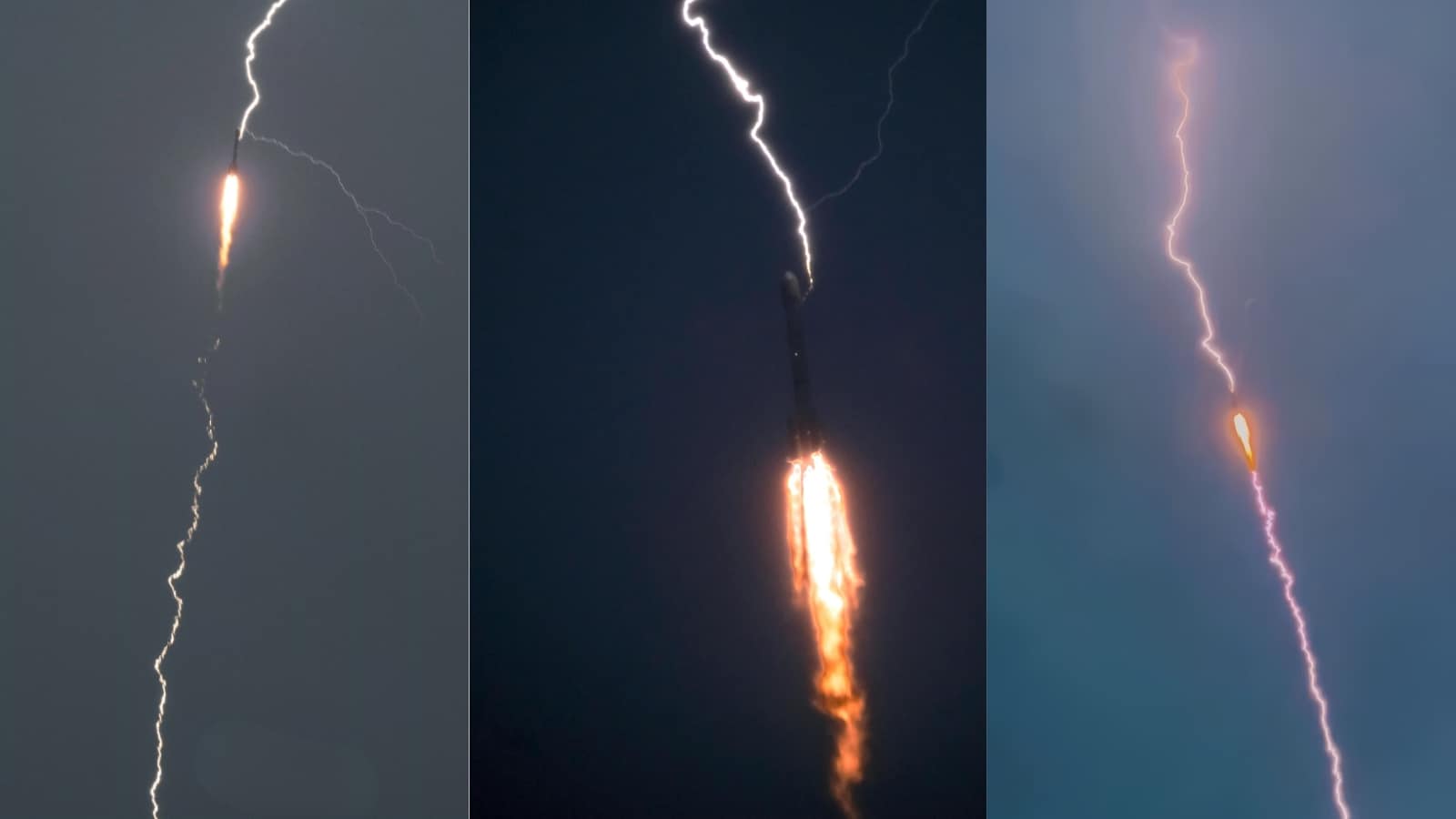
A massive bolt of lightning slammed directly into a Long March 3B rocket shortly after it blasted off from Xichang Satellite Launch Center. Bright white light flashed across the screen, illuminating the night sky and sending a jolt through everyone watching the live feed. Most people assumed the worst. Rockets carry thousands of gallons of explosive propellant, and high-voltage atmospheric discharges are usually a recipe for total catastrophe.
Against all odds, the rocket kept climbing. It punched through the storm clouds, maintained its trajectory, and successfully placed its satellite payload into geostationary transfer orbit.
It looks like a miracle. It isn't. Rocket engineers have spent decades preparing for this exact scenario, building Faraday cages and redundant guidance systems to survive the worst weather conditions imaginable.
The physics behind surviving a direct lightning strike in midair
When lightning strikes a rocket in flight, it doesn't just happen by random bad luck. Rocket launches actually trigger lightning strikes.
As a rocket speeds through the atmosphere, its metallic hull and the ionized plume of hot exhaust gases create a conductive path between electrically charged cloud layers and the ground. The rocket basically acts as a massive moving lightning rod. Scientists call this triggered lightning, and it's a known hazard in aerospace operations.
So why didn't the Long March 3B blow up?
The secret lies in passive protection design. Spacecraft shells rely on the Faraday cage principle. The outer aluminum or composite skin of the rocket forms an electrically conductive shell. When lightning hits the vehicle, the electric current travels around the exterior surface of the metallic skin rather than penetrating inside where sensitive electronics, guidance computers, and volatile fuel tanks sit.
Energy enters at one extremity—usually the nose cone or payload fairing—and exits through another, typically the engine nozzle or the trailing exhaust plume. The internal systems barely feel a ripple.
Why space agencies usually don't launch in storms
If rockets can handle lightning, why do space agencies routinely delay launches for bad weather?
Because risk management in spaceflight is ruthless. You don't gamble a multi-hundred-million-dollar satellite on a conductive shell if you don't have to.
NASA learned this lesson the hard way back in 1969 during the Apollo 12 mission. Just 36 seconds after liftoff, lightning struck the Saturn V rocket, triggered by the vehicle's own exhaust trail. A second strike hit at 52 seconds. The electrical surge tripped circuit breakers, knocked out the main fuel cells, and scrambled the command module's display panel. Astronaut Pete Conrad and the ground crew managed to reset the systems and reach orbit safely, but it was an uncomfortably close call.
Then came 1987. An Atlas-Centaur rocket carrying an AC-67 satellite launched during a rainstorm. Lightning struck the rocket, corrupted its flight computer memory, and caused the vehicle to pitch wildly. The structural stress broke the rocket apart, forcing range safety officers to destroy it.
Since those incidents, launch rules have become remarkably strict. Launch commit criteria at facilities across the globe—whether it's the Kennedy Space Center in Florida or Xichang in Sichuan province—explicitly prohibit launching through thick anvil clouds, thunderstorm cells, or high surface electric fields.
How China built a weather-resistant space program
China's space program operates under intense schedules. The Long March 3B, a workhorse heavy-lift rocket with three and a half stages, handles the bulk of China's high-orbit satellite deployments, including communication satellites and the Beidou navigation network.
The Xichang Satellite Launch Center sits in a mountainous region of southwestern China. The terrain makes weather forecasting tricky, with sudden microclimates and localized storm cells developing quickly during peak launch windows.
To keep launches on track without sacrificing safety, Chinese aerospace engineers implemented aggressive hardening protocols on the Long March series:
- Heavy shielding on wiring harnesses: Critical data cables feature thick braided copper shielding to prevent electromagnetic pulses from corrupting flight computer code.
- Redundant flight computers: Multiple redundant processors run identical algorithms simultaneously. If lightning causes a transient glitch in one processor, the backup units override the error without missing a beat.
- Optoelectronic isolation: Critical control paths rely on optical fiber links instead of copper wires, stopping electrical surges from jumping between subsystems.
- Advanced static discharge wicks: Placed along aerodynamic trailing edges to shed excess electrical charge back into the atmosphere continuously.
When the strike occurred on the Long March 3B, these defensive layers worked in tandem. The skin channeled the current, the shielding protected the computer, and the redundant sensors kept the engines vectoring correctly.
What this means for the future of spaceflight
Commercial space companies and state agencies are pushing for higher launch cadences than ever before. Waiting out bad weather costs millions of dollars per day in logistics, pad delays, and orbital slot scheduling.
Does this successful flight mean rockets will start launching in thunderstorms routinely? Absolutely not. No flight flight director will intentionally clear a rocket to fly through an active lightning cell. The risks to payload electronics, sensor calibration, and structural integrity are simply too high.
However, the Long March 3B event proves that modern aerospace architecture has reached a level of resilience where accidental atmospheric discharges are survivable events rather than automatic mission failures.
If you're tracking satellite launches or managing aerospace hardware, focus on three primary hardware checks to ensure atmospheric resilience: verify the continuity of conductive bonding across all structural joints, ensure full optical isolation on data buses, and audit flight control software for immediate automatic reset capabilities following transient voltage drops.