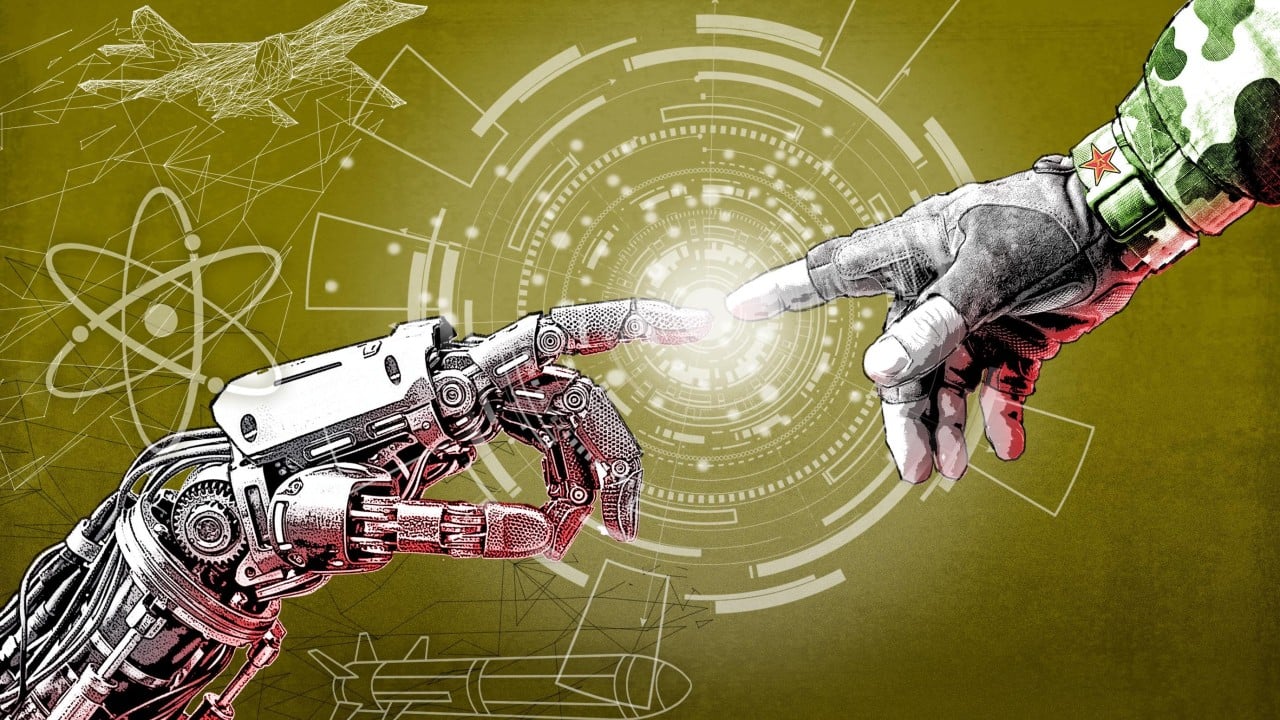
If you think modern military power is just about having the biggest ships or the most tanks, you are missing the entire point of what Beijing is building. The People's Liberation Army isn't just buying more gear. They are rewriting how wars get fought from the ground up, pivoting hard toward what their strategists call "intelligentized warfare".
This shift isn't happening in some distant vacuum. It is a calculated rush to master disruptive tools like artificial intelligence, quantum sensing, and autonomous drone swarms before anyone else does. Understanding this obsession requires looking past the standard headlines and examining how technology, policy, and raw ambition collide inside China's defense apparatus.
The Shift From Mechanization to Intelligence
For decades, military modernization meant upgrading hardware. You swap old rifles for new ones, build bigger aircraft carriers, and field faster jets. Beijing checked those boxes long ago. Now, the focus has moved past mere mechanization and traditional informatization into a phase where algorithms act as the primary operational backbone.
Chinese military planners view future conflicts as high-speed chess matches played out across land, sea, air, space, and cyberspace simultaneously. In that environment, human brains simply process data too slowly. By injecting artificial intelligence into command systems, the goal is to see first, decide first, and strike before an adversary can even react.
You can see this doctrine in practice through recent military exercises and public technology competitions. These aren't just parades for domestic television. They are functional stress tests designed to discover commercial innovations, filter out weak software, and rapidly integrate civilian tech breakthroughs straight into frontline units.
Weaponizing the Commercial Sector
One major oversight analysts often make is looking only at traditional defense contractors. Beijing's strategy relies on a framework called military-civil fusion. This policy blurs the line between commercial tech companies and state military requirements.
If a private firm in Shenzhen develops advanced robotics, computer vision, or high-efficiency battery management, that innovation finds its way into military supply chains with minimal friction. Quadrupedal robots—often called robotic wolves—serve as a prime example. Commercial off-the-shelf LiDAR and mobility hardware are rapidly adapted for scouting, obstacle breaching, and logistical supply runs in complex terrain.
This setup gives the PLA a structural edge in speed. Traditional defense procurement in Western nations can take years to move from concept to deployment. Beijing harnesses its massive commercial tech ecosystem to bypass those bureaucratic bottlenecks, cycling new hardware and software iterations into the field at a pace traditional militaries struggle to match.
The Real Bottlenecks and Internal Friction
Of course, writing doctrine is easy; executing it flawlessly is another story entirely. Building an intelligent military system comes with massive hurdles that state media rarely highlights.
Recent years have exposed significant internal turbulence. Sweeping anti-corruption purges and leadership overhauls at the highest levels of the Central Military Commission have removed dozens of top-tier commanders and theater-level officers. Replacing experienced leadership with newly promoted officers creates institutional gaps. When you clear out the upper ranks, operational continuity takes a hit, no matter how advanced your software claims to be.
Furthermore, technical limitations remain. Real-world testing during recent challenges showed that counter-drone systems and automated swarm defenses still struggle with low autonomy levels and complex electronic interference. Turning raw AI research into reliable, combat-proven software that won't fail under heavy jamming is an immense engineering hurdle. The gap between theoretical concepts and actual battlefield readiness is narrower than Beijing wants admitting, but wider than enthusiasts assume.
What Drives the 2027 Deadline
Deadlines matter in this ecosystem. The primary gravitational pull behind this rapid technological adoption is the 2027 centennial goal for the PLA. Chinese leadership set this milestone to force the military into a fully capable, modern force by that specific year.
Exercises near Taiwan, such as extensive blockade rehearsals and multi-domain encirclements, serve as living laboratories for these disruptive technologies. The objective isn't just intimidation. It is a live evaluation of whether autonomous systems, networked logistics, and AI-driven decision support can successfully manage a high-stakes, contested operational environment without collapsing under pressure.
If you want to understand where global security is heading, stop looking at troop counts. Look at algorithms, supply chain integration, and who controls the software defining the next generation of tactical command.