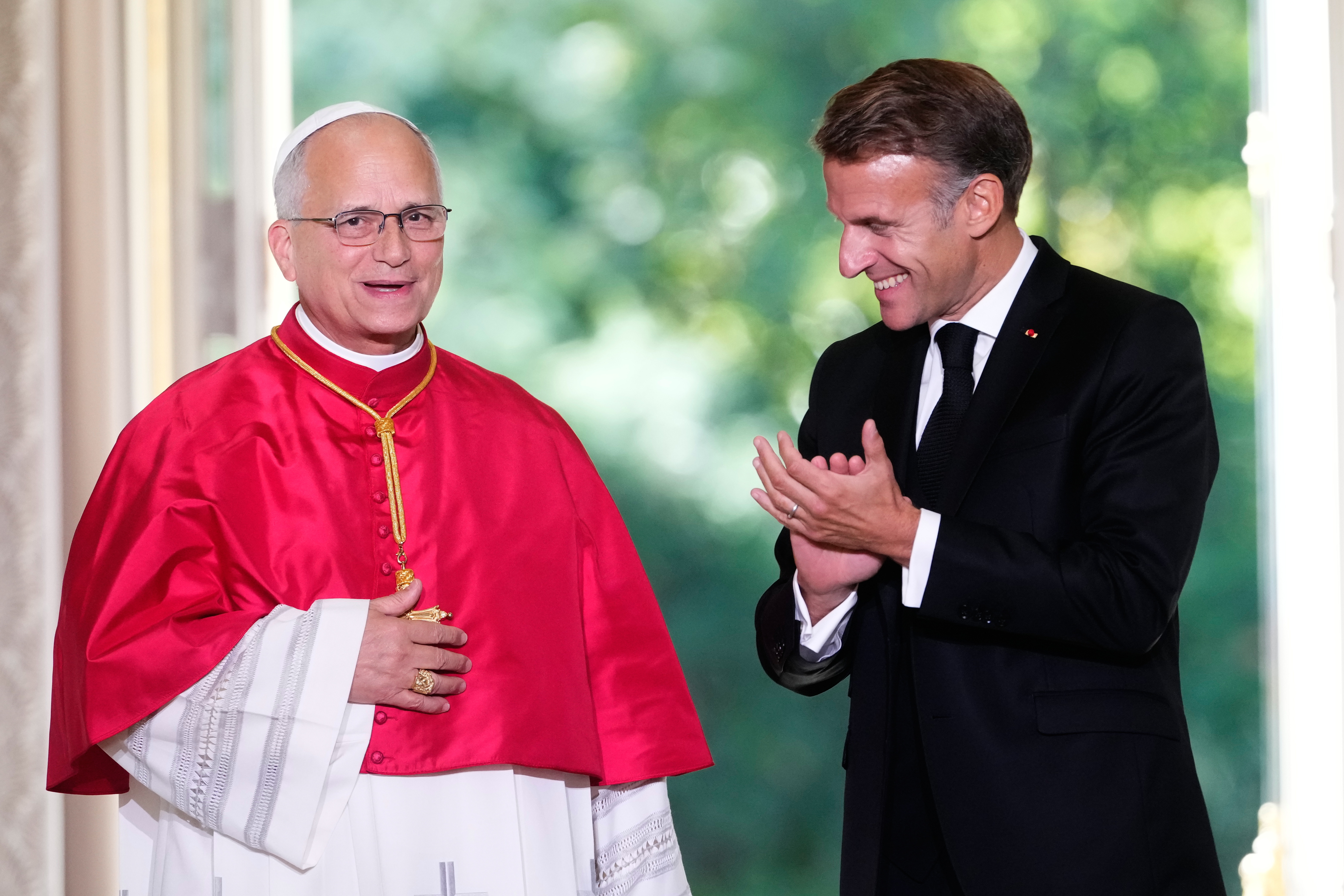
The light in the Rue du Bac never quite reaches the floorboards. It filters through old glass, bruised by slate roofs and the stubborn gray clouds that roll off the Seine, pooling in corners where generations of footfalls have worn the stone into smooth, concave hollows. Standing there, holding a lukewarm cup of paper-cup coffee while the autumn wind rattles the corner ironwork, you realize how quiet human anxiety can become when it is dressed up as progress.
We built the tools to save us time, and then we ran out of time to use.
This is the strange, muffled panic that brought Pope Leo to France. Not a panic of fire and brimstone, but of silence. The kind of silence that settles over a room when everyone is looking down at a glowing rectangle, nodding at ghosts while the living person across the table waits for a glance that never comes. When the Pontiff stepped onto French soil to warn against what he called a paradise of machines, he was not tilting at windmills or waging some archaic war against copper wire and silicon. He was naming a ghost we have all invited into our homes.
Imagine a living room in Lyon. It is eight o'clock on a Tuesday evening. The radiator ticks against the wall, a familiar, analog heartbeat in a digital age. On the sofa sits a fourteen-year-old girl named Camille. Her thumb moves across glass with the practiced speed of a concert pianist playing a Chopin etude. She is not lonely, exactly. She is surrounded by millions of voices, infinite libraries, and automated companions trained to anticipate her preferences before her own mother can guess her mood.
Yet, as the room grows dark, she is profoundly untethered.
The machine does not ask her to compromise. It does not misunderstand her accent, roll its eyes at her silence, or demand the messy, terrifying vulnerability of actual forgiveness. It gives her a bespoke reality, curated down to the millisecond, flat and safe and completely sterile.
This is the paradise the Pope looked at and called a desert.
We have confused efficiency with salvation. For three centuries, the West has marched to a single, relentless drumbeat: make it faster, make it cleaner, make it frictionless. If a task requires friction—if writing a letter requires scratching ink across paper and waiting a week for an envelope to cross a mountain range—we engineer the friction away. If a conversation requires awkward pauses and the risk of offense, we outsource the dialogue to algorithms that smooth the edges until every interaction slips down the throat like lukewarm water.
We got what we asked for. We engineered a world where the laundry is smart, the cars see better in the fog than we do, and the algorithms guarding our attention know our anxieties better than our confessors ever did.
And yet, look at the waiting rooms. Look at the crowded cafes where five people sit around a mahogany table, each staring intently into the palm of their hand, texting the person three inches away because speaking aloud feels like too much of a public disturbance.
We have built a paradise where nothing can break, because nothing is real enough to shatter.
History is littered with the bones of our previous attempts to outsmart our own fragility. Every time we invent a new lever, we imagine it will lift us straight into Eden. When the loom clattered into the English countryside, the factory owners promised a permanent end to cold backs and empty bellies. They were right about the wool, but wrong about the weavers. The loom broke the rhythm of the seasons, hitched human life to the unyielding pulse of the steam piston, and turned the artisan into a gear.
The machine does not care about your grandmother’s recipes. It does not remember the way the light hit the orchard behind the old stone house in Dijon on the evening of your tenth birthday. It compresses existence into data points, sorting the tragic and the trivial into identical rectangular tiles on a glass screen, all of them begging for a fraction of a second of your dwindling focus.
When a spiritual leader warns against this, the technologist smiles and talks about productivity gains. The Silicon Valley pitch deck rolls out terms like empowerment and connectivity, as if stringing fiber-optic cables across the ocean floor were the same thing as teaching neighbors how to share their bread.
They are speaking different languages. One measures the world in throughput; the other measures it in soul-weight.
Consider the alternative. What does a human life look like when every obstacle has been sanded away by software? It looks like a museum exhibit of a person. It looks like a life lived entirely behind double-paned glass, where the rain makes no sound and the wind never bites your cheeks.
The French know something about old stones. You do not build a cathedral by eliminating friction. You build it by piling tons of rough, jagged granite on top of each other, mortaring the gaps with sweat and prayer, and trusting that the arch will hold because thousands of tons of dead weight are leaning against one another in a delicate, tense conspiracy of mutual support.
That is what human community is. It is heavy. It is annoying. It interrupts your favorite television show. It requires you to listen to your uncle tell the same boring story about his sciatica for the fourth Thanksgiving in a row, and it forces you to look your neighbor in the eye after you forgot to return his lawnmower.
The machine offers an escape from all of that. Press a button, mute the uncle, swipe away the neighbor.
But when you escape the annoyance of other human beings, you also escape their grace.
The Pope's warning in France was not a Luddite retreat. It was an urgent plea to remember the architecture of our own humanity. We are not processing units. We are not biological optimization problems waiting for a smarter update. We are creatures of dust and stubborn love, designed for a world that bleeds when you scratch it.
If we surrender our capacity for silence—real, unscripted, terrifying silence where no screen buzzes with a notification—we lose the only space where conscience can breathe. If we let algorithms do our grieving, our courting, and our wondering for us, we do not become gods. We become pets in a very expensive, very efficient cage of our own devising.
The Rue du Bac is quiet now. The mist is turning into a steady, gray drizzle that coats the asphalt in a slick sheen. Down the street, a delivery van idles, its electric motor humming with an eerie, insectoid purr that leaves no exhaust in the damp air. It is clean. It is quiet. It is the future.
As you pull your coat tighter against your chest and step out into the rain, you can feel the cold water soaking through the knit of your sleeves. It is uncomfortable. It is inconvenient.
And for the first time all day, you are entirely, undeniably awake.