The global energy stage has a favorite script. It is a comforting, high-minded theater where government officials stand behind polished podiums, gesture to slick PowerPoint slides, and declare that their respective nations are "rising to the moment."
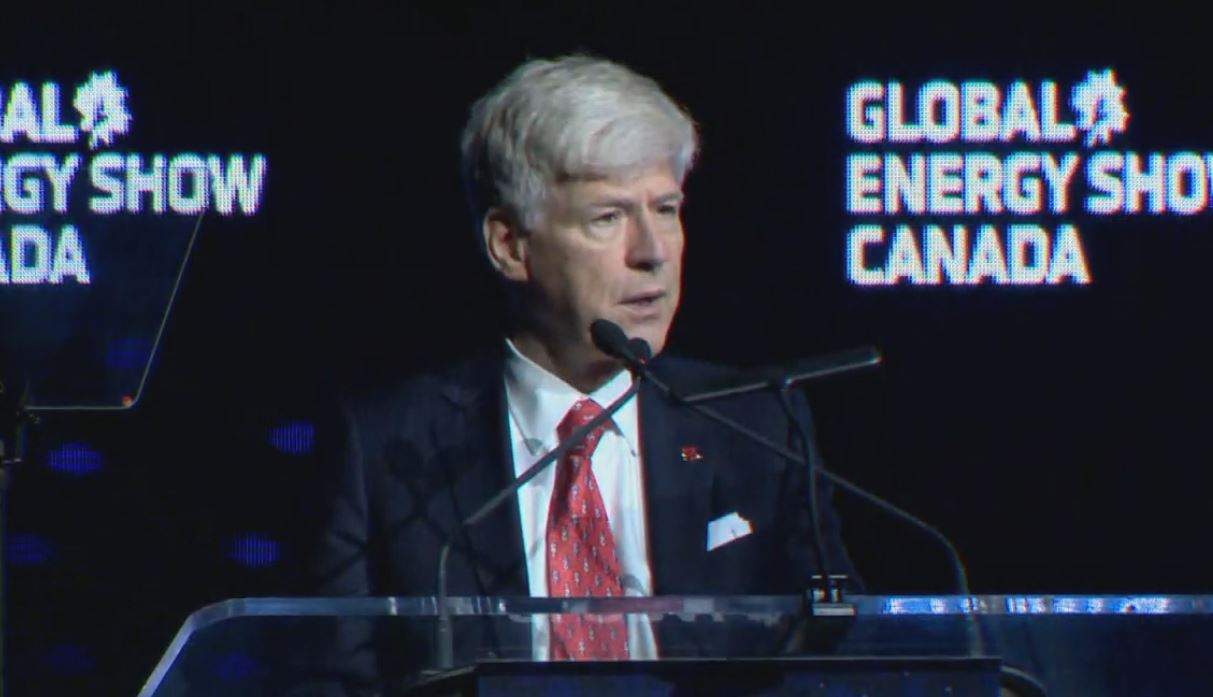
At the Global Energy Show in Calgary, Canada’s federal energy minister delivered this exact performance. The narrative was predictable: Canada is uniquely positioned to lead the global energy transition. It can simultaneously slash emissions, build out a massive clean energy grid, and remain a reliable exporter of traditional oil and gas to a volatile world. It is a beautiful, politically bulletproof vision of having your cake and eating it too.
It is also an absolute mathematical impossibility.
Behind the corporate hand-clapping and bureaucratic self-congratulation lies a brutal, unacknowledged reality. Canada is not pioneering a flawless template for the green transition. It is playing a high-stakes game of economic double-speak. The country is funding its ambitious climate promises with the record-breaking revenues of the very fossil fuels it promises to phase out, all while choking the infrastructure development needed to actually build a clean grid.
Let us stop pretending the current strategy is working. The lazy consensus of the energy transition is broken.
The Trans Mountain Pipeline Delusion
The crown jewel of Canada’s recent energy infrastructure is the Trans Mountain pipeline expansion. It is a project that perfectly captures the internal friction of Canadian energy policy.
The political talking point is simple: this pipeline connects Canadian crude to international markets, specifically Asia, reducing reliance on the United States and securing top dollar for Canadian resources. The government bought the project to ensure its survival, framing it as a strategic bridge to a lower-carbon future.
Here is what they do not say at the podium. The project cost ballooned from an initial estimate of $7.4 billion CAD to a staggering $34 billion CAD. I have watched energy boards and private equity firms miscalculate infrastructure costs for two decades, but this is a masterclass in bureaucratic mismanagement. Taxpayers are on the hook for a project that private enterprise walked away from because the regulatory hurdles were intentionally designed to be insurmountable.
More importantly, the pipeline accomplishes the exact opposite of a transition. It locks in high-volume, carbon-intensive oil sands production for the next thirty to forty years to recoup capital costs. You do not spend $34 billion on a fossil fuel highway if you plan on abandoning the car anytime soon.
Canada’s energy policy is a functioning hypocrisy. The country is using state-backed fossil fuel expansion to underwrite its green credentials.
The Clean Energy Grid That Regulation Killed
While the federal government boasts about its Clean Electricity Regulations, the reality on the ground is a mess of red tape, provincial infighting, and grid instability. The official goal is a net-zero electricity grid by 2035. It sounds magnificent on a campaign flyer. It falls apart completely under the laws of thermodynamics and project finance.
To replace fossil-fuel baseload power with intermittent renewables like wind and solar, Canada needs to scale its grid capacity by a factor of two or three. It requires thousands of miles of new high-voltage transmission lines crossing provincial borders.
Try building a transmission line in Canada today. You will spend a decade trapped in a purgatory of environmental assessments, provincial jurisdictional disputes, and shifting regulatory goalposts. The Impact Assessment Act—originally designed to streamline reviews—has instead created an environment of total investor paralysis.
Consider the provincial civil war between Ottawa and Alberta. Alberta placed a temporary moratorium on new renewable energy projects simply because the rapid influx of intermittent power was threatening grid stability and distorting local electricity markets. When a jurisdiction known for abundant wind and solar halts projects because the regulatory framework cannot handle the integration, your transition plan is failing.
The hard truth? Canada cannot build anything fast enough to meet its own arbitrary timelines. Clean energy requires mining for critical minerals, constructing massive battery storage facilities, and stringing copper across thousands of kilometers of wilderness. The federal regulatory apparatus has made it functionally illegal to build the very infrastructure the transition demands.
Dismantling the Clean Energy Transition Myths
The public discourse around Canada's energy future is built on flawed premises. Let's address the questions people ask, and correct the foundational errors baked into them.
Can Canada replace oil and gas revenues with clean tech exports?
No. This is an economic fantasy. In 2023, the oil and gas extraction sector contributed over $100 billion to Canada’s nominal GDP. It represents a massive chunk of the country’s total export value. Clean tech, while growing, is nowhere near capable of filling that macroeconomic chasm.
Clean tech manufacturing is a race to the bottom on margins, dominated by Chinese state-subsidized solar paneling and battery cells. Canada cannot compete on cost, and its domestic market is too small to sustain a massive manufacturing base. Relying on clean tech to replace oil revenues is a recipe for a structural fiscal deficit that would hollow out Canada's social safety net.
Is Carbon Capture, Utilization, and Storage (CCUS) a viable bridge to net-zero?
Only if taxpayers fund it permanently. The energy sector points to CCUS as the technology that will decarbonize the oil sands. The federal government has responded with massive investment tax credits to subsidize these projects.
But CCUS is an energy sink. It takes immense amounts of electricity to capture, compress, and store carbon dioxide underground. According to data from the International Energy Agency (IEA), large-scale CCUS deployment globally has consistently underperformed its design capacity. It adds capital expenditure and operational costs to oil production without generating a single extra barrel of revenue. The moment government subsidies dry up, the economic viability of commercial CCUS collapses. It is an expensive band-aid designed to buy social license, not a sustainable industrial strategy.
The Hypocrisy of Exporting Emissions
The ultimate flaw in Canada’s energy narrative is the accounting trick of scope emissions. The federal government pledges to reduce domestic emissions while simultaneously maximizing liquefied natural gas (LNG) and oil exports to global markets.
Under international carbon accounting rules, Canada is not responsible for the emissions generated when its oil is burned in a refinery in Ohio or its natural gas is combusted in a power plant in Tokyo. Those are categorized as Scope 3 emissions, belonging to the importing nation.
This allows Canadian politicians to claim they are hitting domestic targets while actively fueling the rest of the world. The global atmosphere does not care about national balance sheets. If Canada exports millions of barrels of crude a day, it is a fossil fuel heavyweight, regardless of how clean its domestic hydroelectric grid is. The claim of global climate leadership while pocketing export revenues from heavy crude is an exercise in public relations, not environmental stewardship.
The Unpopular Blueprint for Real Energy Sovereignty
If Canada actually wanted to achieve a realistic, stable energy strategy rather than winning applause at international conferences, it would abandon its current approach immediately. A real strategy requires making choices that offend both environmental purists and traditional oil executives.
First, Canada must embrace nuclear energy on an unprecedented scale. If you want to decarbonize heavy industry and the oil sands themselves, wind and solar will not cut it. The energy density of nuclear power is the only viable replacement for industrial heat and baseload power. This means deploying Small Modular Reactors (SMRs) directly into industrial zones and the oil sands fields.
Second, the regulatory system needs a chainsaw, not a scalpel. If a clean energy project or a critical mineral mine cannot clear environmental review and native consultation within 24 months, the framework is a failure. You cannot transition an economy through endless litigation.
Third, acknowledge the downsides. A real transition means accepting that energy costs will rise in the medium term. It means admitting that domestic industries will become less competitive globally during the overhaul. It means accepting that pristine wilderness will have to be cleared for transmission lines and lithium mines.
Instead of these hard truths, the Global Energy Show gets platitudes. The federal government offers a comforting lie: that bureaucratic regulation can magically conjure a green economy without industrial pain, while the oil and gas sector pretends it can decarbonize the heavy extraction of bitumen with a few tax incentives.
Stop listening to the speeches. Look at the capital flows. Look at the regulatory gridlock. Canada is not rising to the moment; it is simply hiding behind a wall of rhetoric while the global energy market continues to demand the very resources Canada pretends it wants to leave in the ground.