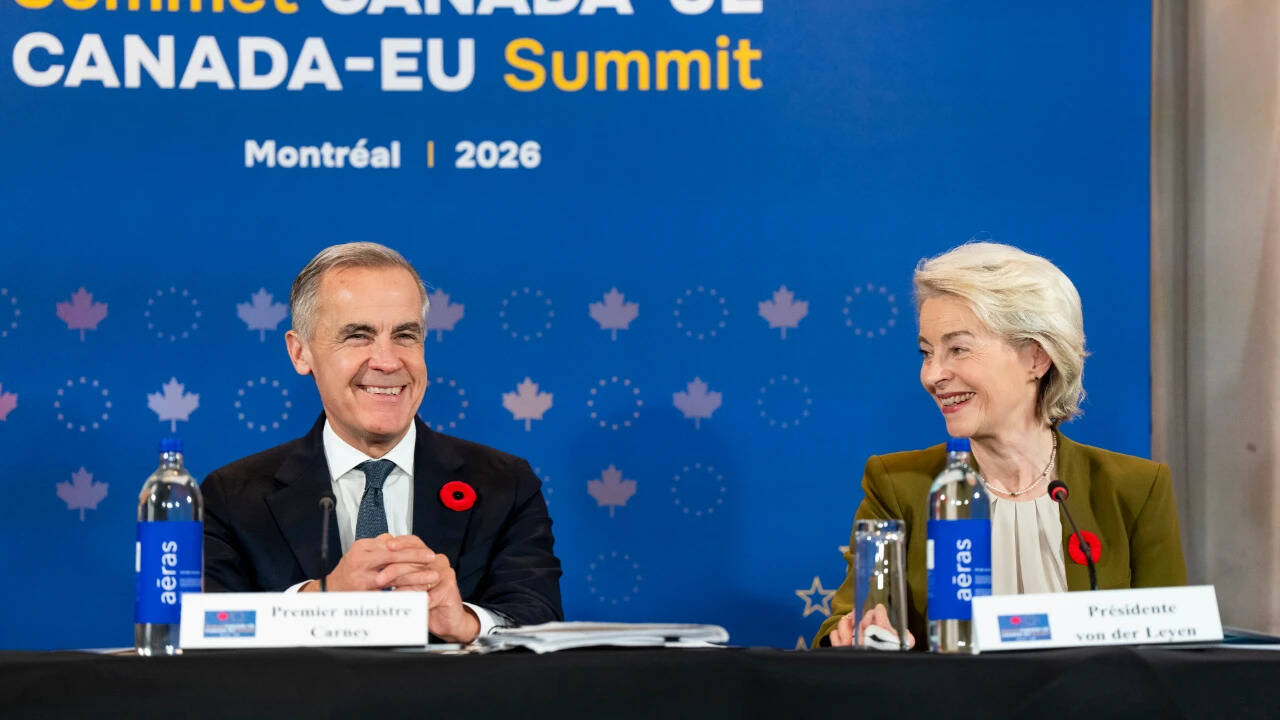
Canada’s pursuit of a formal, deep-tier partnership with the European Union is not a diplomatic preference; it is an emergency capital-allocation hedge against monopsony risk. When roughly 70 percent of a nation’s outbound trade flows into a single market, that buyer possesses structural pricing power and coercive political advantage. Under the tariff regime enacted by the second Trump administration—spanning broad sectoral duties on steel, aluminum, automotive manufacturing, and forest products, alongside 50 percent Section 338 retaliatory levies—Ottawa’s historical reliance on continental integration ceased to function as an efficiency engine and became a balance-sheet liability. Prime Minister Mark Carney’s push to establish Canada as the European Union’s first associate member represents an attempt to re-engineer trade architecture in real time, trading geographic proximity for institutional predictability.
The Structural Vulnerability of Monopsony Dependence
Standard coverage of transatlantic diplomacy frames Ottawa’s pivot toward Brussels as a reaction to political friction. That diagnosis misses the underlying economic mechanics. For decades, North American supply chains operated under the assumption of frictionless border transit, optimizing for just-in-time inventory and cross-border component assembly. That optimization created a classic monopsony trap: Canada built physical infrastructure—pipelines, rail corridors, automotive stamping plants, and electrical grids—oriented almost exclusively along a north-south axis.
When the United States weaponized market access through executive tariff actions starting in early 2025, Canadian exporters discovered that infrastructure cannot be rotated overnight. Even with roughly 90 to 95 percent of exports initially qualifying for exemptions under existing North American trade pact rules, the threat of arbitrary executive escalation—such as Section 338 tariffs requiring no formal investigation and carrying no expiration date—introduced a permanent risk premium into Canadian capital markets.
Investors do not wait for tariffs to bankrupt an enterprise before repricing its equity; they discount future cash flows the moment regulatory certainty collapses. Carney’s strategy addresses this discount rate directly. By anchoring Canadian regulatory frameworks to the European Union—a bloc representing the world’s largest single market—Ottawa is attempting to lower the cost of capital for domestic industries by proving they have a viable secondary buyer.
The Three Pillars of the Transatlantic Hedge
The October 2026 Montreal summit between Carney, European Commission President Ursula von der Leyen, and European Council President António Costa moved beyond ceremonial rhetoric by targeting three specific bottlenecks in transatlantic commerce. Rather than attempting to renegotiate tariff schedules line by line—a process already largely completed under the existing Comprehensive Economic and Trade Agreement—the two sides focused on structural friction.
1. Digital and Financial Plumbing
Physical goods face ocean freight costs and port capacity limits, but digital services and financial flows scale at near-zero marginal cost. The substantive conclusion of a bilateral digital trade agreement, paired with initiatives to link Canadian and European instant-payment systems and align competition policy, targets non-tariff barriers. By harmonizing data governance and cross-border settlement rails, Ottawa and Brussels are reducing transaction costs for service-sector firms that would otherwise default to American cloud and financial intermediaries.
2. Upstream Resource Security and Capital Deployment
Europe faces an acute structural deficit in processed critical minerals required for defense manufacturing, grid electrification, and electric vehicle supply chains. Canada possesses the geological reserves but lacks the domestic capital pool to scale extraction and midstream refining rapidly. The agreement between Ottawa and the European Investment Bank creates an institutional conduit for European state-backed capital to flow directly into Canadian mining and processing assets. In exchange for capital expenditure, European industrial buyers secure off-take agreements insulated from Washington’s export controls and tariff swings.
3. Compute Sovereignty and Industrial R&D
Modern industrial competitiveness depends on access to high-performance computing clusters. Canada’s integration into European supercomputing initiatives, notably gaining access to the JUPITER exascale system—capable of executing in a single day calculations that require six months on Canada’s fastest domestic hardware—addresses a severe domestic capability gap. For Ottawa, pooling research and development infrastructure with Brussels bypasses the capital cost of building sovereign exascale capacity from scratch while anchoring Canadian artificial intelligence and defense researchers inside European regulatory standards.
The Institutional Friction of Associate Membership
Despite clear alignment on industrial policy, the political mechanism proposed to house this relationship—making Canada the European Union’s first associate member—faces severe legal and geopolitical resistance. Journalists often treat the "associate member" label as a branding dispute, yet the resistance among European member states stems from rigid constitutional constraints within the European treaties.
The European Union’s single market rests on the indivisibility of its four freedoms: the free movement of goods, capital, services, and labor. Allowing a non-European state to cherry-pick sectoral access without accepting full budgetary contributions, European Court of Justice jurisdiction, and unrestricted labor mobility threatens the internal equilibrium of the bloc. Member states bordering Eastern Europe and the Western Balkans—candidates that have spent decades undergoing painful domestic reforms to qualify for accession—view a bespoke fast-track designation for a wealthy G7 nation as politically destabilizing.
This explains why the joint declaration issued in Montreal omitted the phrase "associate member," substituting the vaguer commitment to define an "ever-closer association" ahead of the 2027 summit. Von der Leyen’s public endorsement of the associate concept signals executive intent in Brussels, but ratification requires unanimous consent across European capitals where domestic agricultural and industrial lobbies remain protective.
Quantifying the Gravity Model Constraints
Any rigorous assessment of Carney’s European pivot must confront the gravity model of international trade, which dictates that bilateral trade volume is proportional to economic mass and inversely proportional to distance. While the European Union matches the economic mass of the United States, the Atlantic Ocean imposes an immutable tax on physical logistics.
Consider the numbers governing this transition:
- Baseline Asymmetry: Bilateral Canada-EU trade stood at roughly $147 billion (127 billion euros) in 2025, making the bloc Canada’s second-largest trading partner. That figure remains a fraction of the north-south volume crossing the 49th parallel, where roughly 70 percent of Canadian exports still terminate.
- Infrastructure Latency: Redirecting heavy commodities—such as crude oil, liquefied natural gas, lumber, and primary metals—from continental pipelines and rail lines to coastal ports requires tens of billions of dollars in port expansion, ice-strengthened maritime capacity, and east-west rail double-tracking. Even with Carney’s September 2026 investment summit securing $500 billion in private commitments across major infrastructure projects, physical build-outs operate on five-to-ten-year timelines.
- Retaliatory Exposure: Washington does not observe transatlantic integration passively. Deeper regulatory alignment between Ottawa and Brussels—particularly around digital taxes, artificial intelligence governance, and industrial subsidies—triggers immediate friction with American trade negotiators. A strategy designed to insulate Canada from U.S. tariffs risks provoking targeted punitive measures against the exact sectors still dependent on American consumers, such as automotive assembly, where 50 percent tariff threats hang over cross-border supply chains.
The Dual-Track Bargaining Dynamic
Observing Ottawa’s simultaneous negotiations
The Transatlantic Pivot Architecture Why Ottawa Cannot Replace Washington With Brussels
business, news
Canada’s diplomatic outreach to the European Union under Mark Carney represents a textbook defensive hedging maneuver against American protectionism, yet it runs directly into the hard physics of trade geography. When a small, open economy relies on a single contiguous neighbor for roughly three-quarters of its merchandise exports, pivoting toward a transoceanic trading bloc is not a substitution strategy; it is a marginal diversification play. The blueprint for understanding Ottawa’s European strategy requires separating political signaling from supply chain reality. While diplomatic alignment with Brussels provides regulatory cover and institutional solidarity against unilateral U.S. tariffs, the structural friction of transatlantic logistics, non-tariff regulatory barriers, and European industrial policy ensures that the Comprehensive Economic and Trade Agreement (CETA) can absorb only a fraction of the economic shock generated by North American trade friction.
The Structural Asymmetry of North American Trade
To evaluate the viability of a Canadian pivot toward Europe, one must first establish the baseline mechanics of North American economic integration. Standard journalistic coverage treats trade flows as fungible capital—implying that a container of goods blocked at the Detroit-Windsor border can simply be rerouted to the Port of Rotterdam. In operational reality, North American manufacturing is not built on finished-goods trade; it is built on deeply integrated, cross-border intermediate supply chains.
Under the mechanics of the gravity model of trade—an foundational economic principle stating that bilateral trade flows are proportional to the economic mass of two countries and inversely proportional to the distance between them—Canada’s alignment with the United States is a geographic inevitability rather than a policy choice.
- Just-in-Time Inventory Architecture: North American automotive, aerospace, and heavy manufacturing sectors operate on narrow inventory buffers. Components cross the U.S.-Canada border multiple times before final assembly. Introducing a 3,500-nautical-mile maritime transit leg destroys the working capital efficiency of these supply chains.
- Infrastructure Lock-In: Canada’s physical export infrastructure—pipelines, rail corridors, and electrical grids—runs north-to-south. Heavy crude from Alberta cannot easily reach tidewater on the Atlantic coast without massive capital expenditure and multi-year regulatory permitting, leaving the U.S. Midwest refining complex as the sole viable clearinghouse for Canadian energy.
- Asymmetric Vulnerability: Trade accounts for roughly two-thirds of Canada’s Gross Domestic Product, with the United States absorbing the overwhelming majority of that volume. Conversely, exports to Canada represent a single-digit percentage of total U.S. GDP. This asymmetry gives Washington immense coercive pricing power in bilateral negotiations, which diplomatic visits to European capitals cannot neutralize.
Deconstructing the Carney Strategy Three Operational Pillars
Mark Carney’s engagement with European leadership is not an attempt to rewrite the gravity model of trade. Instead, from a strategic consulting perspective, the outreach operates across three distinct, non-trade mechanisms designed to raise the diplomatic cost of U.S. unilateralism and secure niche industrial advantages.
Pillar One Regulatory and Climate Alignment
The primary point of convergence between Ottawa and Brussels is carbon pricing and industrial decarbonization policy. The European Union’s Carbon Border Adjustment Mechanism (CBAM) penalizes imports from jurisdictions lacking equivalent carbon pricing regimes. By aligning Canada’s industrial carbon pricing framework with European standards, Ottawa protects Canadian steel, aluminum, and fertilizer producers from European border tariffs. This creates a defensive regulatory moat: if U.S. industrial policy diverges from European climate standards, Canadian raw materials retain preferential access to European manufacturing inputs, positioning Canada as a compliant supplier in green supply chains.
Pillar Two Critical Minerals and Defense Procurement
Europe faces an acute structural deficit in upstream critical minerals—specifically lithium, nickel, cobalt, and rare earth elements—required for its energy transition and defense industrial base. Simultaneously, geopolitical instability in Eastern Europe has forced EU member states to rapidly expand defense spending. Canada possesses the geological reserves and the political stability that European procurement agencies require to de-risk their supply chains from Chinese dominance. Ottawa’s strategic play here is to trade upstream resource security for European capital investment and joint defense manufacturing contracts, bypassing the domestic content restrictions embedded in U.S. industrial subsidies.
Pillar Three Plurilateral Institutional Hedging
When the World Trade Organization’s Appellate Body was paralyzed, middle powers lost their primary legal shield against unilateral tariff actions by major economies. By reinforcing ties with the EU, Canada is attempting to construct a plurilateral coalition capable of enforcing rules-based trade norms. The objective is collective deterrence: ensuring that retaliatory tariffs or regulatory countermeasures against U.S. protectionism are coordinated across multiple major markets rather than executed by Ottawa in isolation.
The Friction Function Why CETA Fails as a Full-Scale Shock Absorber
The Comprehensive Economic and Trade Agreement (CETA), provisionally in force since 2017, eliminated 98 percent of tariff lines between Canada and the EU. On paper, the legal architecture for a massive transatlantic trade expansion already exists. In practice, bilateral trade growth under CETA has consistently underperformed initial macroeconomic projections, revealing severe operational bottlenecks that diplomatic goodwill cannot clear.
The first limitation is the prevalence of non-tariff barriers (NTBs). While tariff schedules are easily zeroed out in treaty text, regulatory divergence in sanitary and phytosanitary standards, chemical registration (such as the EU’s REACH framework), and technical certifications act as shadow tariffs. Canadian agricultural producers, particularly in the beef and pork sectors, have repeatedly encountered European inspection protocols and quota administration rules that effectively block market entry despite nominal tariff-free status.
The second limitation is the incomplete ratification of the agreement itself. Because CETA is classified as a mixed agreement under EU law, it requires ratification by all individual member state parliaments to take full effect. Several European legislatures have stalled ratification due to domestic agricultural protectionism and disputes over investor-state dispute settlement (ISDS) mechanisms. Until full ratification occurs, foreign direct investment flows remain constrained by legal uncertainty regarding investment protection standards.
The third limitation is European industrial protectionism. Brussels is actively deploying its own state-aid frameworks—such as the Net-Zero Industry Act and the European Chips Act—to localize clean-tech and semiconductor manufacturing within the bloc. European policymakers are focused on protecting domestic champions from both Chinese overcapacity and American subsidies; they have zero institutional appetite to absorb displaced Canadian manufacturing exports that would compete directly with German or French industrial output.
Assessing the Second-Order Risks of Transatlantic Alignment
Pursuing a closer economic and regulatory embrace with Brussels carries distinct strategic hazards for Ottawa. Trade policy is not conducted in a vacuum; aligning with European regulatory frameworks frequently creates direct friction with North American standards.
If Canada adopts EU-style digital regulation, artificial intelligence governance, or stringent chemical and packaging mandates to ease transatlantic friction, it risks creating non-tariff barriers along the 49th parallel. For a Canadian subsidiary of a multinational corporation, complying with two divergent regulatory regimes—one harmonized with Washington, the other with Brussels—erodes economies of scale. In capital allocation decisions, firms forced to choose between a market of 335 million contiguous consumers and a fragmented transoceanic market of 450 million consumers will overwhelmingly optimize for North American standards.
The Strategic Play for Ottawa and Canadian Enterprise
Given the immutable constraints of geography and the structural realities of European protectionism, treating the European Union as a macro-level counterweight to the United States is a strategic error. Ottawa and Canadian corporate leadership must abandon broad diversification rhetoric and execute a targeted, sector-specific decoupling strategy focused exclusively on high-value, low-logistics-friction verticals.
- Monetize Regulatory Arbitrage in Upstream Inputs: Canadian heavy industry—specifically aluminum, low-carbon steel, and critical minerals—must aggressively pursue full CBAM equivalence with Brussels. By certifying Canadian raw materials as compliant with European carbon thresholds, exporters can capture a green premium in European markets that U.S. competitors, burdened by a lack of federal carbon pricing, cannot match.
- Focus on Intangible and High-Value-to-Weight Exports: Transatlantic trade must prioritize sectors immune to maritime shipping bottlenecks. Ottawa should concentrate CETA utilization efforts on financial services, engineering consulting, software, pharmaceuticals, and aerospace components—sectors where intellectual property and regulatory mutual recognition matter far more than physical freight costs.
- Maintain Strict Regulatory Harmonization with Washington in Core Manufacturing: In automotive, agrifood, and consumer goods, Canada must resist the temptation to import European regulatory frameworks. Preserving seamless technical alignment with U.S. standards remains the non-negotiable baseline for keeping Canadian plants integrated into continental supply chains, even during periods of acute tariff volatility.
- Deploy Targeted Sovereign Co-Investment: Rather than waiting for broad private-sector capital inflows from Europe, Ottawa should utilize its sovereign investment vehicles to structure direct joint ventures with European defense and clean-tech primes, tying upstream Canadian mineral off-take agreements directly to downstream European capital commitments within Canada.