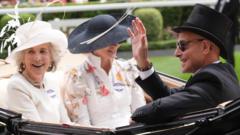
The annual spectacle of Royal Ascot has long been dismissed by outsiders as a mere playground for the elite, a sea of silk top hats, and an excuse for high fashion. When King Charles III attended the races alongside American actor Stanley Tucci, casual observers saw little more than a standard celebrity photo opportunity framing a traditional royal outing. This superficial reading misses the entire point of the modern monarchy's public relations strategy. The presence of Hollywood royalty alongside actual royalty at Berkshire's famous racecourse is not an accidental collision of different worlds, but a deliberate deployment of contemporary cultural capital designed to keep an ancient institution relevant.
For centuries, Royal Ascot functioned primarily as an exclusive playground for the British aristocracy, a closed-loop social ritual where the upper echelons of society validated their own status. Under the current reign, however, the event has been quietly repurposed into a high-stakes platform for international soft power and diplomatic charm. The monarchy faces an ongoing battle to maintain global prestige amid shifting cultural values and economic scrutiny. By intertwining the strict, historic protocols of the Royal Enclosure with the global, democratic appeal of modern cinema icons, the institution achieves a specific equilibrium. It projects stability through tradition while signaling a calculated openness to the broader world.
The Micro Diplomacy of the Royal Enclosure
The Royal Enclosure operates under a dress code so rigid it borders on the litigious. Morning dress for men and specific dress lengths and strap widths for women are enforced with bureaucratic precision. Yet, within these uncompromising stylistic boundaries, the guest list tells a story of deliberate modernization.
When figures like Stanley Tucci—an American actor celebrated not just for his filmography but for his curation of culinary culture and effortless style—enter this space, the dynamic shifts. It is no longer just about British heritage. It becomes a cross-cultural validation. The King’s choice of companions in the Royal Procession or within the exclusive mounting yard serves as a subtle endorsement, mapping royal approval onto global cultural figures who command immense respect among younger, more skeptical demographics.
This is micro-diplomacy in plain sight. The monarchy utilizes the immense media apparatus surrounding Royal Ascot to broadcast a message of curated continuity. They are fully aware that a photograph of the King sharing a laugh with an international actor will travel further, faster, and with greater cultural resonance than any standard state communique. It reframes the monarch not as an isolated historical relic, but as a central node in a vibrant, international cultural network.
The Economic Engine Behind the Pageantry
Behind the Champagne tents and the custom millinery lies a massive economic engine that relies entirely on maintaining this delicate illusion of effortless glamour. Royal Ascot is the crown jewel of the British flat-racing season, an industry that contributes billions to the national economy. The event acts as a primary shop window for international bloodstock investment, attracting wealthy owners and breeders from the Middle East, the United States, and Asia.
- Global Investment: The presence of the British monarch ensures the participation of international elites who view horse racing as the ultimate sport of kings.
- Tourism and Hospitality: The hospitality sector relies heavily on the influx of high-net-worth individuals during the five-day event, generating immense revenue for luxury hotels, transport services, and high-end tailoring.
- The Fashion Multiplier: The strict dress code fuels a massive, year-round economy for independent British milliners, bespoke tailors, and luxury fashion houses, turning tradition into tangible manufacturing and retail jobs.
To keep this economic engine firing, the event must remain aspirational. It cannot degenerate into a stuffy historical reenactment. The inclusion of contemporary cultural icons ensures that the event retains its status as a premier global lifestyle summit rather than a dusty relic of the Edwardian era. The fashion on display is not merely decorative; it is a highly monetized exhibition of luxury craftsmanship that relies on royal patronage to maintain its premium valuation.
The Shift from Aristocratic Isolation to Global Curation
Historically, the guest list for the Royal Enclosure was vetted through a network of peerage and personal recommendations, effectively barring anyone outside a tight-knit social circle. Today, the curation is commercial and strategic. The organizing committee actively courts individuals who embody a specific brand of modern excellence and sophistication.
This shift is a survival mechanism. An institution that relies solely on hereditary deference will eventually starve in a democratic cultural landscape. By aligning itself with self-made excellence—whether in the arts, philanthropy, or business—the monarchy borrows a secular legitimacy that its own bloodlines can no longer automatically guarantee.
The Counter Argument to the Glamour Narrative
There is a growing counter-argument that this reliance on celebrity alignment is a double-edged sword. Critics argue that by inviting the glare of Hollywood into the sacred spaces of royal tradition, the monarchy risks cheapening its brand, drifting perilously close to standard influencer culture. If the King becomes just another celebrity standing next to an actor, the unique mystique that separates the Crown from ordinary fame begins to erode.
Furthermore, during times of domestic economic hardship, the display of immense wealth and unbridled luxury at Ascot can alienate a public struggling with the cost of living. The imagery of silver waistcoats and bespoke top hats can easily be weaponized by republican movements as evidence of a profound disconnect between the palace and the populace. The institution is walking a tightrope, trying to display the grandeur necessary for state prestige without appearing vulgarly ostentatious to a strained public.
Balancing the Mystique with Accessibility
The late Queen Elizabeth II managed this balance through her genuine, lifelong obsession with the sport of horse racing. Her expertise was undeniable; she was a knowledgeable breeder who understood the bloodlines and the mechanics of the turf. Her presence at Ascot was viewed as an authentic pursuit of a personal passion.
King Charles III faces a different challenge. His interests have historically leaned toward architectural preservation, organic farming, and global sustainability. Therefore, his attendance at Ascot must be managed with a higher degree of theatrical intent. He must show continuity in supporting the late Queen's favorite event while adapting the guest list to reflect his own vision of a more global, modernized Britain. The inclusion of diverse cultural figures is a clear signal that his court will not be defined by the rigid insularity of the past.
The True Anatomy of Contemporary Royal Style
The fashion choices at Royal Ascot are frequently dissected by tabloid media as mere expressions of personal taste, but every garment worn by a senior royal or a high-profile guest is a calculated statement. The choice of designer, the sourcing of materials, and even the re-wearing of older garments are scrutinized for political and social messaging.
+-------------------+--------------------------+------------------------------------+
| Participant       | Wardrobe Strategy        | Intended Subtext                   |
+-------------------+--------------------------+------------------------------------+
| Senior Royalty    | Heritage British Tailors | Economic Patriotism & Continuity   |
+-------------------+--------------------------+------------------------------------+
| International     | High-Fashion Innovation  | Modernity & Global Relevance       |
| Cultural Guests   | Within Strict Protocols  |                                    |
+-------------------+--------------------------+------------------------------------+
| Traditional Gentry| Vintage, Inherited       | Authentic Generational Status      |
|                   | Morning Dress            |                                    |
+-------------------+--------------------------+------------------------------------+
This deliberate sartorial architecture ensures that the event remains a visual feast for global media while subtly reinforcing the structural hierarchy of British society. The newcomers bring the buzz, the traditionalists bring the history, and the royals sit at the apex, unifying both factions into a singular, highly marketable cultural product.
The Unspoken Mandate of the Modern Monarch
The real story of Royal Ascot is not that a King went to the races with an actor. The real story is that the British monarchy understands exactly what it must do to survive in an era that is deeply cynical of inherited privilege. It must transform itself from an exclusive club into a premier global curator of culture, taste, and soft power.
The alliance between the crown and the camera is not a novelty; it is a structural necessity for a modern state. By maintaining the rigorous traditions of the past while opening the gates to the defining cultural figures of the present, the monarchy ensures that Royal Ascot remains relevant to an international audience. The event serves as a vivid reminder that while empires fade and political landscapes shift, the art of the spectacle remains an incredibly potent tool of statecraft. The survival of the institution depends entirely on its ability to keep making this ancient machinery look like the hottest ticket in town.