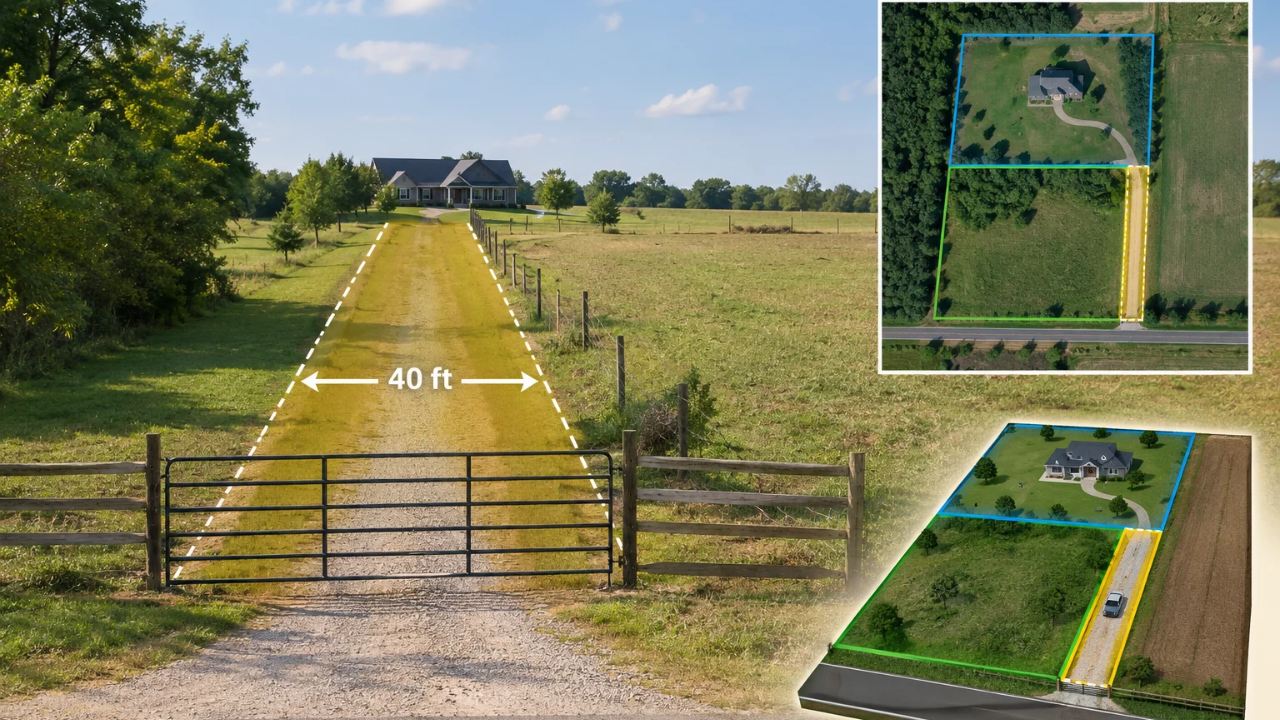
Buying landlocked property without direct road access feels like a nightmare the moment you look at a map and realize there is no public way in. Yet winning a court-approved route across a neighbor's land does not hand you ownership of the dirt underneath it. That was the core lesson when a Missouri Court of Appeals panel reversed a judgment that had effectively transferred fee simple ownership of a 40-foot-wide road strip across a neighbor's property in Bowen v. Roeder.
Under Missouri law, homeowners with no legally enforceable access to a public road can petition for a private road of strict necessity. In Bowen v. Roeder, the trial court approved a 40-foot-wide route running roughly 428.24 feet across part of the landowner's existing road—about 0.39 acres or 17,130 square feet—before the appellate court stepped in on the ownership question. The appeals court made a sharp distinction that trips up plenty of buyers and even lower courts: a statutory private road creates a permanent easement appurtenant to the landlocked parcel, not full ownership of the underlying strip. If you liked this post, you might want to read: this related article.
Why Missouri Courts Draw a Hard Line on Road Ownership
People routinely confuse having the right to cross land with owning the land itself. Honestly, it's easy to see why. If you pay money, go through court commissioners, and build or maintain a 40-foot-wide lane so you can reach your house or timberland, it feels like "your road." For another look on this event, refer to the latest update from NBC News.
Legally, it isn't. Under Revised Statutes of Missouri section 228.358, a private road established by necessity is a permanent easement, not a transfer of fee simple title. Missouri courts have long treated an easement as a non-possessory right to use someone else's property for a specific purpose—here, getting to and from your land—rather than taking title to the soil itself.
A private road statute is a form of private eminent domain allowed by the Missouri Constitution, not a backdoor way to strip a neighbor of title to their ground.
There is a constitutional reason for this restraint. Article I, Section 28 of the Missouri Constitution bars taking private property for private use except for private ways of necessity. Because forcing a neighbor to give up land for a private benefit is an extraordinary power, Missouri courts strictly construe the private road statutes. Granting an easement gives the landlocked owner practical access without transferring broader ownership rights like selling the underlying land, claiming mineral or timber rights beyond the scope of use, or treating the strip as an independent parcel.
Strict Necessity Versus Other Ways People Claim Access
Landlocked property disputes rarely happen in a vacuum. When buyers discover their parcel lacks frontage on a public road, they usually run into three distinct legal concepts—and mixing them up is one of the fastest ways to lose time and money in court.
Statutory Private Roads of Strict Necessity
To win a statutory private road under sections 228.342 through 228.358, a landowner generally has to show three things: they own the land, no public road runs through or alongside it, and the requested road is mandated by strict necessity. "Strict necessity" does not mean "more convenient" or "cheaper than fixing a rough spot." Courts look at whether the owner has a legally enforceable right to use a reasonably practical route to and from the property.
Even when strict necessity is proven, location is not a blank check. Under section 228.345, the road must be situated so it causes as little damage and inconvenience to the landowner as is practicable. If there is a practical route that hurts the neighbor less—or if an existing path or farm road can be used sensibly—courts weigh those burdens carefully.
Common Law Easements by Necessity and Prescription
Missouri also recognizes common law easements by necessity, which turn on the history of how parcels were split and whether access was implied or necessary at severance. That is different from a prescriptive easement, which looks backward at long-term use rather than immediate necessity.
To establish a private prescriptive easement in Missouri, a claimant generally must prove use that is continuous, uninterrupted, visible, adverse, and maintained for at least ten years. A July 2026 Missouri Court of Appeals decision, Klingert v. Lee, clarified an important wrinkle: simply believing a route was public does not automatically wipe out a private prescriptive easement claim if the claimant's actual use—such as specialized commercial truck access to a loading dock—differs from ordinary public use and meets the legal elements. Still, even a winning prescriptive claim gives a right of use, not fee simple ownership.
Why Adverse Possession Is a Different Beast
Sometimes people hear "ten years" and assume they can claim outright ownership of a neighbor's strip or old roadbed through adverse possession. Adverse possession in Missouri requires actual, hostile, open and notorious, exclusive, and continuous possession for ten years. Driving across a strip to reach your own land is classic access behavior, not exclusive ownership possession of the entire strip—and if a road is still an active public road, adverse possession does not run against public rights while it remains public.
What Buyers and Neighbors Miss in Road Disputes
From years of watching rural and semi-rural boundary fights play out, the biggest mistakes happen long before a judge ever signs an order.
First, buyers fall in love with acreage, timber, or privacy and treat "access to be worked out later" like a minor detail. A handshake promise from a seller or a casual "sure, you can use the lane" from a neighbor is not a recorded easement. If a neighbor changes their mind—or sells their land to someone else—informal permission can evaporate overnight.
Second, people underestimate damages and procedure in private road cases. Under Missouri's statutory process, commissioners assess damages to the burdened landowner. A landowner who believes a road harms their remaining property or lowers its market value has specific statutory windows—including filing exceptions within ten days after notification of the commissioners' report—to challenge the report or take the damages question to a jury. Missing deadlines or misreading how interlocutory and final judgments work can turn a straightforward dispute into years of appellate litigation.
Third, "self-help" escalates bad situations fast. Putting up a sudden fence, blocking a gate, or bulldozing a wider path without clear legal authority inflames neighbors and creates messy factual records. Courts do not love parties who treat disputed land like a wild west skirmish before asking for a legal ruling.
Practical Steps Before You Buy or Fight Over an Access Road
If you are eyeing landlocked property in Missouri or dealing with a disputed road across your land, a few concrete steps protect you right away:
- Pull the full title history and recorded easements before closing. Don't rely on a verbal assurance that "everyone uses that drive." Check whether an express easement is actually recorded and runs with the land.
- Hire a licensed land surveyor early. Know exact property lines, road widths, and whether a disputed track sits partly on your parcel, a neighbor's parcel, or an old public right-of-way.
- Document historical use if a route already exists. Gather dated photos, aerial imagery, surveys, maintenance records, and witness statements showing when and how the route has been used.
- Talk to a real estate litigator before building or blocking. Whether you need a private road of strict necessity or want to protect your land from an overbroad claim, getting legal advice early keeps you from blowing statutory deadlines or claiming the wrong legal remedy.
- Put negotiated access agreements in writing and record them. If you and a neighbor can work out a shared lane, a clear written easement spelling out width, maintenance, and gates beats a court battle every single time.