Escalation in the Occupied Territories
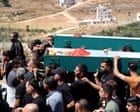
Two Palestinian men lie dead in the West Bank dirt after a armed confrontation involving Israeli settlers and military forces. For residents of rural villages like Jit, Al-Mughayyir, and Turmus Ayya, these incidents are no longer viewed as isolated criminal acts by rogue extremists. They represent an operational reality where private settler militias and the Israel Defense Forces (IDF) function with blurred boundaries. Palestinian eyewitnesses, local mayors, and human rights monitoring groups consistently describe a pattern where armed civilian settlers initiate attacks on Palestinian farmland and homes while soldiers provide tactical cover, active gunfire, or deliberate inaction.
Understanding this dynamic requires looking beyond immediate casualties. The core mechanism driving West Bank instability is the structural integration of local security squads, political patronage within the Israeli government, and the systematic erosion of military enforcement against Israeli citizens living in illegal outposts.
From Marginal Extremists to State-Armed Auxiliaries
The perception that West Bank settlers operating against Palestinian communities are marginal, anti-state actors no longer aligns with facts on the ground. Over the past decade, and accelerating sharply under recent coalition governments, the legal and operational lines between state security apparatuses and civilian settler organizations have virtually dissolved.
The Mechanism of Joint Operations
When violence breaks out in Area C—the 60 percent of the West Bank under full Israeli military and administrative control—the deployment sequence often follows a predictable playbook.
- The Initial Incursion: Settlers enter private Palestinian olive groves, pastures, or village outskirts, frequently constructing makeshift outposts or establishing grazing routes designed to squeeze out native farmers.
- The Escalation: When local Palestinians assemble to defend their property or push back against incursions, altercations intensify quickly.
- Military Intervention: IDF units arrive at the scene. Under current operational rules of engagement and civil-military jurisdictional laws, soldiers routinely direct crowd-control weapons—and live ammunition—exclusively at the Palestinian crowd.
Civilian settlers in the West Bank are governed by Israeli civil law, while their Palestinian neighbors live under military law. This dual legal framework creates a profound accountability vacuum on the battlefield.
When a Palestinian is shot during these clashes, proving whether the fatal round came from a settler's assault rifle or a soldier's service weapon becomes an administrative nightmare. Investigations conducted by the Israeli military advocate general or the Judea and Samaria District Police rarely result in indictments, let alone convictions, for civilian shooters.
The Legal Shell Game and Institutional Impunity
To grasp why these fatal encounters keep happening, one must examine the legal architecture governing violence in the occupied territory.
| Jurisdiction & Status | Israeli Settlers | Palestinian Residents |
|---|---|---|
| Legal System | Israeli Civilian Law (Extraterritorial application) | Israeli Military Law & Military Courts |
| Law Enforcement Agency | Israel Police (Judea & Samaria District) | IDF Forces / Border Police / Civil Administration |
| Detention Standards | Standard Israeli criminal procedure safeguards | Administrative detention without trial permissible |
| Conviction Rate for Violence | Below 7% for reported nationalist offenses | Exceeds 95% in military tribunals |
This institutional disparity directly influences behavior on the ground. Settlers know that soldiers lack the legal mandate—and often the political backing—to arrest them. Israeli military law explicitly restricts soldiers from detaining Israeli citizens except in extreme, immediate threats, instructing them instead to call the civilian police force. By the time police officers arrive in remote West Bank hills, crime scenes are contaminated, evidence is lost, and suspects have departed.
Civil Guard Weaponization
Following political directives to expand regional defense systems, thousands of assault rifles were distributed to civilian self-defense squads (Kitot Konnenut) across West Bank settlements and unauthorized outposts. Many of these weapons went directly to individuals who wear military uniforms as reservists one week and conduct vigilante patrols as private citizens the next.
The distinction between a soldier enforcing state order and a settler enforcing territorial expansion has vanished. The uniform is now interchangeable.
Economic Displacement as a Strategic Outcome
Focusing exclusively on human casualties obscures the primary objective of these coordinated actions: land transfer.
Violence is rarely chaotic; it is functional. By rendering daily life unbearable and dangerous for rural Palestinian communities, armed pressure achieves what formal state confiscation orders sometimes struggle to accomplish under international scrutiny.
[Settler Outpost Established]
       │
       ▼
[Systematic Harassment of Local Farmers]
       │
       ▼
[Palestinian Defense / Protests Trigger Military Intervention]
       │
       ▼
[Area Declared "Closed Military Zone" by IDF]
       │
       ▼
[Permanent Palestinian Abandonment of Grazing Land]
When two Palestinians are killed during an attack on a village, the immediate grief is compounded by long-term economic destruction. Herding communities in regions like the South Hebron Hills and the Jordan Valley have been forced to dismantle their encampments entirely, retreating into urban enclaves. The abandoned land is almost immediately absorbed by neighboring settler pastures.
The Policy Framework Driving the Reality
This state of affairs is not a failure of law enforcement; it is the execution of political strategy. Key cabinet posts governing civil administration in the West Bank are held by figures who openly champion the annexation of the territory and the dismantling of the Palestinian Authority.
When political leadership actively encourages civilian colonization and views military presence as a tool to facilitate that mandate, field commanders adapt. A young lieutenant deployed to a West Bank hotspot knows that arresting an aggressive settler will likely lead to public condemnation from government officials and political friction for his commanding officers. Restraining or shooting a Palestinian protester, conversely, is viewed as standard operational protocol for maintaining control.
Until the fundamental policy shift occurs—treating law enforcement in the occupied territories as an equal duty to protect all civilian populations regardless of ethnicity—the pattern remains locked. Armed settlers will continue to advance, the military will continue to secure their perimeter, and Palestinian casualties will continue to be recorded not as systemic failures, but as predictable outcomes of a unified strategy.