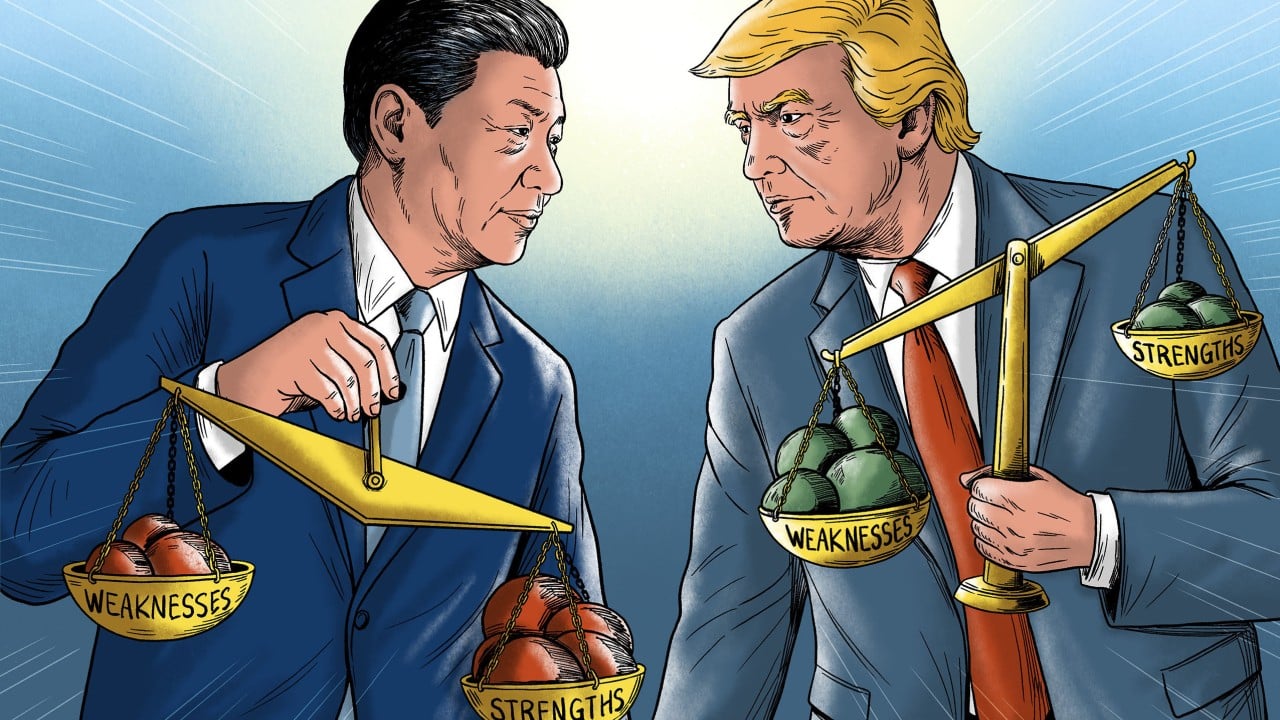
Donald Trump arrives in Beijing this week for a high-stakes summit that marks a fundamental shift in the global order. For the first time in a decade, the American president is walking into the Great Hall of the People from a position of tactical disadvantage. While the superficial narrative focuses on trade truces and Boeing purchase orders, the structural reality is much grimmer for Washington. A series of judicial defeats at home, a burgeoning energy crisis in the Middle East, and a Chinese economy that has successfully "de-risked" itself from Western pressure have stripped the United States of its most potent bargaining chips.
The core of the problem lies in the collapse of the administration's primary weapon: the universal tariff. You might also find this similar coverage interesting: The Quiet Mutiny Against Keir Starmer.
The Judicial Gutting of the Tariff Shield
Just days before the Air Force One wheels touched down on the tarmac in Beijing, the U.S. Court of International Trade dealt a massive blow to the administration’s economic strategy. The court ruled that the sweeping 10% global tariffs imposed under Section 122 of the Trade Act of 1974 were an unlawful overreach of executive power. This wasn't just a legal technicality. It was the demolition of Trump’s "catch-all" tariff wall.
By declaring these duties unauthorized, the court has effectively signaled to Xi Jinping that the American president’s ability to unilaterally punish China with broad-based taxes is legally fragile. Beijing’s negotiators are well aware that while an appeal is likely, the legal uncertainty makes the threat of "more tariffs" far less terrifying than it was in 2018. Trump is attempting to negotiate a new "Grand Deal" while his most effective tool is currently tied up in domestic litigation. As highlighted in detailed coverage by Associated Press, the effects are significant.
This domestic weakness is a gift to Xi. The Chinese leader no longer has to wonder if the U.S. can sustain a multi-front trade war; he now knows the American judiciary is prepared to act as a check on the executive branch’s economic warfare.
China’s Pivot to Internal Resilience
While Washington has been bogged down in legal battles and political infighting, Beijing has spent the last year reinforcing its domestic foundations. In 2025, China completed its 14th Five-Year Plan with a GDP that hit roughly 140 trillion yuan. More importantly, Xi has used the "Busan Truce" of late 2025—a one-year freeze on new hostilities—to accelerate "involution" reforms.
These reforms are designed to consolidate China’s lead in critical sectors like electric vehicles, batteries, and solar technology. By reducing internal subsidies and forcing weaker domestic players to merge, Xi is creating "national champions" that are more efficient and less vulnerable to foreign pressure.
- Manufacturing Dominance: China now accounts for a staggering percentage of global output in green technologies.
- Technological Sovereignty: The push for "de-risking" has moved from a Western slogan to a Chinese reality, with massive investments in domestic semiconductor and AI research.
- Alternative Trade Networks: The expansion of the BRICS+ framework has given China a safety valve, allowing it to bypass U.S.-led financial systems if necessary.
The result is a China that is significantly less reliant on the American consumer than it was during the first trade war. If Trump threatens to walk away from the table, Xi can afford to let him.
The Iranian Shadow Over the Great Hall
The most overlooked factor in this summit isn't economic at all; it’s the war in Iran. The conflict has destabilized global energy markets and, more importantly, given China a diplomatic lever that it didn't have five years ago.
Washington desperately needs Beijing’s cooperation to maintain pressure on Tehran and ensure the Strait of Hormuz remains open to global shipping. Xi knows this. Every barrel of oil that is threatened by Middle Eastern instability increases the value of Chinese "mediation." Trump, who has built his political brand on "America First" and ending "forever wars," cannot afford a massive energy price spike or a broader regional conflagration right before the midterm elections.
By positioning itself as a silent power-broker in the Middle East, China has effectively tied Trump’s hands. He cannot push too hard on trade without risking Chinese withdrawal from the delicate diplomatic dance surrounding Iran.
The Illusion of the Dealmaker
Trump's strategy remains rooted in the belief that he can extract massive purchase commitments—specifically in agriculture and aviation—to satisfy his political base. Expect to see headlines about billions of dollars in new soybean contracts and Boeing jet orders. These are the "carrots" Xi is willing to dangle to keep the status quo.
But these are transitory victories. A purchase commitment is not a structural change. It does nothing to address the fundamental issues of intellectual property theft, state-led industrial policy, or the forced transfer of technology. By accepting "purchases" in exchange for "peace," the U.S. is trading its long-term strategic advantage for short-term political optics.
[Image showing the map of the Strait of Hormuz and major global oil transit routes]
The Strategic Pause That Favors the Dragon
The upcoming year will likely be defined by an "uneasy calm." Both sides seem content to extend the Busan trade truce, but the motivations couldn't be more different. Trump wants a win he can sell to voters; Xi wants time to finish building a self-sustaining Chinese economy that is immune to Western sanctions.
For the veteran observer, the most telling sign of the power shift isn't what is said in the joint statements, but what is omitted. There is no mention of rolling back the "Dual Circulation" strategy. There is no commitment from China to stop the subsidization of its tech giants. Instead, the focus has shifted to "financial stability" and "early-warning protocols"—the language of two powers trying to avoid a crash, rather than two competitors seeking a fair playing field.
The American era of "maximum pressure" has hit its ceiling. Between the judicial system at home and the geopolitical realities abroad, the leverage has evaporated. Xi Jinping isn't just a host this week; he is the man holding all the cards.
The summit will likely end with a handshake and a flurry of press releases. But beneath the gold-leaf ceilings and the red carpets, the reality is clear. The U.S. is no longer dictating terms. It is negotiating for a manageable retreat.



