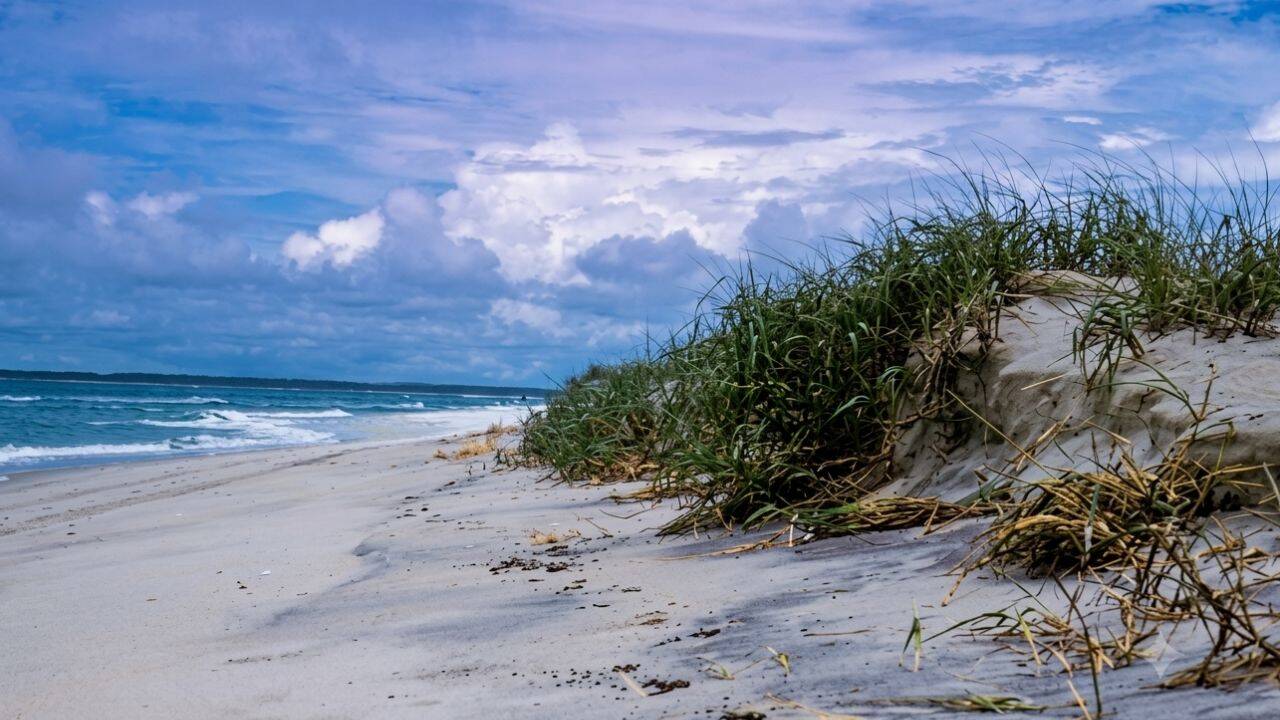
Long before federal protections drew millions of wildlife enthusiasts to its shores, Assateague Island was slated to become the next sprawling Mid-Atlantic playground. Developers envisioned a glittering oceanfront metropolis named Ocean Beach, complete with thousands of residential lots, paved boulevards, and bustling commercial strips. That grand ambition vanished. Two severe weather events—the Chesapeake-Potomac hurricane of 1933 and the devastating Ash Wednesday storm of 1962—shattered the concrete dreams of speculators and redirected the fate of a fragile barrier island into a pristine national seashore.
Real estate speculation along dynamic coastal strips relies on a dangerous suspension of disbelief. Promoters treat shifting sands as permanent bedrock. History repeatedly proves otherwise. For a different view, consider: this related article.
The Blueprint of an Illusion
During the late 1950s, land developers set their sights on the northern end of Maryland's segment of Assateague Island. Capitalizing on post-war economic expansion and an insatiable public appetite for coastal real estate, the Ocean Beach development corporation carved the landscape into thousands of individual parcels. Buyers purchased plots measuring roughly one-half acre, enticed by glossy marketing brochures promising an exclusive beachside haven.
Construction crews pushed forward with grading roads, erecting utility poles, and building initial model homes. Speculators ignored the obvious geographic reality. Barrier islands are not static landmasses; they are nature's shock absorbers, constantly migrating in response to ocean currents, wind, and rising tides. Building permanent multi-million dollar infrastructure on mobile sediment is an exercise in defiance against planetary physics. Further analysis on this trend has been provided by AFAR.
The 1933 Catalyst
The geological unraveling of the planned resort began decades before the first foundation was poured, though developers conveniently overlooked the warning signs. In August 1933, a ferocious hurricane tore through the region, slicing completely through the slender barrier spit just south of Ocean City.
This violent breach created the Ocean City Inlet, permanently separating Assateague from Fenwick Island. While local authorities eventually fortified the new inlet to protect maritime commerce, the storm demonstrated how easily ocean forces could redraw local geography. Instead of treating the disaster as an ecological veto against dense construction, planners treated it as an engineering obstacle to be conquered with bulkheads and bridge designs.
The Ash Wednesday Reckoning
Mother Nature delivered the final verdict in March 1962. The infamous Ash Wednesday storm parked itself off the mid-Atlantic coast for five punishing days. It was not a brief squall, but an unrelenting atmospheric blender combining astronomical high tides with hurricane-force wind gusts.
The ocean washed entirely over the narrow stretches of Assateague Island. Newly paved roads buckled and vanished beneath feet of churning saltwater. The few houses and utility lines that developers had managed to construct were splintered into matchsticks or swallowed by the surf.
The physical destruction broke the financial and psychological momentum of the project. Investors realized that pouring more capital into an environment hostile to permanent habitation was financial suicide. The illusion of a tamed coastline evaporated overnight.
From Concrete Ambitions to Protected Wilds
Faced with mounting reconstruction costs and insurmountable insurance liabilities, public policy shifted dramatically. Federal and state leaders stepped in to halt the cycle of rebuilding. Through legislative action and strategic land acquisitions, the planned community was dismantled on paper before it could rise again in steel and drywall.
In September 1965, President Lyndon B. Johnson officially established the Assateague Island National Seashore. The private lots were bought out or condemned, transforming a would-be concrete jungle into tens of thousands of acres of protected marine and estuarine habitat.
Today, the only permanent residents of this wild stretch are the iconic roaming bands of feral horses, ghost crabs, and migratory shorebirds. The skeletal remnants of asphalt roads still occasionally emerge beneath shifting dunes, serving as silent monuments to human hubris. The twin meteorological hammer blows of 1933 and 1962 did not merely ruin a real estate venture; they preserved one of the last functioning barrier island ecosystems on the eastern seaboard.