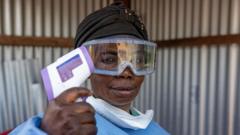
Public health officials are running a predictable, dangerous playbook in Kinshasa. Following reports of Ebola virus disease spillover, the immediate bureaucratic reflex has been deployed: a total ban on mass gatherings in the capital.
It feels decisive. It looks robust on an international news feed. It is also entirely wrong.
Banning public gatherings in a hyper-dense metropolitan area of over fifteen million people does not stop a hemorrhagic fever. It hides it. By driving human interaction underground, cutting off informal economic lifelines, and shattering public trust, these blunt instruments predictably accelerate the exact transmission chains they are meant to break. We need to stop treating complex epidemiological crises like simple crowd-control problems.
The Kinshasa Reality Check
To understand why a mass gathering ban fails, you have to look at how Kinshasa actually functions. This isn't a Western capital where people can smoothly transition to remote work and grocery delivery services. More than seventy percent of the city's economy relies on informal trade. People eat because they went to a market that day to sell goods.
When you outlaw gatherings, you do not stop people from meeting. You simply force those meetings into unmonitored, semi-private spaces. Instead of a well-ventilated outdoor market where health monitors can conduct temperature checks and distribute handwashing stations, commerce moves behind closed doors. Tracing contacts becomes a statistical impossibility.
Epidemiology has proven time and again that visibility is survival. During the 2018–2020 Nord-Kivu outbreak, researchers from the London School of Hygiene and Tropical Medicine observed that top-down restrictions enforced by security forces routinely backfired. When communities feel targeted by aggressive state mandates, compliance drops to zero. Symptoms are hidden. The sick are cared for in secret. Dead bodies—highly infectious in Ebola cases—are buried clandestinely to avoid state interference. A ban does not freeze a city; it blindfolds the medical response.
Dismantling the Myth of the Super-Spreader Market
The core argument for closing public spaces relies on a flawed premise: that Ebola spreads like influenza or Covid-19. It does not. Ebola is not an airborne pathogen that vanishes into a crowd on a breeze. Transmission requires direct contact with the bodily fluids—blood, saliva, vomit, feces—of a symptomatic individual.
A person in the early stages of Ebola, walking through a crowded market, is rarely a super-spreader. Why? Because they are not yet shedding massive viral loads, and they are usually still capable of walking. The real danger zones are not political rallies or soccer stadiums; they are homes, local clinics, and traditional healing centers where severely ill patients are actively vomiting or bleeding.
By focusing resources on policing public squares, the state misallocates limited operational capacity. Instead of tracking specific contact networks of known infected individuals, police are deployed to disperse peaceful crowds. It is an expensive, performative distraction from the tedious, unglamorous work of meticulous contact tracing and ring vaccination.
The Cost of Breaking Public Trust
I have analyzed health interventions across sub-Saharan Africa for over a decade. The biggest casualty of any poorly conceived health mandate is never economic—it is psychological.
When a government institutes a sweeping ban without providing economic safety nets, the population views the medical response not as a savior, but as an oppressor. The World Health Organization has explicitly noted in its emergency frameworks that community engagement is the single most critical factor in controlling filovirus outbreaks. You cannot engage a community while simultaneously threatening them with arrest for trying to buy food.
Consider the data from the West African Ebola epidemic of 2014–2016. In regions where coercive quarantine measures and forced restrictions were heavily utilized, local populations actively resisted healthcare workers. Treatment centers were attacked because they were perceived as government detention camps. Conversely, when local leaders were given the autonomy to design localized risk-mitigation strategies, transmission numbers plummeted within weeks.
The Playbook for Real Containment
If blanket bans are a net negative, what actually works in a dense urban environment? The solution requires shifting from coercion to precise execution.
- Decentralized Testing and Triage: Do not force people to travel across a gridlocked city to a centralized isolation zone. Set up rapid-diagnostic posts at existing community health hubs.
- Targeted Ring Vaccination: Utilize the rVSV-ZEBOV vaccine aggressively around the social and geographic networks of confirmed cases. This creates a human shield of immunity around the virus, rendering mass lockdowns irrelevant.
- Voluntary, Compensated Isolation: If an individual needs to be isolated, their family must be provided with food, clean water, and financial support. Compliance should be an economic rational choice, not a legal threat.
- Localized Market Structuring: Instead of closing markets, re-engineer them. Create one-way foot traffic lanes, mandate hand hygiene stations at every entrance, and train market vendors to act as frontline health lookouts.
Stop Managing Perceptions
The ban in Kinshasa is not about public health; it is about political risk management. It is designed to signal to foreign donors and international bodies that the situation is under control.
But viruses do not care about political signaling. When you lock down a city of fifteen million without a data-driven epidemiological reason, you create a pressure cooker of panic, poverty, and institutional distrust. You create the perfect environment for an outbreak to transform into a protracted humanitarian disaster.
Drop the megaphones and stop sending police into the streets. Fund the contact tracers, empower local neighborhood leaders, and leave the markets open. If you want to kill the virus, you have to let the city breathe.