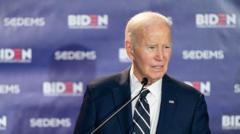
Political commentary has devolved into high-society theater criticism. When Joe Biden steps onto a stage at a high-dollar fundraising event to mock Donald Trump’s financial legal woes or brand his opponent's real estate ventures as failed "vanity projects," the media quickly regurgitates the narrative. The lazy consensus is simple: biggest war chest wins, crowd sizes at private galas dictate political momentum, and public mudslinging in front of ultra-wealthy donors translates to grassroots electoral power.
This is a fundamental misunderstanding of how modern political capital actually operates. You might also find this related story useful: Inside the Persian Gulf Crisis Nobody is Talking About.
For decades, political insiders have watched campaigns pour hundreds of millions into elite, closed-door dinners, operating under the archaic assumption that buying television airtime and securing the backing of coastal elites is the definitive metric of a viable candidacy. It is a comforting illusion for party establishment figures. It allows them to mistake a room full of nodding billionaires for a mandate from the electorate.
The reality is far more clinical, and far more damaging to the status quo. High-dollar fundraising events are no longer leading indicators of political viability. They are lagging indicators of institutional inertia. As highlighted in latest articles by Associated Press, the results are widespread.
The Mirage of the Mega-Donor Gala
Let's dismantle the premise of the high-dollar fundraiser. When a candidate stands before a crowd of people who paid $25,000 a plate, the speeches are not designed to persuade. They are designed to validate. The rhetoric becomes a closed loop of confirmation bias.
When Biden attacks Trump’s financial track record at these events, it serves as cheap entertainment for attendees who already agree with him. It does nothing to shift the needle where elections are actually decided: among the disaffected independent voters in Rust Belt precincts who could not care less about Manhattan real estate valuations or the legal definitions of campaign finance violations.
The traditional campaign playbook dictates that securing early, massive commitments from traditional PACs and wealthy individuals builds an insurmountable firewall. I have watched campaigns burn through tens of millions of dollars relying on this exact philosophy, only to watch their numbers collapse the moment a candidate faces real, decentralized opposition.
Consider the basic mechanics of political spending. A massive influx of institutional cash from a single evening does two things to a campaign staff: it breeds compliance and it slows down decision-making. When a campaign is flush with elite capital, it defaults to legacy spending structures. They buy traditional ad blocks that modern audiences skip, hire bloated consulting firms that reuse strategies from 2012, and build top-heavy organizations that cannot pivot when a cultural shift occurs overnight.
Small-Dollar Velocity Over Institutional Mass
To understand why the old model is failing, we must look at the structural difference between institutional mass and decentralized velocity.
A $5 million haul from a single star-studded night in Los Angeles or New York looks impressive on a Federal Election Commission filing. It creates a temporary news cycle. But that money is static. It represents a one-time transaction from individuals who have already hit their legal contribution limits.
Conversely, look at the mechanics of micro-donations. When a campaign triggers a surge of $15 and $20 contributions from hundreds of thousands of individual citizens via digital platforms, they are not just raising money. They are registering intensity.
- Commitment: A donor who gives $20 is highly likely to show up at a polling place. A donor who writes a maximum-allowable check to attend a dinner is often simply buying access or social capital within their peer group.
- Data Harvest: Digital micro-donations provide massive streams of clean, first-party data. This allows campaigns to track voter sentiment, test messaging instantly, and build a highly responsive volunteer apparatus.
- Replicability: A micro-donor can be asked to give five, ten, or fifteen times across an election cycle as milestones hit. A maximum-tier donor is tapped out on day one.
The reliance on elite fundraisers creates an inherent blind spot. Candidates spend their valuable time catering to the anxieties and policy preferences of the top 0.1% of the economic spectrum, completely losing touch with the economic realities of the average voter. When you spend your evenings in rooms where the minimum entry fee is a year's salary for a working-class family, your worldview warps. You start believing that your opponent’s "vanity projects" are the primary concern of voters who are actually wondering how they will afford groceries next week.
The Counter-Intuitive Truth of Adversity Fundraising
There is a glaring asymmetry in modern political finance that the establishment completely ignores: negative press and institutional attacks are often the most efficient fundraising mechanisms ever created.
Every time the legacy media or an opposing candidate launches a coordinated attack on a polarizing figure, it does not suppress their financial viability; it supercharges it. When Trump faces legal setbacks or public condemnation from the incumbent administration, his campaign does not panic about losing institutional donors. They use the moment to trigger massive, automated digital fundraising campaigns aimed directly at their populist base.
This creates a paradox that traditional political strategists are entirely unequipped to handle. The very actions intended to diminish a candidate's standing often provide the exact financial liquidity needed to sustain their operation. It turns political liability into operational fuel.
Imagine a scenario where a corporate brand faces a massive public boycott. Under traditional public relations rules, the brand retreats, apologizes, and attempts to appease the critics. In modern populist politics, however, the playbook is reversed. You lean into the conflict. You treat the boycott as proof that the "elites" are trying to silence you. For a specific subset of the electorate, that conflict is the ultimate validation. They do not open their wallets because they expect a polished policy platform; they open their wallets because they want to fund a counter-offensive.
The Fatal Flaw in the "Loser" Narrative
Calling an opponent a "loser" based on legacy financial metrics or conventional corporate structures is a dangerous tactical error. It assumes that the rules of engagement remain unchanged.
The traditional corporate world values stability, predictability, linear growth, and institutional approval. A successful business venture under this framework is one that satisfies shareholders, maintains clean balance sheets, and operates within established regulatory boundaries.
But populist political movements do not operate on corporate logic. They operate on grievances, disruption, and anti-institutional sentiment. To a populist voter, the fact that an opponent is viewed as an outsider, a disrupter, or even a financial pariah by the established order is not a disqualifier; it is a badge of honor. It proves they are not part of the system that those voters distrust.
When an establishment candidate uses a high-dollar fundraiser to mock an opponent's financial struggles or unconventional assets, they are inadvertently reinforcing the exact narrative that their opponent thrives on. They are framing the contest as the wealthy, polished insiders versus the chaotic outsider. In an era defined by deep-seated institutional distrust, that is a losing framework.
Redefining Political Capital
If traditional fundraising dinners are a failing metric, how should we evaluate a campaign's actual strength? We have to look at the metrics that cannot be bought by a room full of hedge fund managers.
First, look at organic content distribution. Tracking how messages move through decentralized networks, alternative media ecosystems, and peer-to-peer messaging applications provides a far more accurate picture of voter engagement than television ad buys. A campaign that relies on a network of passionate supporters creating and distributing their own material will always outpace a campaign that has to pay a media agency millions of dollars to blast a polished, focus-grouped advertisement into an empty living room.
Second, measure the speed of financial mobilization. The critical question is not "How much money did you raise this quarter?" The critical question is "How quickly can you raise $5 million in response to a sudden breaking news event?" High-velocity digital operations can mobilize millions within hours of a debate performance or a judicial ruling. Institutional campaigns require weeks of planning, venue booking, and host committee outreach to achieve the same result.
There is an obvious downside to this shift. The death of the traditional fundraising model means that political discourse becomes more polarized, louder, and less predictable. When campaigns realize that conflict generates more revenue than consensus, they stop seeking common ground. They optimize for outrage because outrage pays the bills. But pretending that the old world of dignified donor dinners still holds the keys to power is not just naive; it is political malpractice.
Stop looking at the total dollar figures announced after closed-door galas. Stop assuming that a candidate who can command the room at a high-end restaurant has an advantage over an opponent who can command the algorithms of the digital ecosystem. The old gatekeepers do not control the gates anymore. They are just standing in an expensive room, talking to each other, wondering why the walls are crumbling around them.