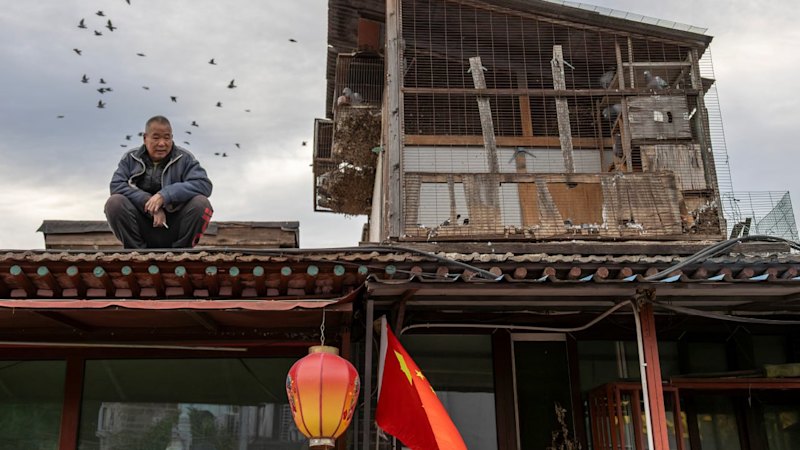
When thousands of homing pigeons are released into the sky over Tiananmen Square during major celebrations, they don't scatter into the vast expanse of China. Instead, they loop overhead, painting spirals in the air above the Chairman Mao Memorial Hall before making a beeline back to their home coops. It looks like choreography, but it is pure biology mixed with centuries of urban tradition.
If you have ever wondered how thousands of birds manage to coordinate a mass flight over one of the world's busiest public spaces and return within minutes, the answer lies deep inside the specialized culture of Beijing's historic pigeon keepers.
The Ancient Tradition of Beijing Pigeon Keeping
Pigeon breeding isn't just a casual hobby in the Chinese capital; it is a generational craft deeply woven into the city's old hutongs. For centuries, residents across Beijing have built wooden coops on top of their courtyard homes. Long before drones filled the modern airspace or city restrictions tightened, the sound of whistling pigeons echoed across the capital.
Breeders attach small, lightweight bamboo or gourd whistles to the tail feathers of their birds. As the flock catches the wind, the air rushing through the whistles creates a haunting, musical hum that drifts across the neighborhoods. Locals call this sound the symphony of the sky.
When these birds are transported to Tiananmen Square for national events, they carry this intense conditioning with them. They are not random strays; they are elite avian athletes trained to recognize specific geographic markers and home frequencies.
How Homing Pigeons Navigate Back So Fast
The rapid return of the pigeons isn't magic. Homing pigeons possess a built-in navigational toolkit that scientists still marvel at.
- Magnetoreception: Birds have tiny iron-oxide crystals in their beaks and inner ears that act as a biological compass, allowing them to read Earth's magnetic field.
- Sun Compass: They use the position of the sun, adjusted by an internal circadian clock, to chart direction.
- Visual Landmarks: In a familiar urban sprawl like Beijing, veteran birds rely on distinct visual cues, massive roadways, and the sprawling layout of the city center to orient themselves instantly.
Breeders spend months conditioning their birds, starting with short distances around the courtyard and gradually increasing the radius to dozens of kilometers. By the time a pigeon is released in Tiananmen Square, its singular objective is to lock onto its loft's specific coordinates and return as fast as possible.
The Logistics Behind the Tiananmen Release
Gathering up to 10,000 pigeons from private owners across different districts requires military-level precision. Organizations like the Beijing Racing Pigeon Association coordinate with veteran handlers to collect the birds days in advance.
The birds are checked, placed into specialized transport crates, and brought to the heart of the city under strict security. When the moment arrives, thousands of handlers open the crates simultaneously. The sheer suddenness of the release startles the flock into a tight, circling formation. They loop over the square to gain altitude and get their bearings, creating the iconic visual spectacle that catches the world's attention every National Day.
Within minutes of completing their ceremonial circles, the vast majority of the flock breaks formation and streams back toward the residential alleyways, navigating over rooftops until they squeeze back into their home coops.
Raising these birds offers a quiet escape from the hyper-modern pace of the metropolis. For the older residents tending to coops in narrow alleyways, the tradition represents continuity. Long after the crowds disperse from Tiananmen Square and the grand ceremonies conclude, the real heartbeat of Beijing's skies returns to the wings of these remarkable birds.