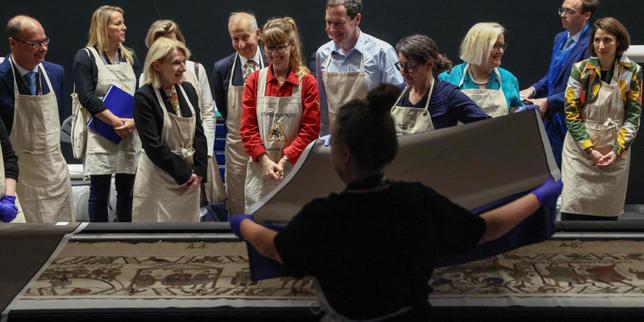
The cultural establishment is currently celebrating a victory that isn’t one. Media outlets are tripping over themselves to praise the arrival of the world’s most famous medieval embroidery at the British Museum. They frame this loan as a triumph of modern diplomacy, a bridge over troubled political waters, and a unique chance for the public to witness history.
They are wrong. You might also find this related story insightful: What Most People Get Wrong About the Crackdown on Minorities in Bangladesh.
This move is a logistical nightmare masquerading as a cultural gift. Moving an unstable, 950-year-old textile across the English Channel is an act of historical recklessness driven by political theater and museum marketing departments desperate for foot traffic. We are risking irreversible damage to a foundational piece of European heritage just so politicians can shake hands in front of a flashbulb and a London museum can boost its gift shop revenue.
The Fragility Myth and the Preservation Reality
Let's clear up a fundamental misunderstanding. This artifact is not a tough piece of carpet. It is wool yarn stitched onto a plain-weave linen backing. Over nine centuries, those fibers have degraded. Linen undergoes chemical changes when exposed to fluctuations in humidity, temperature, and mechanical stress. Every time you roll, unroll, pack, vibrate, or hang this textile, you pull at the microscopic structural bonds holding it together. As discussed in latest articles by The Guardian, the results are notable.
Museum conservators know this. The conventional wisdom says modern casing protects artifacts. But transit introduces unpredictable variables. A climate-controlled crate can suffer a power failure. A shipping vessel or transport truck experiences low-frequency vibrations that cause micro-tears in fragile ancient thread.
I have watched institutions risk irreplaceable artifacts for temporary exhibitions. The playbook is always the same. Executives downplay the physical risks to secure the prestige of a blockbuster show. In this case, the decision ignores decades of textile conservation data for a short-term public relations win.
The Broken Logic of Traveling Blockbusters
Why are we doing this? The public is told that art must travel to be accessible. This premise is fundamentally flawed.
In an era of ultra-high-resolution digital imaging, multi-spectral scanning, and virtual exhibitions, physical displacement is no longer a prerequisite for global study. Scholars do not need to look at the physical object through three inches of glass in London to understand its composition. They need access to the raw data, the fiber analysis, and the high-def imaging that can be shared instantly with any researcher on earth.
Moving the artifact to London does not democratize history. It merely shifts the economic benefit of tourism from Normandy to Bloomsbury. It addresses the wrong problem. The issue isn't that people can't see the work; the issue is that museums refuse to invest in decentralized digital infrastructure because they want physical bodies clicking through turnstiles.
The True Cost of Political Art Loans
This loan is political theater. Diplomatic history shows that when governments use ancient artifacts as bargaining chips, the objects lose, and the public gets a sanitized version of history.
Consider the downside to this contrarian view: keeping the artifact permanently in Bayeux restricts access for those who cannot travel to France. That is a valid logistical point. But local preservation is the price we pay for long-term survival. Centralizing every major artifact in a few imperial museums in London, Paris, or New York creates a monoculture. It strips the object of its contextual geography. The narrative of 1066 belongs to the landscape of Normandy and the coast of England, not the sterile, crowded galleries of a London mega-museum.
When you tear an artifact from its home context, you reduce it to a prop. It stops being a historical record and becomes a trophy.
Stop Demanding That History Move to You
People often ask if these international loans are necessary to foster global cultural education. The honest answer is no. They are necessary to sustain the inflated operating budgets of massive cultural institutions that rely on temporary blockbusters to survive.
If we want to protect our shared past, we must reject the idea that every piece of history should be mobile. We need to stop rewarding museums for treating ancient textiles like touring rock bands.
The next time you buy a ticket to a blockbuster international loan exhibition, understand what you are actually supporting. You are not supporting history. You are supporting the slow, deliberate wearing down of our past for the sake of a museum quarterly report.
Leave the artifact in France. Buy a digital scan. Protect the thread.