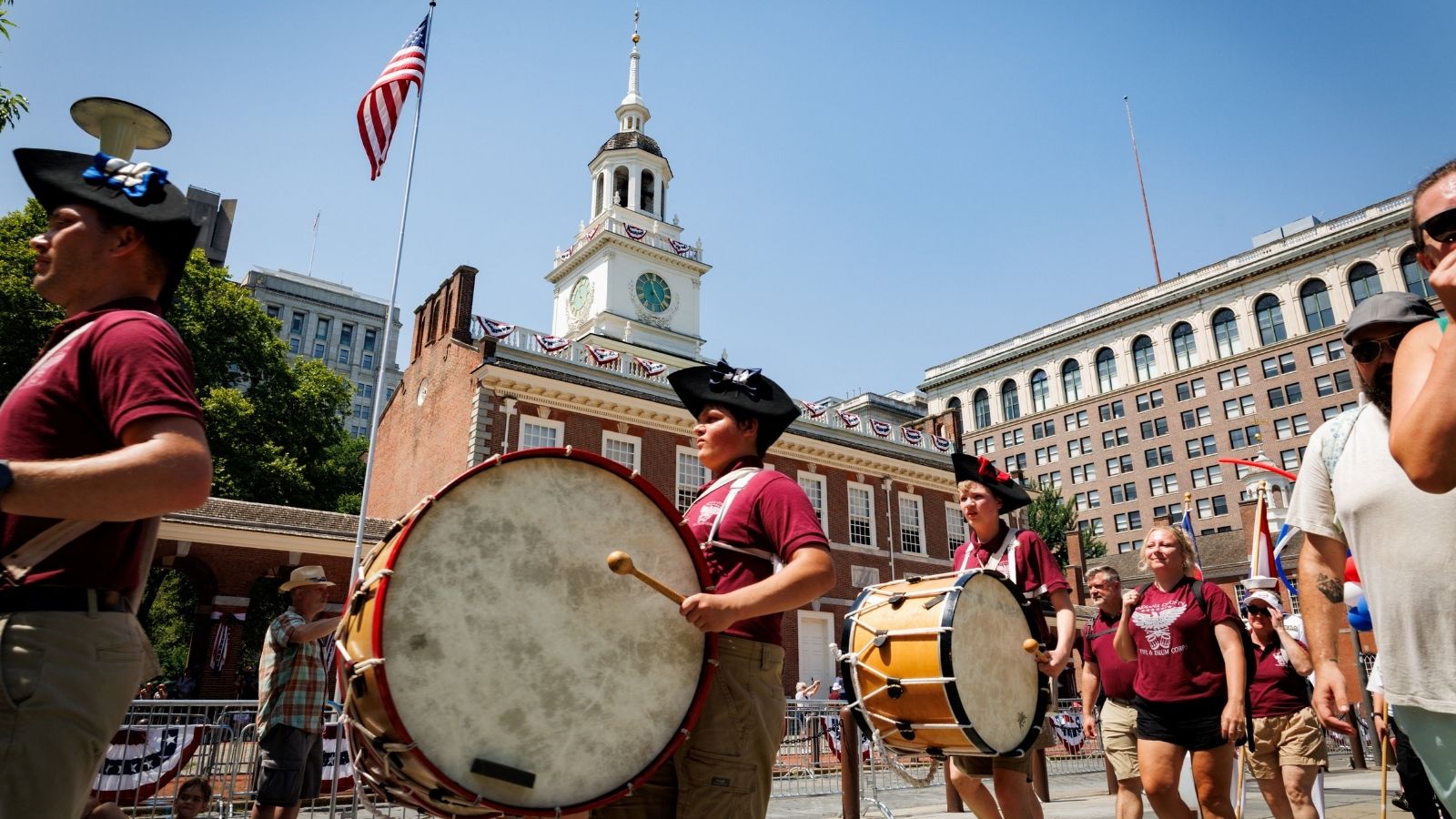
To watch the official Semiquincentennial celebrations on July 3 and July 4, viewers can stream live broadcasts directly through the America250 official website, its dedicated mobile app, and Twitch. Broadcast television coverage centers on PBS, which will air the historic "A Capitol Fourth" concert from Washington, D.C. on July 3, followed by the "America Made in Virginia" spectacular from Colonial Williamsburg on July 4 at 8:00 PM ET. Radio and audio streams are anchored by iHeartMedia. The official schedules feature an unprecedented daytime Times Square ball drop at 2:00 PM ET on July 4, alongside the White House "Freedom 250" military flyovers starting at 1:15 PM ET and a record-breaking fireworks show at 10:30 PM ET.
Behind this wall of synchronized broadcast times and star-studded lineups lies a messy, ideologically fragmented reality. The 250th anniversary of the United States was envisioned a decade ago as a unified moment of national reflection. Instead, the holiday has become a tale of two competing celebrations, run by separate entities with entirely different visions of what modern American identity looks like.
The Corporate Grid vs the Federal Spectacle
The official congressional entity, the US Semiquincentennial Commission and its non-profit arm America250, has poured years of planning into decentralized, corporate-sponsored public engagement. Their flagship events focus heavily on media partnerships and symbolic civic actions. On July 3 at 9:00 PM ET, their broadcast kicks off in Times Square, featuring a bizarre logistical feat: the New Year’s Eve ball will drop eight separate times to mark midnight in every American time zone, concluding on the morning of July 4 with American Samoa. On the West Coast, America250 is anchoring its programming with a massive benefit concert at the Los Angeles Memorial Coliseum, featuring Queen Latifah, Chris Stapleton, and the Smashing Pumpkins.
Step into Washington, D.C., however, and the tone changes completely. The White House has largely bypassed the original America250 commission framework, executing its own parallel track under the banner of "Freedom 250" and "Task Force 250".
Where America250 leans on pop music and time-zone gimmicks, the federal program leans heavily on military might and historic traditionalism. The National Mall schedule for July 4 is an aggressive display of hardware. Beginning at 1:15 PM ET, an hourly fleet review will paint the sky with historical and modern aircraft, moving from NASA F-5 jets to multi-wave flyovers from the Air Force, Navy, and Marines. The display culminates in an afterburner pass by B-1 bombers and a low flight by the newly renovated Air Force One, just before Donald J. Trump delivers an address from the Washington Monument grounds at 9:45 PM ET.
Official Broadcasting Schedule Breakdown
========================================================================
Event / Location                     Time (ET)        Platform / Network
------------------------------------------------------------------------
Times Square Multi-Zone Drops        July 3, 9:00 PM   America250 / Twitch
A Capitol Fourth (National Mall)     July 3, 8:00 PM   PBS / Local Affiliate
National Mall Military Flyovers      July 4, 1:15 PM   White House Stream
Times Square Historical Ball Drop    July 4, 2:00 PM   America250 App
Virginia 250 (Colonial Williamsburg) July 4, 8:00 PM   PBS / PBS.org
Presidential Address (Washington)    July 4, 9:45 PM   Major Networks / Web
Salute to America Fireworks Display  July 4, 10:30 PM  Freedom250.org
========================================================================
This structural division has forced local organizers across the country to pick a side or try to balance both narratives. Virginia’s official state commission, VA250, has managed to carve out a middle ground by focusing on localized historical gravity. Their July 4 special, broadcast live from Colonial Williamsburg, avoids the overt commercialism of the New York events and the intense political theater of Washington. It opts instead for deep-dive historical readings and acoustic performances spotlighting indigenous, West African, and English colonial drumming traditions.
The Logistical Strain of a July Heatwave
Planning a celebration of this magnitude introduces severe operational vulnerabilities that organizers are scrambling to manage. The National Mall is bracing for nearly a million visitors. The sheer volume of human traffic, combined with an intense summer heatwave, has forced emergency modifications to the schedule.
Initially, access to the primary viewing grounds at the Washington Monument was scheduled for early morning. Federal emergency planners at FEMA, cooperating with the National Park Service and the Secret Service, intervened to push the main gates back to 5:00 PM ET. The objective is simple: reduce prolonged exposure to the blistering mid-day sun. Meanwhile, the Great American State Fair and the FIFA Fan Zone located further down the Mall will remain open, relying on temporary cooling pavilions and heavily expanded hydration networks to prevent mass heat exhaustion.
The scale of the pyrotechnics presents its own set of dangers. The "Salute to America" fireworks display at 10:30 PM ET is being billed as the largest in global history, detonating over 850,000 shells from ten distinct launch locations, including the Lincoln Memorial Reflecting Pool and eight massive barges anchored in the Potomac River.
Local municipal fire marshals have expressed quiet apprehension about the fallout perimeters. A show of this size requires a massive safety exclusion zone, effectively shutting down river transit and choking off primary pedestrian escape routes for hours after the final shell falls. If a medical emergency occurs deep within the crowd during the 40-minute display, getting emergency vehicles through the gridlock will be a logistical nightmare.
Funding and Friction Behind the Scenes
The structural fractures of the 250th birthday are rooted in years of quiet bureaucratic infighting and funding shortfalls. When Congress first chartered the Semiquincentennial Commission in 2016, it was designed to operate on a mix of federal grants and massive corporate sponsorships. But corporate America proved hesitant to attach its brands to a national celebration during a period of intense cultural and political polarization.
Big tech and major automotive brands, which funded the 1976 Bicentennial with pride, largely stayed on the sidelines this time around. This left the official America250 organization financially hamstrung for years, forcing them to rely on late-stage media partnerships with entertainment conglomerates like iHeartMedia to maintain a national footprint.
Seeing the official commission falter, the White House stepped into the vacuum. By creating a parallel task force, the executive branch was able to redirect existing federal agency budgets directly into the celebration. The Department of Defense, NASA, the Department of Veterans Affairs, and the National Archives were instructed to absorb the costs of the massive D.C. footprint under the guise of statutory public outreach.
This move effectively nationalized the capital's celebration, turning it from a civic commemoration into a showcase of federal executive authority. The result is a highly uneven distribution of resources. While Washington dangles massive military flyovers and historic naval reviews, smaller municipal celebrations across the Midwest and South are operating on shoestring budgets, relying on local volunteer fire departments and small-town historical societies to mark the milestone.
The stark contrast between the commercialized, multi-time-zone broadcast of America250 and the heavy military focus of Freedom 250 reveals a deeper truth about the state of the nation at its 250-year mark. There is no single, agreed-upon script for American history or American progress anymore. The split-screen television reality of July 4 offers viewers a choice between a corporate entertainment product and a state-directed display of power, leaving the actual substance of the American experiment somewhere in the dark spaces between the fireworks.


