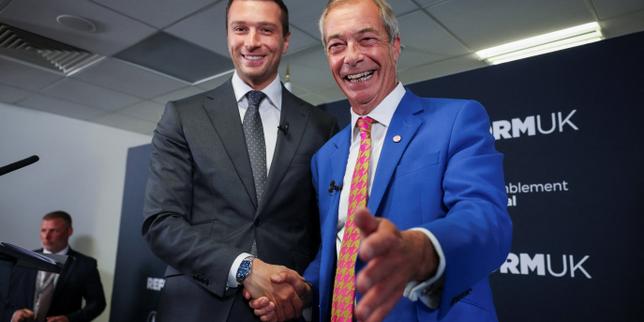
The headlines treat the Birmingham handshake between Jordan Bardella and Nigel Farage as an operational earthquake. A cross-Channel pact between France's National Rally and Britain's Reform UK promising to bounce small-boat asylum seekers back across the water. It sounds punchy. It plays well on evening news segments. It is also an absolute legal fantasy built on a profound misunderstanding of international jurisdiction, constitutional reality, and how sovereign states actually function.
Everybody is debating whether two populist opposition parties can bully Brussels and London into submission if they ever win national power. They are arguing over the wrong question entirely. The real issue is not whether the political will exists. The real issue is that the mechanism they are selling violates basic legal architectures that neither party can rewrite with a simple stroke of a pen. Recently making news lately: Why the Falkland Islands Dispute Just Got Dangerously Loud Again.
Let us look at the lazy consensus. Mainstream commentary assumes that if the National Rally takes the Élysée and Reform UK takes Downing Street, a bilateral memo of understanding signed in a Birmingham conference hall magically overrides international maritime law, the European Convention on Human Rights, and domestic administrative codes. This is absurd. Treaties require ratifications, states require operational apparatuses, and courts require legal foundations. A party-to-party protocol is worth precisely the paper it is printed on. Nothing.
The Jurisdiction Trap
Imagine a scenario where a rubber dinghy packed with forty migrants leaves the beaches near Calais, enters international waters, and gets intercepted by British border forces. Under the Bardella-Farage blueprint, these individuals would face immediate detention and a direct ticket back to French soil. More information on this are covered by NBC News.
Here is what the populist fantasy leaves out: France has zero legal obligation to accept them back simply because Nigel Farage thinks it is a good idea. Sovereign states do not take back foreign nationals arriving from international zones unless a formal, binding readmission agreement dictates it. A memorandum signed between two political parties out of government does not create international customary law.
Furthermore, under the Dublin Regulation framework and broader international asylum protections, a state cannot simply bounce human beings across a border without processing claims or establishing proper jurisdictional responsibility. If France's future administration under the National Rally attempts to slam the door on these returnees, or if French administrative courts strike down the decrees as violations of the principle of non-refoulement, the entire machinery grinds to a halt in thirty seconds.
The Economics of Smuggling Networks
The media loves to frame small-boat crossings as a failure of political attitude. If leaders just sound tougher, the boats will stop. This reveals a staggering ignorance of black-market logistics.
Smuggling syndicates operating along the northern French coastline are not ideologically motivated political movements. They are transnational criminal enterprises generating hundreds of millions of euros. They treat law enforcement crackdowns as a variable cost of doing business. When ports tighten security, smugglers shift launch sites further down the coast. When patrol boats increase, they pivot to larger, cheaper, more dangerous vessels packed with more desperate people.
A political pact between two nationalist parties does nothing to disrupt the upstream financial flows, encrypted communication networks, or supply chains of outboard motors originating in central European warehouses. Treating a sophisticated criminal market with political slogans is like trying to stop an international drug cartel by passing a municipal ordinance against public intoxication.
What Actually Happens When You Close the Channel
Let us game out the operational reality if this policy somehow made it into actual state policy.
If Britain successfully seals its maritime border and forces France to take back every single arrival, the bottleneck simply shifts inland. Northern French towns like Calais, Dunkirk, and Boulogne-sur-Mer transform into permanent, high-density containment zones. Camps swell. Local municipal resources collapse entirely under the strain of thousands of unprocessable individuals trapped between a closed British border and a hostile French state refusing to grant asylum or repatriation.
The social friction on the ground multiplies exponentially. Far from solving the crisis, the policy exports the political headache from British coastal towns directly into French municipalities, triggering domestic blowback that would tear apart any governing coalition in Paris within months.
The Competence Illusion
We see this constantly in modern politics. Opposition figures pitch frictionless solutions to structural nightmares because nuance does not fit into a thirty-second clip on social media.
When you look closely at the fine print of the Birmingham agreement, it relies entirely on future hypotheticals. If we win power, if the courts do not block us, if the civil service complies, if the destination countries accept deportations. That is not a policy. That is a wish list.
Real statecraft requires dealing with the agonizing friction of international law, bilateral tribunals, and logistical reality. If you want to cut off illegal maritime crossings, you do not sign party-to-party press releases. You dismantle the financial plumbing of the cartels, you reform the Byzantine domestic legal processes that drag out appeals for years, and you build functioning return pipelines with countries of origin that actually work.
Everything else is just noise designed for people who prefer the comfort of a clean slogan over the messy truth of how the world actually works. Stop buying the marketing. Look at the mechanics.