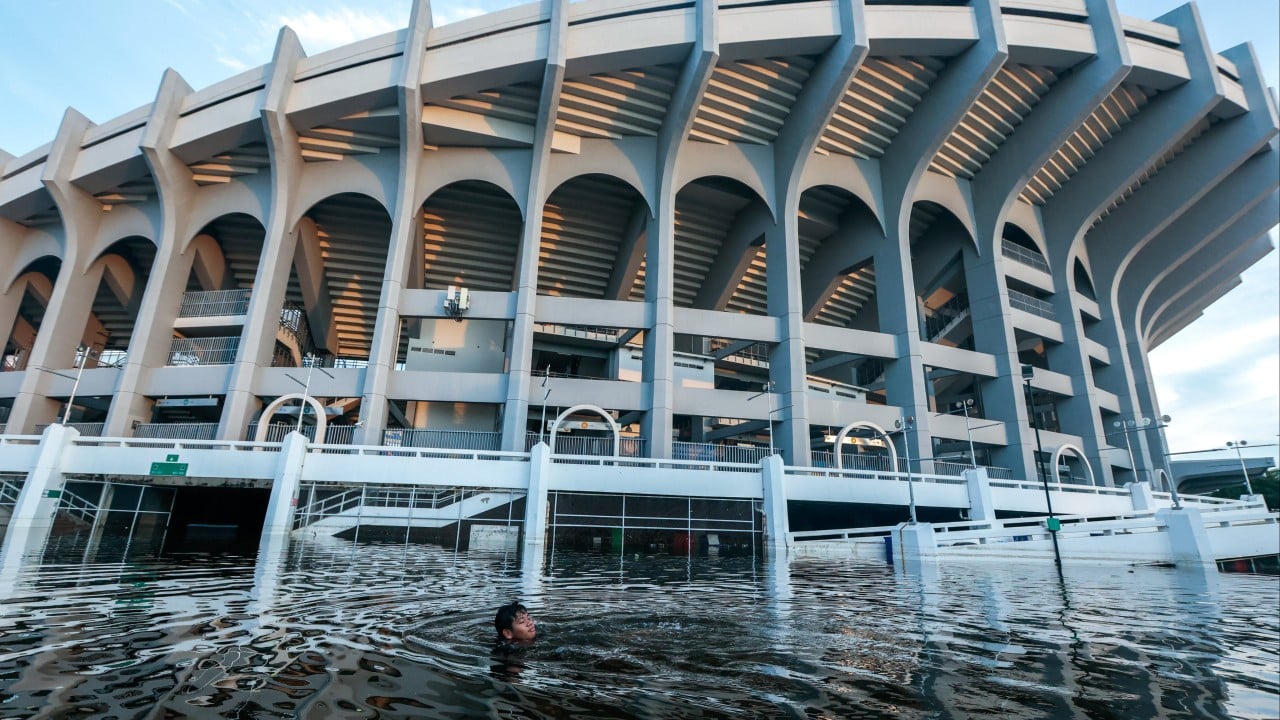
Urban macro-infrastructure under tropical monsoon stress reveals the fragility of concentrated administrative centers. When Bangkok faces concurrent hydrometeorological threats and high-level international convenings like the International Monetary Fund and World Bank summit, the resulting friction points expose systemic vulnerabilities in municipal drainage capacity, inter-agency coordination, and logistical redundancy.
The Hydrological Cost Function of Urban Basins
Bangkok operates within a low-lying delta floodplain where natural drainage vectors are constrained by flat topography, rapid urbanization, and soil subsidence. The mathematical relationship governing urban inundation during heavy precipitation events is a function of inflow volume exceeding discharge capacity:
$$I(t) - Q_{out}(t) = \Delta S$$
In this equation, $I(t)$ represents the volumetric inflow rate driven by seasonal monsoon precipitation and upstream runoff from the Chao Phraya River basin, while $Q_{out}(t)$ represents the combined municipal pumping and gravitational drainage capacity. When $\Delta S$ (surface storage accumulation) exceeds critical thresholds, urban infrastructure stalls.
The primary structural limitation lies in the velocity of water removal versus the spatial distribution of impermeable surfaces. Concrete-heavy development has reduced natural retention basins, forcing stormwater into subterranean drainage tunnels and canal networks that often suffer from siltation and mechanical pump failures.
Vulnerability Vectors During High-Profile Conclaves
Hosting a global economic summit introduces an operational load that interacts negatively with environmental stress. The convergence of thousands of delegates, international media, and security details creates high-density micro-zones within the central business district.
- Logistical Choke Points: Primary transit arteries such as Sukhumvit and Silom are hypersensitive to localized flooding. A 10-centimeter accumulation of standing water at major intersections reduces vehicular throughput by over sixty percent, triggering cascading gridlock across commercial sectors.
- Communications and Power Continuity: Subterranean utility corridors in low-lying districts remain susceptible to seepage. Intermittent power outages disrupt traffic signaling systems and backup generator fuel logistics, compounding the mobility crisis.
- Reputational Exposure: International summits act as concentrated lenses for institutional competency. Infrastructure failures under these conditions expose systemic planning deficits to global financial markets, impacting foreign direct investment sentiment and tourism yields.
Institutional Coordination and Response Latency
The institutional architecture responding to flood threats in the capital region involves multiple overlapping agencies: the Bangkok Metropolitan Administration, the Royal Irrigation Department, and the Department of Disaster Prevention and Mitigation. This fragmentation introduces response latency.
Decision-making hierarchies often require multi-tiered bureaucratic clearance before opening major flood gates or diverting runoff through retention polders. This friction prevents real-time tactical adjustments, forcing a reliance on reactive emergency measures rather than predictive resource allocation.
Strategic Operational Playbook
To decouple urban economic continuity from seasonal hydrological volatility, municipal authorities and event planners must implement structural redundancy models.
- Decentralized Event Scheduling: Transition high-impact international summits away from peak monsoon windows or migrate proceedings to secondary hubs with superior flood-resilient infrastructure.
- Dynamic Pumping Protocols: Automate drainage networks using sensor-driven telemetry to trigger diversion canals before localized thresholds are breached, bypassing bureaucratic authorization delays.
- Hardened Logistics Corridors: Designate elevated or amphibious transit pathways specifically for emergency services and delegate movement during critical weather events.
Operational resilience requires shifting capital allocation from post-event disaster recovery to predictive hydrological engineering. Until systemic drainage velocity matches peak monsoon volume, urban centers in low-lying deltas will remain vulnerable to exogenous weather shocks.



