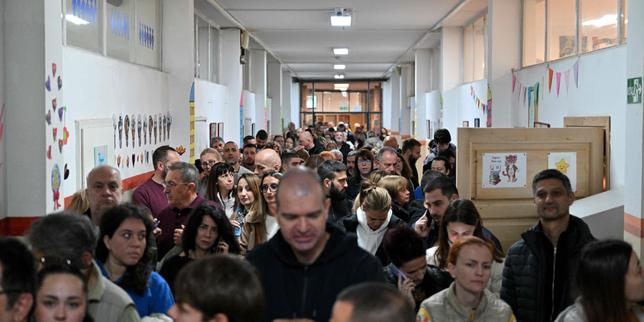
When Serbian citizens head to the polls for parliamentary elections, international media feeds invariably fill with predictable photo galleries showing elderly citizens dropping envelopes into transparent acrylic ballot boxes, party leaders posing beside smiling families, and crowded polling stations in Belgrade. These visual dispatches capture the surface mechanics of democracy in action, yet they miss the structural reality driving Serbia's electoral machine. Législatives en Serbie, or Serbian parliamentary elections, are rarely decided by spontaneous voter persuasion on election day; instead, they reflect years of institutional consolidation, asymmetric media control, and deeply entrenched patronage networks across the Balkans.
Surface-level photo journalism treats an election as a single-day civic festival. Anyone who has spent decades covering Southeast European politics knows better. A photograph of a line outside a polling station in Novi Sad or Niš tells you nothing about why those voters showed up, what pressures shaped their choices, or how the rules governing the campaign were rewritten months before the first ballot was printed.
The Illusion of the Election Day Snapshot
Photo essays serve a specific editorial purpose for wire services and mainstream outlets. They are visually digestible, politically neutral on their face, and quick to publish while vote counting is still underway. Editors love them because a picture of a voter holding an identification card requires zero geopolitical explanation.
Yet this visual shorthand creates a dangerous distortion. By framing Serbian legislative elections primarily through human-interest imagery—grandmothers walking slowly to municipal schoolhouses, young couples taking selfies outside polling centers—coverage inadvertently normalizes an electoral environment that international observers have repeatedly flagged as deeply skewed.
Consider what a camera lens cannot capture at 10:00 AM on a Sunday morning:
- Administrative pressure exerted on public-sector employees whose jobs depend on local party loyalty.
- Media saturation during the preceding six weeks, where governing party officials dominate national broadcast frequencies while opposition voices remain confined to limited cable networks.
- Voter registry anomalies, including documented allegations of organized voter migration from neighboring municipalities or across borders to tip close municipal and parliamentary races.
- Parallel tracking systems, where party activists stationed near polling centers check off names against external lists to verify turnout among mobilized supporters.
When foreign coverage reduces these systemic dynamics to a slideshow of "Serbs going to the polls," it mistakes the theater of voting for the substance of democratic competition.
How Serbia's Electoral Machinery Actually Operates
To understand why legislative elections in Serbia unfold the way they do, you have to examine the architecture built over the past decade by President Aleksandar Vučić and his Serbian Progressive Party (SNS). Even when Vučić himself is not a candidate on the parliamentary ballot, his name frequently anchors the governing coalition's list, turning local and legislative contests into personalized referendums on his leadership.
This centralization is deliberate. Serbia uses a proportional representation system with a single nationwide constituency and a three percent electoral threshold—lowered from five percent prior to the 2020 vote. On paper, a lower threshold encourages pluralism by helping smaller parties enter the 250-seat National Assembly. In practice, it often fragments the opposition into competing micro-coalitions while allowing the dominant party to absorb smaller satellite movements into a single, disciplined bloc.
The Patronage Pipeline
In much of Serbia outside the affluent districts of central Belgrade, the state remains the largest employer. Municipal administrations, state-owned utility companies, hospitals, and public schools form the backbone of local economies.
Over time, political affiliation has become closely intertwined with job security. Critics and civil society watchdogs, such as CRTA (Center for Research, Transparency and Accountability), have documented how temporary contracts in public enterprises function as recurring loyalty tests. Workers hired on short-term agreements understand the unspoken bargain. Keeping a position often requires demonstrating political reliability—attending rallies, collecting signatures for candidate lists, and ensuring family members cast their ballots on election day.
It is a system that leaves few fingerprints inside the polling booth itself. Nobody needs to stand over a voter's shoulder behind the cardboard privacy screen when economic survival has already structured the choice weeks earlier.
The Snap Election Strategy
Another defining feature of modern Serbian legislative politics is the frequent use of snap elections. Rather than waiting out a full four-year parliamentary mandate, the ruling coalition has repeatedly dissolved parliament early, triggering compressed campaign cycles.
Snap votes serve multiple tactical goals simultaneously:
- Disrupting opposition organizing: Opposition alliances, often strapped for cash and plagued by internal ideological divides between pro-European liberals and conservative nationalists, struggle to build nationwide ground operations on short notice.
- Resetting the political clock: Calling an early election allows the government to postpone difficult policy decisions, particularly regarding negotiations over Kosovo or alignment with European Union foreign policy sanctions.
- Maintaining permanent campaign footing: A ruling party with continuous access to state resources and nationwide organizational infrastructure thrives in a state of perpetual mobilization, whereas smaller parties burn through their limited donor funds and volunteer energy.
Media Asymmetry and the Battle for Narrative
If patronage secures the core vote, television secures the broader narrative. Despite rapid growth in digital media consumption among younger urban Serbs, terrestrial television remains the primary source of political news for the majority of the electorate, particularly older voters and residents in rural areas.
National broadcast frequencies in Serbia are held by outlets that overwhelmingly favor the government. Monitoring reports from the OSCE Office for Democratic Institutions and Human Rights (ODIHR) have consistently noted a stark imbalance in airtime, tone, and framing across major television channels. Government officials receive extensive, uncritical coverage presented as routine state activity—opening a new stretch of highway, visiting a factory, announcing pension increases—while opposition figures are either ignored or subjected to coordinated smears in pro-government tabloids.
Independent outlets like N1 and Nova S provide rigorous investigative reporting, yet their reach is constrained by cable distribution disputes with state-backed telecom operators. The result is an information ecosystem divided into two parallel realities. One segment of the population watches daily broadcasts depicting an era of unprecedented economic stability and infrastructure expansion; another segment follows independent media detailing corruption scandals, environmental protests, and institutional erosion.
When election day arrives, these two audiences walk into the exact same school gymnasiums to cast their ballots, carrying completely incompatible understandings of the country's trajectory.
What International Observers See Behind the Curtain
Following recent parliamentary cycles, particularly the December 2023 snap elections, the gap between official photo ops and ground-level reality became impossible for European institutions to ignore. Observation missions from the OSCE, the European Parliament, and domestic monitors documented widespread irregularities that sparked weeks of street protests in Belgrade and prompted a formal resolution from the European Parliament calling for an independent international investigation.
The reports highlighted specific structural vulnerabilities:
- Misuse of public resources: State funds, municipal vehicles, and public facilities were routinely leveraged to support the ruling coalition's campaign activities.
- Blurring of state and party lines: The president's active participation in parliamentary campaigning undermined the constitutional separation between a head of state representing national unity and a partisan political actor.
- Electoral roll discrepancies: Independent investigators uncovered clusters of voters registered at non-residential addresses—including abandoned buildings and municipal offices—raising serious questions about the integrity of local and parliamentary voter lists.
These findings do not mean that every ballot cast in Serbia is fraudulent or that the governing party lacks genuine popular support. Dismissing SNS's electoral strength purely as a product of manipulation would be a major analytical mistake. Many Serbs credit the government with tangible improvements in road networks, foreign direct investment, and macroeconomic stability compared to the turbulent transition years of the 2000s.
Acknowledging that gray area is essential. The ruling party commands a genuine, substantial base of loyal voters who appreciate its blend of economic pragmatism and cautious balancing between Brussels, Moscow, and Beijing. However, genuine popularity and an uneven playing field are not mutually exclusive; in competitive authoritarian systems, incumbents use institutional advantages precisely to turn a solid plurality into an insurmountable parliamentary majority.
The Opposition's Own Structural Blind Spots
Blaming every opposition defeat solely on state capture ignores the strategic missteps made by the government's critics over the past decade. Even when public anger has boiled over into massive street demonstrations—such as the environmental protests against lithium mining in the Jadar Valley or the "Serbia Against Violence" marches following two tragic mass shootings in May 2023—converting street energy into durable parliamentary power has proven elusive.
Opposition coalitions frequently suffer from three recurring weaknesses:
First, ideological incoherence. In an effort to unite anyone opposed to the current administration, alliances often stitch together pro-EU social democrats, center-right market reformers, and hardline nationalists who reject Western integration. Voters looking for a clear governing alternative struggle to see how such a coalition would function once in power, especially on divisive questions like Kosovo or relations with Russia.
Second, an over-concentration in Belgrade. Opposition leaders excel at mobilizing educated, urban voters in the capital, where they consistently perform well in municipal races. Yet winning a national parliamentary majority requires building trusted local chapters in smaller towns across Šumadija, southern Serbia, and Vojvodina—regions where opposition presence often vanishes between election cycles.
Third, tactical inconsistency. Debates over whether to boycott elections or participate under unfair conditions have repeatedly fractured the opposition camp. The 2020 boycott handed the ruling coalition an overwhelming parliamentary supermajority without meaningful resistance, leaving opposition parties starved of public financing and parliamentary visibility for two years. Returning to the ballot box in subsequent cycles forced them to rebuild from a weakened starting position.
Geopolitics Keeps the Spotlight Muted
Why do Western capitals often respond to Serbia's electoral controversies with measured diplomatic statements rather than decisive pressure? The answer lies in regional geopolitics.
Serbia sits at the center of the Western Balkans, holding decisive influence over stability in neighboring Bosnia and Herzegovina, Montenegro, and Kosovo. For policymakers in Washington and Brussels, Belgrade is simultaneously a difficult partner and an indispensable interlocutor. European leaders want Serbia's cooperation on managing migration routes, securing critical raw materials like lithium for Europe's green transition, and preventing renewed conflict in northern Kosovo.
Consequently, foreign diplomats frequently prioritize short-term regional stability over confrontation regarding domestic democratic standards. A calm election day that produces a predictable government in Belgrade—even one accompanied by critical footnotes in an OSCE report—is often treated in European chancelleries as preferable to prolonged political instability in the heart of the Balkans.
Reading Between the Lines of Future Serbian Elections
The next time wire services publish photo galleries of Serbs casting ballots in legislative elections, look past the staged choreography at the polling station entrance. Pay attention instead to the indicators that actually determine the outcome months before the cameras arrive.
Watch whether the recommendations of the OSCE ODIHR regarding voter roll audits and media regulator reform are genuinely implemented or merely cosmetic. Track whether opposition movements establish permanent offices in industrial towns outside Belgrade rather than relying solely on capital-city rallies. Observe how state-owned broadcasters allocate airtime during non-election months, when public opinion is quietly shaped long before official campaign rules take effect.
Democracy is rarely dismantled in front of a press photographer on a Sunday afternoon; it is either sustained or hollowed out in the quiet administrative decisions made on ordinary Tuesdays years in advance.