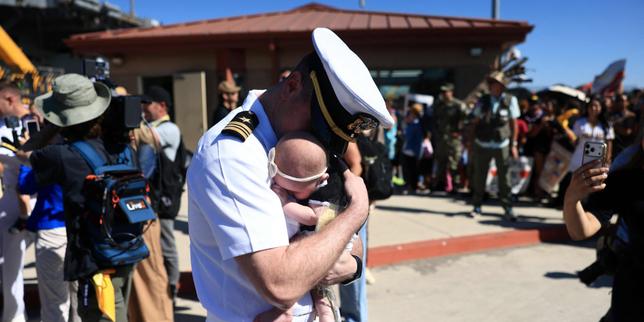
Naval power projection relies on a fragile intersection of mechanical endurance and human operational capacity. When a nuclear-powered aircraft carrier and its associated strike group sustain operations in a high-threat theater like the Middle East for nearly twelve months, the strain extends far beyond routine military rotation. The return of the USS Abraham Lincoln following a prolonged deployment highlights a fundamental systemic vulnerability in modern force management: the widening gap between strategic commitments and asset sustainability.
Evaluating prolonged maritime deployment requires stripping away the emotional framing of homecoming ceremonies to examine the core components of naval operational stress. Deployments of this duration create distinct vectors of degradation that compound over time, affecting machinery, logistics chains, and personnel retention.
The Mechanical Cost Function of Extended Tempo
A Nimitz-class aircraft carrier represents an engineering marvel, yet its physical systems operate under severe environmental and operational constraints. At sea, corrosion from salt spray, thermal stress from continuous flight operations, and the relentless mechanical load on catapult arresting gear and nuclear propulsion support systems accelerate wear rates far beyond standard baseline projections.
When a deployment stretches from the standard six-month window to nearly a year, the maintenance backlog grows exponentially.
- Preventive Maintenance Deferral: Routine servicing cycles are postponed to maintain operational presence, converting minor maintenance requirements into critical failure risks.
- Component Fatigue: High-cycle assemblies, particularly in the flight deck and aviation support infrastructure, experience micro-fractures and metal fatigue that exceed manufacturer specifications.
- Supply Chain Strain: Sustaining high-tempo operations thousands of miles from domestic industrial bases forces reliance on expedited logistics, increasing downtime for critical spare parts transit.
The physical plant of the ship does not reset simply because the mission ends. Every extra month at sea subtracts from the vessel's overall operational lifecycle, accelerating the timeline toward major mid-life overhauls and reducing total fleet availability over the next decade.
Human Capital Degradation and Cognitive Fatigue
The most critical variable in prolonged carrier operations is not steel or propulsion, but the crew. Unlike land-based military installations, an aircraft carrier provides no escape from the operational environment. Sailors and aviators live, sleep, and work within inches of heavy machinery, weapon systems, and continuous flight operations.
Cognitive fatigue manifests through measurable declines in reaction times, decision-making accuracy, and situational awareness. In high-stakes aviation environments where launch and recovery operations occur around the clock, cumulative sleep deprivation introduces systemic safety hazards.
The psychological toll of indefinite extensions—often referred to as stop-loss or deployment creep—directly impacts force readiness. When sailors experience repeated extensions without clear timelines, morale erodes. This erosion translates directly into post-deployment retention challenges, as experienced technicians and operators separate from military service rather than accept a recurrence of unsustainable deployment tempos. The institutional knowledge lost through early separations degrades the capability of subsequent crews, creating a compounding deficit in human capital.
Strategic Opportunity Costs and Force Posture Friction
Deploying a single carrier strike group for twelve months is often framed as a demonstration of global reach and commitment. From a resource allocation perspective, however, it represents a high-cost strategy with diminishing returns.
Keeping one asset forward-deployed for an extended period disrupts the maintenance and training pipeline for the rest of the fleet. The Carrier Strike Group Force Generation Model depends on a predictable cadence: maintenance, basic training, integrated training, deployment, and sustainment. When a deployment doubles in length, the subsequent phases are compressed or delayed.
- Training Deficits: Crews returning from extended deployments miss critical advanced training windows, delaying their integration into complex joint exercises.
- Surge Capacity Exhaustion: The ship that has just returned must enter an extensive depot-level maintenance period, leaving fewer available hulls to respond to unforeseen geopolitical contingencies elsewhere.
- Operational Predictability: Adversaries can observe and adapt to the predictable gaps left in other theaters when disproportionate naval resources are concentrated in a single focal point.
The Structural Limits of Extended Maritime Power
The return of the USS Abraham Lincoln serves as an empirical indicator of a structural imbalance. Relying on extended deployments to bridge capability gaps treats a chronic systemic shortfall with a temporary, high-risk fix.
Sustainable maritime strategy requires aligning operational demands with the physical and human limits of the force. Without a reevaluation of deployment lengths and fleet sizing, extended operations will continue to trade long-term military readiness for short-term presence.