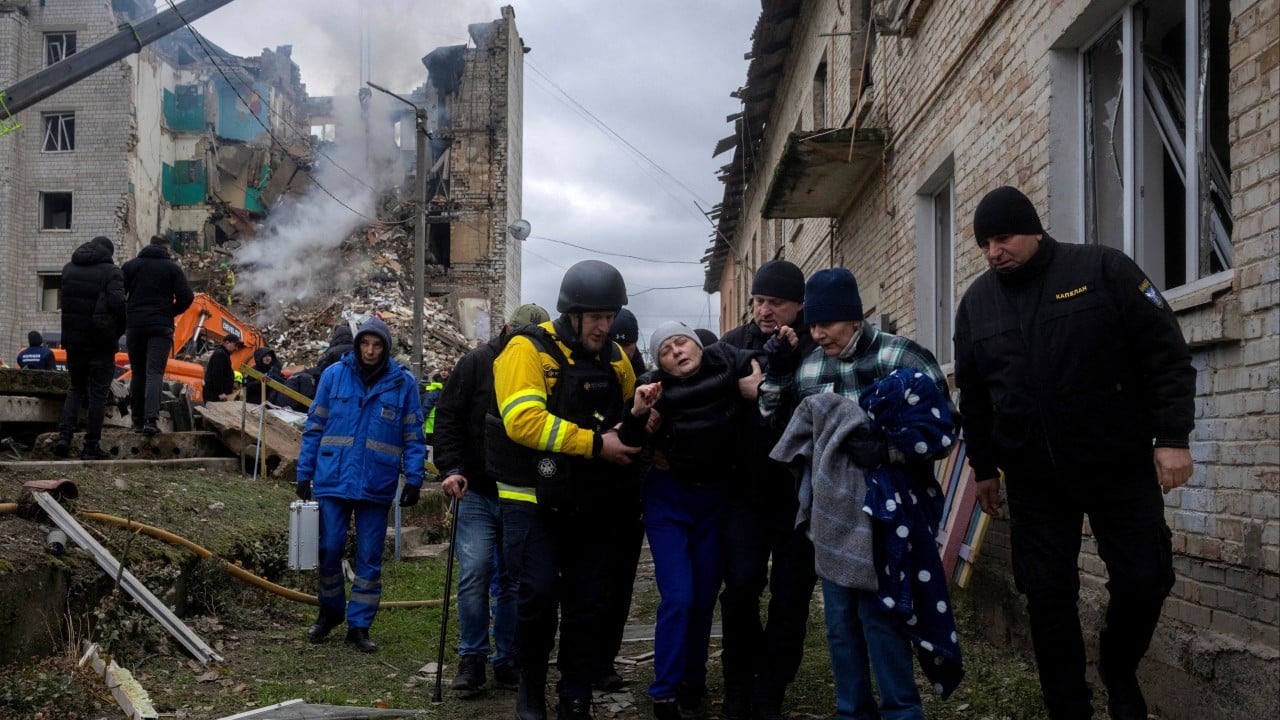
When Ukrainian authorities report six fatalities following Russian strikes in the Kyiv region, standard news coverage treats the event as an isolated casualty tally. That framing obscures the underlying operational logic. A strike package that penetrates air defenses around a heavily fortified capital is not merely an act of kinetic destruction; it is a calculated move in an ongoing economic and psychological attrition campaign designed to force defensive resource misallocation, degrade grid resilience, and fracture civilian morale.
To understand the true impact of these strikes, analysts must move beyond raw casualty counts and examine the mechanics of air defense saturation, the asymmetric cost functions of modern missile warfare, and the second-order effects on national infrastructure.
The Mechanics of Air Defense Saturation
Modern integrated air defense systems (IADS) protecting high-value targets like Kyiv operate on layered interception probability. Rather than creating an impenetrable dome, layered defenses—combining long-range surface-to-air missiles, medium-range interceptors, and mobile short-range anti-aircraft artillery—function as a probabilistic filter. Each layer reduces the volume of incoming threats, but no filter operates at 100 percent efficiency against a complex, multi-vector salvo.
Russian strike planners exploit the mathematical limits of this filter through saturation tactics. Instead of launching single-type volleys, planners synchronize disparate munition profiles to arrive within narrow time windows:
- Low-altitude, slow-moving decoys and one-way attack drones force radar networks to illuminate, track, and allocate engagement channels, while forcing mobile firing units to expend ammunition and reveal their positions.
- Subsonic cruise missiles follow terrain-hugging flight paths to exploit radar horizon blind spots, demanding continuous low-altitude surveillance.
- Ballistic and aeroballistic missiles descend at hypersonic terminal velocities, compressing defender reaction times to seconds and requiring the highest-tier interceptors for a successful kinetic kill.
When six civilians die in the Kyiv oblast, the fatalities are rarely the result of a single unopposed munition hitting a primary military target. More often, casualties occur through two distinct failure modes: either an interceptor battery experiences temporary channel saturation and a munition leaks through to a residential or mixed-use zone, or a successful high-altitude interception produces falling debris over populated suburbs surrounding the capital. The geographic sprawl of the Kyiv region makes debris mitigation nearly impossible; intercepting a warhead outside the urban core still drops tons of burning propellant and shrapnel onto outlying towns and villages.
The Asymmetric Cost Function of Strike and Defense
Every strike package executed against the Kyiv region enforces a severe economic penalty on the defender, regardless of interception rates. In military economics, this is the cost-exchange ratio—the financial and industrial expenditure required to stop an attack compared to the expenditure required to launch it.
A one-way attack drone costs a fraction of a modern surface-to-air interceptor missile. Even when defenders use lower-cost electronic warfare or autocannon fire against drones, the ballistic and cruise missile components of a mixed salvo force the expenditure of scarce, high-cost interceptors whose global production rates are measured in hundreds per year rather than thousands.
This creates a structural dilemma for Ukrainian air defense commanders:
- Protect the periphery or protect the core. Concentrating batteries around Kyiv leaves regional energy substations, logistics hubs, and residential areas in the surrounding oblast exposed to leakage. Spreading batteries across the broader region lowers the interception density over the capital's critical command and industrial nodes.
- Conserve interceptors or accept kinetic damage. Holding fire on ambiguous tracks preserves magazine depth for future salvos but increases the probability that a live warhead reaches the ground. Engaging every detected track maximizes immediate civilian protection but accelerates magazine depletion, creating vulnerability windows days or weeks later.
The human toll in the Kyiv region is a direct downstream consequence of this resource-allocation problem. Each strike forces the defender to burn through finite interceptor stockpiles, incrementally degrading the shield's capacity to absorb the next wave.
Strategic Objectives Beyond the Blast Radius
Kinetic damage to physical structures accounts for only a portion of the strategic effect sought by long-range bombardment. When strikes kill civilians in the capital region, the operation targets three systemic vulnerabilities simultaneously.
Infrastructure Coupling and Cascading Failures
The Kyiv region sits at the center of Ukraine's electrical transmission and logistics networks. Strikes aimed at substations, transformer yards, and rail junctions do not need to destroy an entire facility to disrupt regional output. Damaging high-voltage autotransformers—components with long manufacturing lead times and complex transport requirements—forces grid operators to execute rolling blackouts. These power disruptions halt local industrial production, strain municipal water and heating systems, and force businesses to rely on expensive diesel generation, acting as a hidden tax on the entire regional economy.
Psychological Attrition and Labor Displacement
Sustained aerial bombardment relies on coercive punishment theory: the hypothesis that imposing continuous pain and uncertainty on a civilian population will erode political will and force leadership toward concessions. While historical precedent from the Blitz to modern conflicts shows that strategic bombing rarely collapses civilian morale outright, it reliably induces behavioral friction. Air raid alerts lasting hours disrupt sleep cycles, halt transit, and clear workplaces. Over time, recurring fatalities in residential areas drive internal displacement and outward migration, shrinking the available labor pool and depressing domestic tax revenue needed to fund the defense effort.
Diplomatic and Supply-Chain Signaling
High-profile strikes near a nation's capital generate immediate international media visibility. From an operational standpoint, this serves as a stress test on the defender's external supply chains. By demonstrating the persistent ability to inflict casualties in the most heavily defended sector of the country, the attacker signals that existing air defense transfers are insufficient, attempting to induce donor fatigue or force allies to divert air defense assets away from frontline maneuver units to protect rear-area cities.
Analytical Limitations and Information Gaps
Assessing the immediate aftermath of any specific strike in the Kyiv region requires separating verified operational facts from wartime information friction. Official statements confirming six deaths establish a concrete human baseline, but several critical variables remain obscured by operational security:
- Exact Munition Mix and Launch Origins: Without forensic recovery data from crash sites, analysts cannot immediately verify whether fatalities resulted from intact warheads or interceptor debris, nor can they confirm the precise ratio of decoys to live warheads in the salvo.
- True Interception Rates: Both belligerents have strong incentives to shape the narrative around interception efficiency. Defenders emphasize shoot-down percentages to project competence and reassure the population, while attackers claim high-value target destruction to validate operational expenditure.
- Magazine Depth and Interceptor Readiness: The true state of Ukrainian interceptor inventories and radar maintenance cycles is strictly classified. External observers can infer pressure on the network from changes in engagement patterns, but cannot quantify exact remaining capacity.
Relying solely on initial casualty reports leads to reactive analysis. A low casualty count does not indicate an ineffective strike if the salvo successfully depleted a battery's remaining ballistic interceptors or disabled a critical grid node. Conversely, a strike that kills six civilians may represent a tactical failure for the attacker if the intended military target remained untouched and the defending network preserved its magazine depth.
The Counter-Attrition Imperative
Breaking the attrition cycle in the Kyiv region requires shifting the defensive posture from reactive interception to proactive cost-imposition and passive resilience. Relying exclusively on expensive surface-to-air missiles to counter mass-produced strike packages is mathematically unsustainable over a multi-year conflict.
Defensive strategy must prioritize three concrete operational shifts:
- Decentralize and Harden Critical Nodes: Instead of defending single massive substations, grid operators must accelerate the deployment of distributed generation, modular transformers, and hardened concrete shelters around high-voltage equipment. Reducing the physical vulnerability of infrastructure lowers the strategic return on investment for every incoming missile.
- Scale Low-Cost Kinetic and Non-Kinetic Interceptors: High-end surface-to-air missiles must be strictly reserved for ballistic and advanced cruise threats. The lower tier of the air defense architecture requires mass-deployed electronic warfare systems, acoustic sensor networks paired with mobile gun teams, and interceptor drones capable of achieving a favorable cost-exchange ratio against one-way attack drones.
- Expand Deep-Strike Counter-Force Operations: The only permanent solution to air defense saturation is reducing the volume of munitions launched at the source. Sustaining long-range strikes against bomber airfields, missile storage depots, propellant manufacturing plants, and drone assembly facilities degrades the attacker's sortie generation rate before munitions ever enter defended airspace.
Until the cost-exchange ratio flips in favor of the defender and launch capacity is degraded at its origin, the Kyiv region will remain locked in a recurring cycle of saturation volleys, interceptor depletion, and civilian casualties.