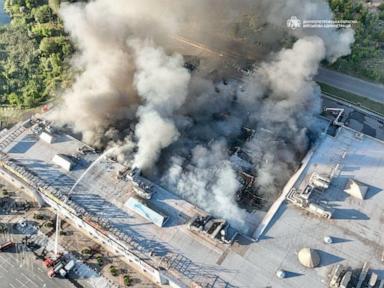
Modern industrial warfare operates on strict economic and logistical feedback loops where aerial campaigns are governed by asset scarcity, interceptor burn rates, and asymmetric cost functions. Recent escalations across the Ukrainian theater, characterized by high-density drone barrages, multi-wave sequencing, and long-range counter-value strikes, demonstrate how strategic attrition dictates operational tempo when front-line maneuver remains restricted.
The Mechanics of Asymmetric Aerial Escalation
The operational architecture of recent aerial strikes relies on coordinated saturation tactics. When forces deploy mixed vectors involving loitering munitions, cruise missiles, and ballistic systems, the primary objective transcends local tactical destruction. It forces defenders into a reactive posture that burns finite interceptor stockpiles.
The engagement sequence in central and urban centers follows a predictable expenditure model:
- Initial saturation waves exhaust immediate point-defense capabilities and force civilian populations into subterranean shelter networks.
- Follow-on secondary vectors exploit the operational lag of emergency response units, amplifying human cost through sequenced pacing.
- Precision ballistic assets target structural nodes like railway logistics and urban commercial hubs to degrade economic continuity and domestic stability.
This multi-tiered methodology exploits the defender's primary operational bottleneck: the replacement rate of high-end surface-to-air interceptors relative to the mass-produced inputs of low-cost attack munitions.
The Air Defense Burn Rate and Deficit Function
The vulnerability of urban centers to ballistic and high-speed threats is governed by a strict capability mismatch. Systems capable of neutralizing ballistic trajectories—specifically tier-one platforms like Western-supplied Patriot batteries—exist in finite quantities.
The defense deficit function operates on a simple ratio:
$$\text{Vulnerability} = \frac{\text{Incoming Threat Volume}}{\text{Available Interceptor Inventory} \times \text{Intercept Success Probability}}$$
When the incoming volume of complex munitions outpaces the replenishment velocity of interceptor missiles, defensive coverage degrades exponentially rather than linearly. Attackers map these capability gaps, concentrating high-value assets against sectors experiencing depleted shielding. This dynamic explains why urban areas face periodic waves of devastation despite high aggregate interception percentages reported by air force commands.
Strategic Reach and Transnational Proportionality
As traditional ground movement along the front line remains checked by automated surveillance and ground robotics, both belligerents have shifted capital toward deep-strike retaliation frameworks. Ukraine's deployment of domestically manufactured long-range platforms targets industrial and military infrastructure deep inside sovereign Russian territory.
The strategic intent behind these cross-border operations relies on shifting the psychological and economic burden of conflict inward. By striking high-value nodes—such as petroleum refineries in Perm and military airfields in Volgograd—the strategy aims to impose tangible costs on the adversary's industrial supply chain. However, the systemic impact of these long-range operations remains bounded by production volume and the density of regional electronic warfare countermeasures.
The Operational Horizon
The ongoing escalation cycle indicates that neither side possesses the localized force concentration required to achieve a decisive breakthrough on land. The campaign has fully transitioned into a war of industrial stamina and technological adaptation.
Future operational capacity will be determined by three distinct variables: the scaling speed of domestic unmanned aerial vehicle manufacturing lines, the stabilization of Western air defense resupply pipelines, and the structural resilience of domestic energy grids under persistent ballistic pressure. Strategic decisions must prioritize distributed manufacturing clusters and decentralized power generation to mitigate the systemic impact of high-density aerial attrition.