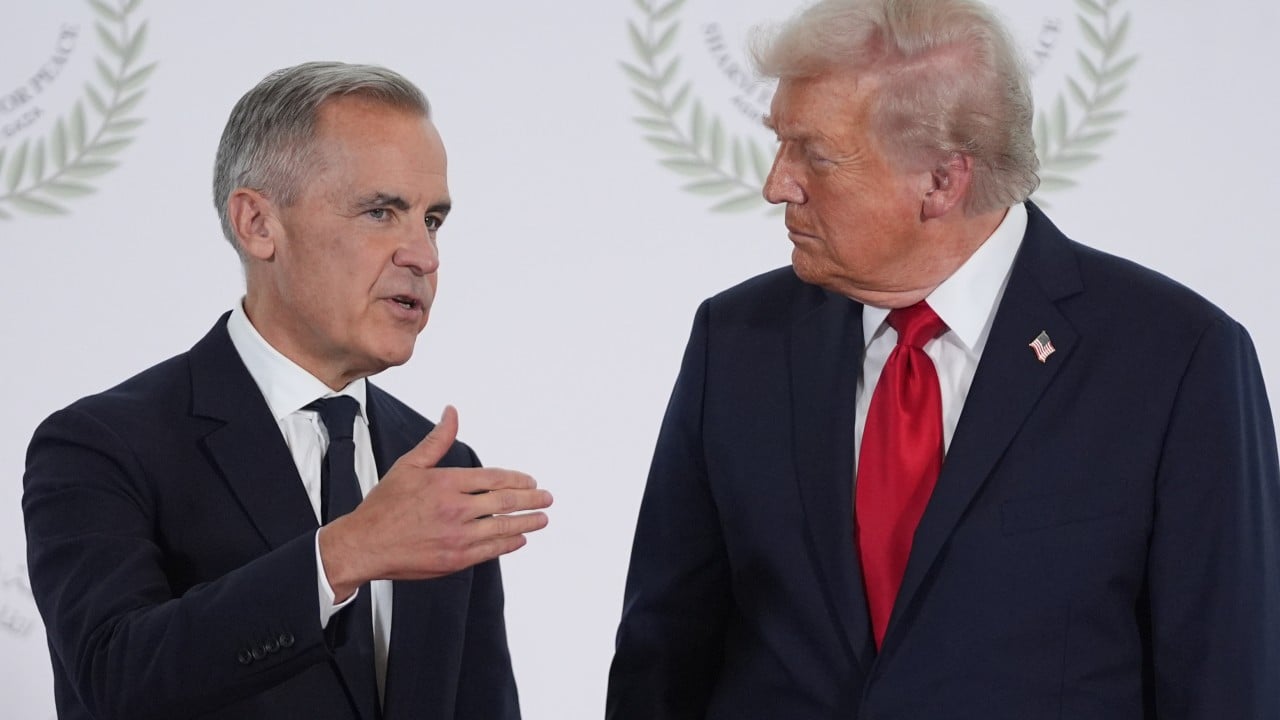
Public declarations from U.S. President Donald Trump asserting that a bilateral trade agreement with Canada is near completion, contrasted against Canadian Prime Minister Mark Carney’s insistence that substantial work remains, illustrate a textbook divergence in negotiation signaling. This gap does not necessarily reflect confusion at the bargaining table; rather, it demonstrates how two leaders facing distinct domestic audiences, macroeconomic exposures, and institutional constraints deploy conflicting rhetorical strategies to gain bargaining power during the same negotiation cycle.
Understanding this divergence requires stripping away diplomatic rhetoric and examining the underlying mechanics of bilateral trade policy, game theory, and cross-border supply chain integration. When evaluating trade negotiations between an economic hegemon and a deeply integrated mid-sized economy, public statements function as strategic instruments rather than objective status reports.
The Mechanics of Divergent Bargaining Signals
In international trade negotiations, public optimism and public caution serve entirely different operational purposes. According to standard bargaining theory, a negotiator's public posture is designed to anchor expectations, manage domestic political coalitions, and pressure the counterparty into making final-stage concessions.
President Trump’s framing—that a deal is "close"—operates as an anchoring and momentum-building tactic. By publicly projecting imminent success, the U.S. executive branch accomplishes three objectives simultaneously:
- Market Stabilization: Equity and currency markets price in reduced tariff risk, relieving immediate downward pressure on domestic industrial stocks reliant on North American inputs.
- Political Credit Claiming: Signaling proximity to a deal allows the administration to project executive efficacy to domestic voters and business lobbies without committing to specific text.
- Pressure Shifting: If the U.S. states that an agreement is nearly finished, any subsequent delay or breakdown can be framed publicly as Canadian intransigence rather than American overreach.
Conversely, Prime Minister Mark Carney’s statement that "work remains" reflects a defensive posture rooted in institutional accountability and asymmetric vulnerability. For a Canadian Prime Minister—particularly one with an extensive background in central banking and macroeconomic risk management—prematurely validating a deal carries severe political and economic hazards:
- Expectation Management: Confirming proximity to an agreement inflates domestic expectations. If the final text includes painful concessions on protected sectors, the political backlash is amplified.
- Preserving Walk-Away Credibility: In game theory, a negotiator loses bargaining power the moment the counterparty believes they will sign any deal to avoid disruption. Emphasizing unresolved issues signals that Canada retains a viable Best Alternative to a Negotiated Agreement (BATNA), even if exercising that alternative carries high economic costs.
- Protecting Technical Detail: Trade agreements fail or succeed in the appendices, rules of origin, and dispute resolution mechanisms. Acknowledging remaining work creates political space for technical negotiators to scrutinize legal text without artificial deadlines imposed by executive rhetoric.
Structural Asymmetry in the US-Canada Trade Relationship
To analyze why Trump and Carney adopt opposing rhetorical strategies, one must examine the structural asymmetry defining North American commerce. While the United States and Canada maintain one of the largest bilateral trading relationships globally, their mutual dependence is profoundly unequal.
This structural imbalance dictates the risk tolerance of each side:
- Export Concentration vs. Diversification: Roughly three-quarters of all Canadian merchandise exports are destined for the United States, accounting for a substantial share of Canada’s total Gross Domestic Product (GDP). By contrast, exports to Canada represent a single-digit percentage of total U.S. GDP. A disruption in cross-border trade inflicts a localized shock on specific U.S. border states and industrial sectors, whereas it triggers a systemic macroeconomic contraction across Canada.
- Capital Mobility and Investment Sensitivity: Because the U.S. market is vastly larger, prolonged trade uncertainty disproportionately depresses business fixed investment in Canada. Multinational firms deciding where to allocate capital for new manufacturing capacity naturally favor locating inside the larger consumer market to hedge against future tariff barriers, even when no formal tariffs are yet enacted.
- Currency Adjustment Mechanisms: In floating exchange rate regimes, trade friction and tariff threats rapidly transmit through currency markets. Expectations of U.S. trade restrictions typically exert downward pressure on the Canadian dollar relative to the U.S. dollar. While a weaker currency partially cushions Canadian exporters by lowering their relative costs, it simultaneously increases the domestic cost of imported capital goods and consumer staples, complicating monetary policy and inflation control.
Because Canada absorbs a higher proportion of systemic risk per unit of trade friction, Prime Minister Carney cannot rely on broad political generalizations. His administration must secure precise, legally enforceable protections against unilateral trade actions before declaring victory. President Trump, operating from a position of lower aggregate macroeconomic exposure, can afford to treat the negotiation as a high-level transactional process where broad political commitments precede technical resolution.
Core Friction Points Behind the Unfinished Work
When Canadian officials state that significant work remains, they are pointing to specific, recurring structural bottlenecks in U.S.-Canada trade relations. Historically and operationally, bilateral negotiations between Washington and Ottawa stall over four primary mechanisms:
1. Tariff Exemptions and Unilateral Trade Remedies
The primary objective for any Canadian government negotiating with the United States is securing durable immunity from broad unilateral tariffs—whether justified under national security provisions, balance-of-payments authorities, or emergency economic powers. From the U.S. perspective, retaining the credible threat of tariffs is the primary mechanism for enforcing compliance and extracting ongoing concessions. A deal that permanently strips the U.S. executive of tariff authority reduces future American bargaining power, while a deal that leaves Canada exposed to arbitrary tariff reimposition fails to provide the certainty Canadian businesses require.
2. Rules of Origin and Supply Chain Integration
North American manufacturing—most notably in the automotive, aerospace, and heavy machinery sectors—does not operate as two separate national economies trading finished goods. Instead, raw materials, sub-assemblies, and components cross the border multiple times before final assembly. Rules of origin dictate what percentage of a product’s value must be produced within North America (or specifically within the United States) to qualify for duty-free treatment. Tightening regional value content requirements forces manufacturers to restructure supplier networks, audit complex bills of materials, and absorb compliance costs. Resolving disputes over how content is calculated requires granular, sector-by-sector negotiation that cannot be bypassed by political announcements.
3. Protected Domestic Sectors and Market Access
Both nations maintain politically sensitive sectors insulated from pure free-market competition. In Canada, the supply management system—governing dairy, poultry, and eggs through production quotas, price controls, and high tariffs on imports above strict thresholds—represents a critical political constituency, particularly in rural Quebec and Ontario. In the United States, government procurement rules (such as "Buy American" mandates) and agricultural subsidies serve similar domestic political functions. Expanding U.S. access to Canadian dairy markets or carving out exemptions for Canadian firms in U.S. federal infrastructure spending requires trading concentrated, visible domestic political pain for diffuse macroeconomic gains.
4. Dispute Settlement Architecture
Trade rules are only as reliable as the mechanisms used to enforce them. Historically, Canada has prioritized binational, binding dispute settlement panels—such as those established under earlier North American trade frameworks—to prevent domestic U.S. trade agencies from unilaterally imposing anti-dumping and countervailing duties on Canadian exports like softwood lumber. U.S. trade negotiators, conversely, frequently resist international panels that supersede domestic judicial authority or constrain American trade remedy laws. Reconciling Canada’s demand for binding third-party arbitration with U.S. demands for sovereign regulatory discretion remains one of the hardest legal hurdles in any bilateral text.
The Two-Level Game Constraint
Political scientist Robert Putnam’s "two-level game" framework explains why a trade deal can appear simultaneously close and distant. In international negotiations, leaders must play on two boards at once: Level I (the international bargaining table with the foreign counterpart) and Level II (the domestic political arena where any resulting agreement must be ratified, funded, or politically defended).
An agreement is only viable if it falls within the "win-set" of both countries—the range of possible outcomes that can secure domestic approval on both sides.
- The U.S. Win-Set: Shaped heavily by executive branch priorities, industrial labor unions in swing states, and domestic manufacturing lobbies. Because executive trade actions can often be implemented or adjusted rapidly, the U.S. win-set is fluid and responsive to immediate political optics.
- The Canadian Win-Set: Constrained by provincial governments, federal parliamentary dynamics, and regional economic interests. In Canada’s decentralized federation, provinces hold significant jurisdiction over natural resources, energy regulation, internal trade barriers, and government procurement. A prime minister cannot sign a comprehensive trade agreement without managing the distinct economic interests of energy-producing western provinces, manufacturing-heavy central provinces, and export-dependent Atlantic regions.
When President Trump indicates a deal is close, he is often referring to an alignment at Level I—an understanding in principle between leaders on headline issues such as border security cooperation, energy flows, or broad industrial targets. When Prime Minister Carney emphasizes remaining work, he is accounting for the friction of translating those headline understandings into legal language that survives Level II scrutiny from provincial premiers, industry associations, and parliamentary opposition.
Distinguishing Known Facts from Strategic Hypotheses
Rigorous analysis requires separating observable facts from analytical inference when evaluating conflicting diplomatic statements:
Established Facts:
- Both leaders have publicly articulated divergent assessments of the negotiation timeline, with Trump emphasizing proximity to a deal and Carney emphasizing incomplete work.
- The U.S. and Canadian economies remain deeply integrated through cross-border supply chains, energy infrastructure, and capital flows, with Canada exhibiting significantly higher trade-to-GDP sensitivity to bilateral friction.
- Core bilateral trade disputes consistently center on tariff application, rules of origin, agricultural market access, and dispute resolution mechanisms.
Analytical Hypotheses:
- Tactical Positioning: The divergence in rhetoric is likely an intentional bargaining dynamic rather than a breakdown in communication, with each leader optimizing messaging for their respective domestic political constraints.
- Textual vs. Conceptual Readiness: Negotiators may have reached conceptual alignment on broad bilateral priorities while remaining deadlocked on enforcement mechanisms, legal exemptions, and implementation timelines.
- Deadline Compression: Public statements asserting that a deal is "close" may be designed to force an artificial deadline, pressuring technical teams to resolve secondary disputes quickly rather than letting negotiations drift into prolonged uncertainty.
Operational Limitations of Bilateral Trade Agreements
Even if Washington and Ottawa bridge their remaining differences and announce a finalized agreement, market participants and policymakers must recognize the inherent structural limitations of any bilateral deal in the current trade environment:
- Durability vs. Executive Discretion: A bilateral agreement that relies on executive understandings rather than ratified treaty law remains vulnerable to sudden shifts in domestic political priorities. If tariff exemptions are granted via executive discretion rather than permanent statutory modification, businesses still face a persistent risk premium when making multi-year capital allocation decisions.
- Third-Party Supply Chain Spillovers: Neither the United States nor Canada operates in a closed bilateral vacuum. Both economies are deeply entangled with global supply chains, particularly involving Asian manufacturing inputs and European regulatory standards. A bilateral deal that tightens rules of origin to exclude third-country components can inadvertently raise production costs for North American firms, eroding their global export competitiveness even as bilateral tariffs fall.
- Non-Tariff Regulatory Friction: Eliminating headline tariffs does not eliminate trade friction. Divergent environmental standards, digital services taxes, data localization rules, and regulatory inspection bottlenecks at border crossings continue to act as de facto tariffs, imposing operational drag that high-level political agreements rarely resolve immediately.
Strategic Execution for Cross-Border Operators
For corporate leaders, supply chain managers, and institutional investors operating across the U.S.-Canada border, treating executive rhetoric as an actionable baseline is a strategic error. Until legal text is published, ratified, and backed by binding dispute resolution, organizations must execute under the assumption of persistent policy volatility.
Supply chain architecture should be stress-tested against two distinct scenarios: a baseline scenario featuring targeted tariff exemptions paired with stricter regional rules of origin, and a downside scenario characterized by rolling, sector-specific tariff escalations. Firms should immediately audit their bills of materials to map tier-two and tier-three component origins, quantify exposure to potential domestic content thresholds, and build dual-sourcing flexibility where cross-border value chains remain vulnerable to unilateral executive trade remedies.