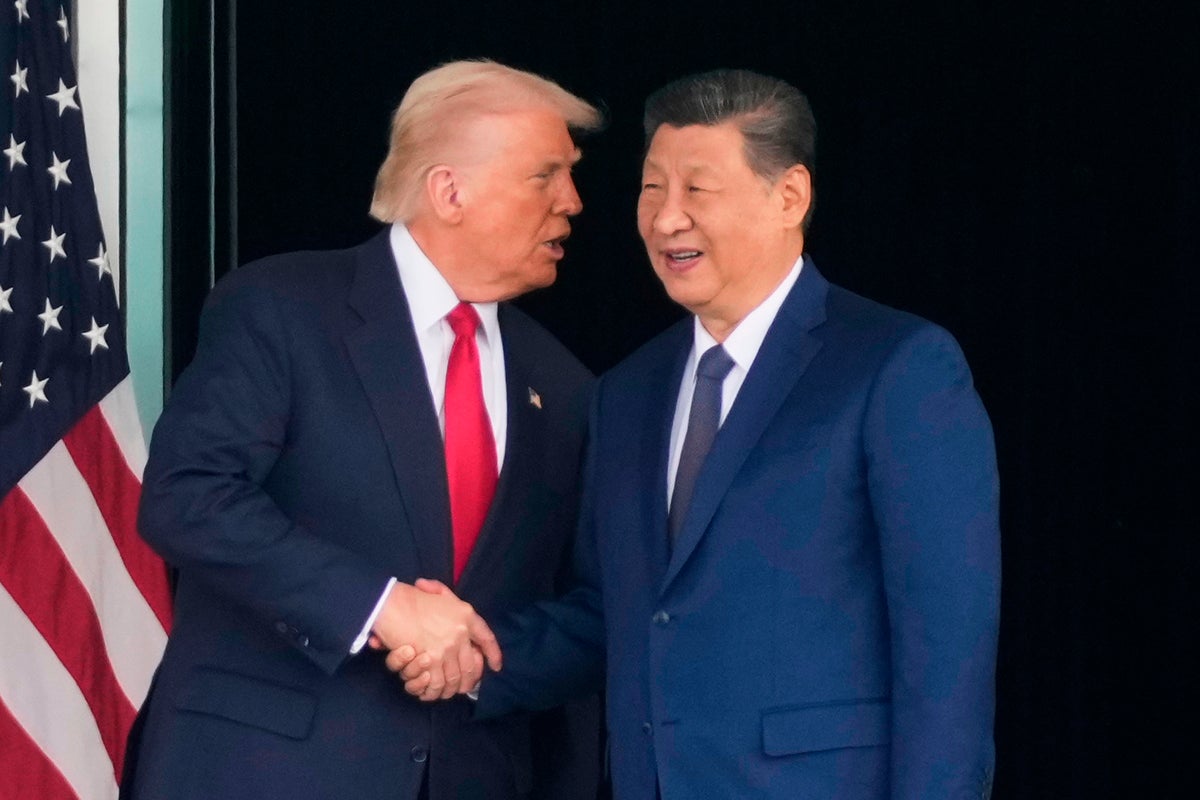
The hum of the air conditioning in a windowless boardroom in Buenos Aires sounds the same as it does in a small-town hardware store in Iowa or a semiconductor plant in Suzhou. It is the sound of expensive, controlled silence. In late 2018, that silence held the weight of billions of dollars and the immediate future of the global economy. Donald Trump and Xi Jinping sat across from one another, two men representing the world’s most powerful engines, trying to find a way to stop the gears from grinding to a halt.
They reached a truce. They shook hands. The markets breathed a sigh of relief that echoed from Wall Street to Tokyo. But the handshake didn't solve the problem; it merely paused the clock.
To understand why this matters, look away from the gilded summits and toward a man we’ll call David. David runs a mid-sized electronics firm in Ohio. For twenty years, his business followed a predictable rhythm. He designed components, sourced raw materials globally, and sold to a steady client base. Then, the trade war arrived like a slow-moving storm. Suddenly, the aluminum he needed cost 25% more. The specialized chips he imported were caught in a bureaucratic nightmare. David isn't a politician. He’s a guy who worries about making payroll on Friday. For him, the "dialing down" of tensions isn't a headline. It’s a matter of survival.
The Friction of Giants
The conflict between the United States and China is often described as a chess match, but that’s too elegant a metaphor. It’s more like a heavy-duty tug-of-war where the rope is made of the world's supply chains. When one side pulls, the tension ripples through every node of the network.
The truce established at the G20 summit was a tactical retreat. Both leaders recognized that an all-out economic scorched-earth policy would leave them ruling over ashes. Washington agreed to hold off on raising tariffs from 10% to 25% on $200 billion worth of Chinese goods. In exchange, Beijing promised to purchase a "very substantial" amount of agricultural, energy, and industrial products.
It felt like a win.
But the friction remains because the core of the dispute isn't actually about soy beans or Boeing jets. It is about who owns the future.
The Intellectual Property Ghost
Imagine you spend ten years and five hundred million dollars developing a new way to manufacture ultra-thin glass for smartphones. You own the patents. You own the process. Then, you realize that to enter the largest market on earth, you have to share that "secret sauce" with a local partner who might become your competitor tomorrow. This is the "forced technology transfer" that keeps American negotiators awake at night.
Washington argues that China’s rise has been fueled by the systematic acquisition—and sometimes outright theft—of Western intellectual property. Beijing views this as a necessary step in their "Made in China 2025" initiative, a plan to move their economy from cheap plastic toys to high-end aerospace and biotech.
This isn't a misunderstanding that can be cleared up over a steak dinner. It is a fundamental clash of systems. One side prioritizes the protection of private innovation; the other prioritizes national strategic advancement. When these two philosophies collide, a 90-day truce feels like a band-aid on a broken limb.
The Human Cost of Uncertainty
While the leaders talk, the uncertainty acts as a tax on the world. Business leaders hate risk, but they loathe uncertainty even more. Risk can be calculated and insured against. Uncertainty—the "will they or won't they" of tariff hikes—causes paralysis.
Consider a logistics manager in Shenzhen. Her job is to ensure that thousands of shipping containers reach Los Angeles on time. When the trade war flared, she saw companies "front-loading" shipments, trying to get goods into the U.S. before the next deadline hit. This created a massive bottleneck at the ports, sent shipping rates skyrocketing, and eventually led to a glut of inventory that sat rotting in warehouses.
The cost is always passed down. It lands on the shelf of your local grocery store. It shows up in the price of the laptop you bought for your kid’s schoolwork. It’s a hidden inflation, a friction fee paid by everyone because the two biggest players in the room can't agree on the rules of the game.
The Technology Iron Curtain
We are witnessing the early stages of what some call a "decoupling." For decades, the goal of the global economy was integration. We wanted a world where a product was designed in California, manufactured in China, and sold in Europe. It was efficient. It was cheap.
Now, that integration is being viewed as a security vulnerability.
If the U.S. bans a Chinese telecommunications giant from its 5G networks, and China responds by restricting the export of rare earth minerals used in electric car batteries, the world splits. We are moving toward a reality where we might have two different internets, two different sets of technical standards, and two different supply chains that never touch.
The efficiency of the "one world" model is being traded for the perceived safety of "us versus them."
The Invisible Stakes
The stakes are higher than the price of a gallon of milk or the stock price of a tech firm. At the heart of this struggle is the question of global leadership. For the last seventy years, the U.S. has set the standards for international trade, maritime law, and financial systems. China is now large enough, and powerful enough, to propose an alternative.
The Buenos Aires summit didn't resolve this. It just gave both sides a moment to catch their breath. The "challenges" lurking in the shadows are not just line items in a trade deal. They are deep-seated fears about national decline and sovereign pride.
As the 90-day clock ticked down following that meeting, the world watched for signs of a real breakthrough. But structural changes—like China fundamentally altering how it subsidizes its state-owned enterprises—take years, not weeks. They require a level of trust that has been eroded by years of rhetoric and retaliatory measures.
Back in Ohio, David watches the news. He sees the photos of the handshakes and the smiles. He wants to believe the worst is over. He wants to hire two new engineers and invest in a new assembly line. But he hesitates. He knows that a truce is not a peace treaty. He knows that in the high-stakes game of global hegemony, the people caught in the middle are often the last to know when the next blow is coming.
The lights in the boardroom eventually went out. The motorcades sped away. The fundamental questions—about power, about theft, about the very nature of the 21st-century economy—remained on the table, unanswered, waiting for the next time the clock ran out.
The world is waiting for more than just a pause in the fighting. It is waiting to see if two giants can coexist in a house that is increasingly too small for both of them to stand at full height. Until then, we all live in the quiet, tense space between the handshakes and the next round of tariffs.
The rope is still taut. The hands are still pulling. The only thing that has changed is the rhythm of the strain.