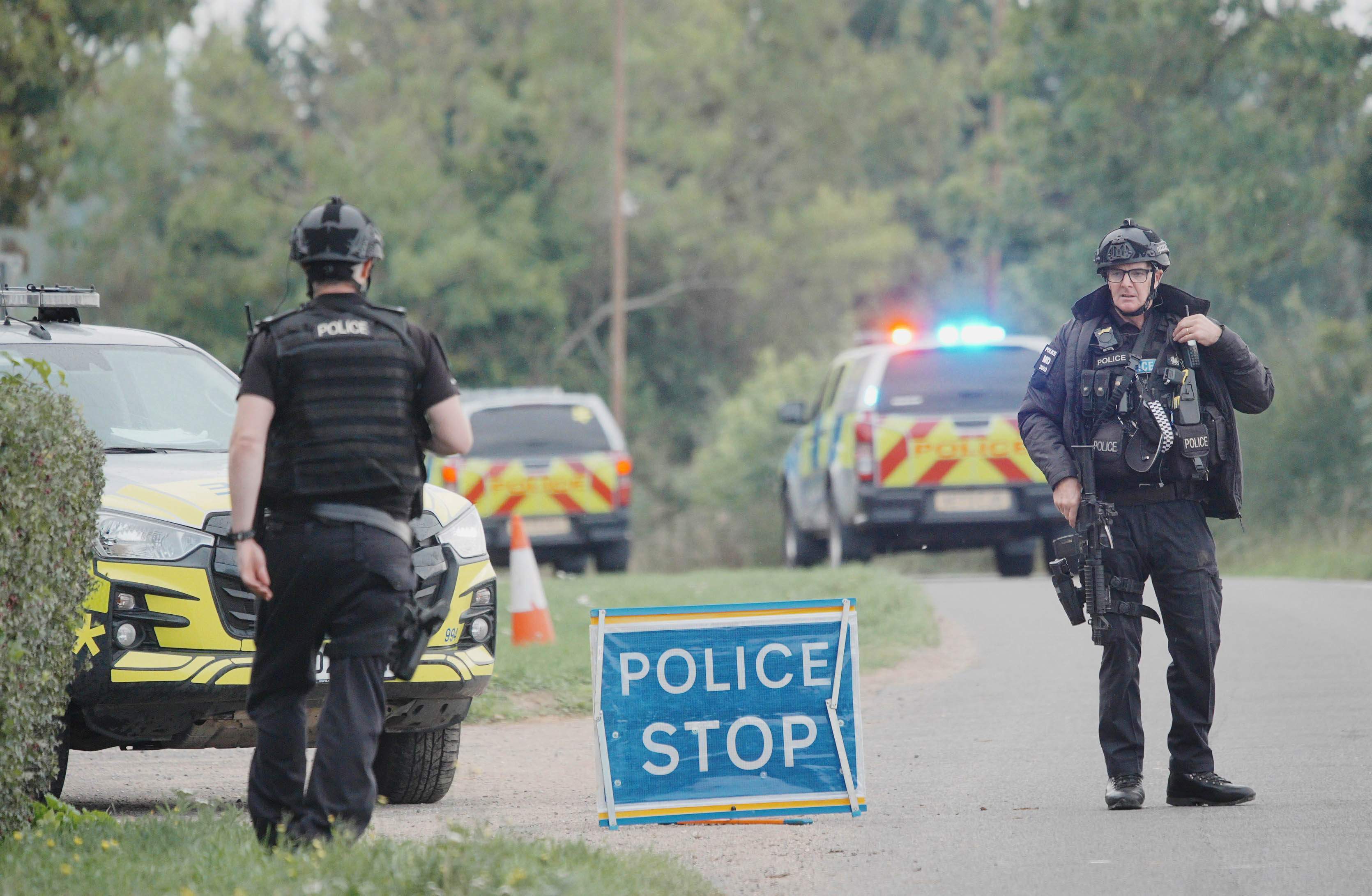
The convergence of international military projection and domestic security vulnerabilities creates a distinct structural risk profile for host nations. When Royal Air Force Fairford in Gloucestershire was designated to support United States bomber operations during the 2026 conflict with Iran, it transitioned from a quiet logistical node into a primary vector for retaliatory subversion. The subsequent arrest of five men near the perimeter—followed by subsequent developments and charges under the National Security Act—exposes the friction points inherent in defending modern high-value military installations against asymmetrical, low-threshold attacks.
The Cost Asymmetry of Low-Threshold Subversion
Traditional threat models prioritize high-signature kinetic incursions, requiring specialized combat engineering, clandestine communications networks, or coordinated paramilitary assaults. However, state-backed proxy operations rely on economic and operational asymmetry. Deploying low-cost assets such as commercial vans, readily accessible accelerants like petrol, and localized operatives minimizes financial overhead while maximizing disruption potential. If you liked this post, you should look at: this related article.
The economic calculus heavily favors the saboteur. Procuring civilian transport and basic incendiary materials incurs negligible capital expenditure compared to the immense valuation of the strategic assets housed within the installation—such as long-range strategic bombers, nuclear-capable platforms, and specialized maintenance infrastructure. When a security perimeter must account for infinite variables across miles of rural perimeter, an adversary needs only a single undetected breach of routine to achieve strategic psychological impact. The arrests near Fairford illustrate that modern state-backed interference often bypasses conventional weapon caches in favor of improvised, deniable tradecraft designed to test the responsiveness of domestic civilian and military policing.
Intelligence Silos and the Public Intervention Gap
A critical vulnerability highlighted by the Gloucestershire incident involves the latency between operational preparation and interdiction. The disruption of the suspected plot did not originate from automated digital surveillance algorithms or predictive intercept networks, but from analog observation—a local resident identifying unusual vehicle configurations blocking rural access routes. For another perspective on this development, check out the latest update from USA Today.
This dynamic underscores a fundamental limitation in contemporary threat detection. High-tier intelligence agencies excel at intercepting encrypted communications and tracking known transnational actors, yet they frequently struggle with compartmentalized micro-cells operating without digital footprints or prior criminal records. When foreign intelligence services utilize local proxies or unwitting intermediaries to conduct reconnaissance, traditional signals intelligence filters often fail to register the anomaly.
The reliance on civilian vigilance introduces a high-variance variable into national security frameworks. While community-reporting hotlines serve as a vital defensive layer, depending on spontaneous citizen intervention exposes a structural blind spot in perimeter defense and counterintelligence monitoring. The latency between initial staging and police response dictates whether an operation is intercepted at the reconnaissance phase or after the initiation of kinetic damage.
Legal Architecture and the Burden of Proof
Prosecuting state-backed subversion under domestic criminal frameworks presents significant jurisdictional hurdles. Traditional criminal law requires proof of an immediate, overt act in furtherance of a specific crime. In contrast, modern national security legislation—such as the U.K. National Security Act—attempts to bridge this gap by criminalizing preparatory acts, foreign intelligence assistance, and material support for foreign actors operating on behalf of a foreign power.
The detention and subsequent charging of suspects under these expanded statutory powers reflect a necessary adaptation in legal doctrine. In cases involving state proxies, suspects often operate under layers of plausible deniability, communicating via burner channels and avoiding direct links to foreign handlers. Investigators must construct a circumstantial case based on physical evidence, such as the recovery of accelerants inside seized vehicles, rather than explicit instructions or intercepted operational manifests.
This evidentiary requirement creates a high operational burden for crown prosecutors. Holding suspects under extended anti-terrorism or national security powers buys time for forensic extraction, but it also places intense pressure on law enforcement to convert raw suspicion into admissible evidence before statutory bail or release thresholds are reached.
The Logistical Feedback Loop of Threat Dispersion
Military installations function as fixed-cost strategic nodes designed for power projection, yet the emergence of credible domestic threats forces a reevaluation of asset placement. Following the security alert at Fairford, the decision by the U.S. Air Force to relocate strategic bombers demonstrates the immediate operational disruption caused by low-level sabotage threats.
This creates a secondary strategic victory for the adversary without requiring a successful attack. If the mere presence of suspicious vehicles and petrol containers is sufficient to induce the redeployment of high-value aircraft away from forward operating bases, the tactical utility of those bases is severely degraded. Adversaries recognize that forcing the host nation into a perpetual defensive posture achieves strategic objectives through deterrence by disruption.
The defensive response must therefore evolve beyond physical hardening and increased police cordons. Securing an active military facility embedded within civilian infrastructure requires an integrated operational matrix combining local intelligence sharing, continuous perimeter telemetry, and rapid-deployment counter-surveillance units capable of neutralizing reconnaissance teams before staging occurs.
Strategic Execution and Operational Forecasts
Future state-sponsored subversion will increasingly bypass traditional espionage channels in favor of decentralized, gig-economy-style proxy tasking. Intelligence services will recruit financially vulnerable individuals or ideologically motivated actors to conduct isolated phases of an operation—surveillance, transport, or procurement—without connecting them to a centralized command structure.
Defending against this operational model requires three distinct structural adjustments:
First, security perimeters must expand outward through active, predictive electronic surveillance and persistent aerial monitoring rather than relying solely on static checkpoints and reactive rural patrols.
Second, civil-military intelligence fusion must bridge the gap between local policing data and national security agency databases, ensuring that minor rural anomalies are instantly cross-referenced against broader transnational threat matrices.
Third, allied host nations must establish clear burden-sharing protocols regarding base security, ensuring that domestic police forces are adequately resourced to manage the extraordinary security overhead imposed by hosting foreign power projection assets.
The events at RAF Fairford serve as an empirical stress test for western domestic security architecture. Resolving these vulnerabilities requires abandoning the assumption that domestic territory remains insulated from the kinetic and psychological spillovers of distant geopolitical conflicts.


