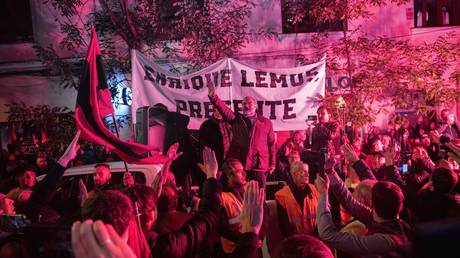
Public commemorations marking the November 20, 1975 death of Spanish dictator Francisco Franco function less as historical memorials and more as tactical recruitment and signaling mechanisms for fragmented far-right networks. While standard media coverage reduces these annual gatherings in Madrid to sensationalist displays of fascist salutes and neo-Nazi iconography, an operational analysis reveals a deliberate institutional and street-level strategy designed to test the boundaries of Spain's Democratic Memory Law while consolidating fringe ideological factions under a unified historical mythos.
To understand the persistence of these events nearly five decades after Spain's transition to democracy, analysts must separate the visual spectacle from the underlying organizational mechanics. The annual "20-N" (November 20) rallies—historically centered around Madrid's Plaza de Oriente, the Mingorrubio cemetery in El Pardo, and previously the Valley of the Fallen (now Valle de Cuelgamuros)—operate through a three-part framework: ideological syncretism, legal arbitrage, and media amplification. For a different perspective, see: this related article.
The Mechanics of Ideological Syncretism
A primary analytical failure in mainstream reporting is treating "Spanish neo-Nazis" and traditional "Francoists" as interchangeable categories. Historically and ideologically, these factions represent distinct traditions that frequently clashed during the twentieth century. Understanding how they converge every November requires breaking down the coalition into its constituent parts.
- National Catholicism and Nostalgic Francoism: Represented by organizations such as the Fundación Nacional Francisco Franco (FNFF), this cohort adheres to the traditional pillars of the Francoist state: authoritarian conservatism, strict Catholic orthodoxy, centralist Spanish nationalism, and anti-communism. Their demographic skews older, and their primary objective is the preservation of the regime's historical legacy rather than revolutionary racial nationalism.
- National Syndicalism (Falangism): Groups such as Falange Española de las JONS draw from the pre-Francoist fascism of José Antonio Primo de Rivera, who was also executed on November 20 (in 1936). Falangism emphasizes a corporatist economic model, third-position anti-capitalism, and radical syndicalism. Historically, orthodox Falangists viewed Franco's military dictatorship as a betrayal that co-opted their movement into a conservative bureaucracy.
- Transnational Neo-Nazism and Identitarian Networks: Younger, skinhead, and autonomous nationalist groups—such as Bastión Frontal (before its dissolution) or remnants of Hogar Social—import pan-European white nationalist and National Socialist symbols, including Celtic crosses, Wolfsangel runes, and explicit neo-Nazi salutes.
The 20-N date acts as a structural bridge across these ideological divides. Because both Primo de Rivera and Franco died on November 20, the calendar creates a shared ritual space. During these demonstrations, organizers deliberately tolerate the presence of transnational neo-Nazi iconography alongside traditional pre-constitutional Spanish flags (bearing the Eagle of Saint John) and Carlist banners. This tolerance serves a specific organizational function: older, wealthier nostalgic organizations provide institutional continuity, legal defense funds, and permit acquisition, while younger neo-Nazi cohorts supply physical presence, street-level intimidation, and radical energy. Similar insight on the subject has been shared by The New York Times.
Legal Arbitrage and the Democratic Memory Law
The persistence of public fascist displays in Spain is directly tied to the friction between constitutional protections for freedom of assembly and statutory prohibitions against the glorification of dictatorship. Analyzing the legal environment exposes how organizers exploit statutory ambiguities.
In October 2022, the Spanish government enacted the Democratic Memory Law (Ley de Memoria Democrática), replacing the 2007 Historical Memory Law. The 2022 legislation explicitly outlawed acts that exalt the 1936 military coup, the Civil War, or the Franco dictatorship, particularly when such acts humiliate victims or occur in public spaces. The law introduced administrative fines ranging from 200 to 150,000 euros and established mechanisms to dissolve foundations that publicly defend Francoism.
Despite this statutory framework, 20-N demonstrations continue to receive administrative authorization from the Government Delegation in Madrid. This occurs through a predictable sequence of legal maneuvers:
- Framing as Religious or Cultural Assembly: Organizers register gatherings as Catholic masses for the souls of the deceased or as historical commemorations rather than political rallies. Under Article 16 and Article 21 of the Spanish Constitution, religious freedom and the right of peaceful assembly carry high thresholds for prior restraint.
- Jurisdictional Separation Between Authorization and Enforcement: Administrative authorities cannot preemptively ban a march solely on the suspicion that participants might commit administrative infractions. Law enforcement relies on post-facto documentation—recording video and photographing individuals performing fascist salutes or displaying banned insignia—to issue administrative sanctions weeks or months later.
- The Criminal Code Threshold: Under Article 510 of the Spanish Penal Code, hate speech and the justification of genocide or crimes against humanity require proof of direct incitement to violence, hostility, or discrimination against protected groups. Courts have consistently ruled that displaying Francoist flags or singing the Falangist anthem Cara al Sol, absent explicit threats of violence, falls short of criminal prosecution, relegating enforcement to slow-moving administrative fines.
This creates an operational asymmetry. For marginal political groups with minimal electoral viability, receiving a state fine for a 20-N demonstration is not a deterrent; it is a low-cost marketing expenditure that validates their anti-system credentials to prospective recruits.
The Media Amplification Loop
Sensationalist journalism—typified by headlines emphasizing raw video and photo galleries of Nazi salutes—inadvertently completes the organizers' communication strategy. Fringe political actors operate under an attention-economy model where visibility is the primary metric of success.
When a gathering of 200 to 500 individuals in a city of over three million generates national and international headlines, the return on organizational effort is disproportionately high. This amplification loop operates through three distinct stages:
- Visual Provocation: Participants wear standardized dark attire, carry torches, and execute synchronized Roman salutes specifically designed to produce high-contrast, emotionally charged imagery for press photographers.
- Editorial Selection: Digital news outlets prioritize high-arousal visual content to maximize click-through rates, framing a numerically small gathering as a widespread resurgence of fascism.
- Internal Distribution: Organizers harvest mainstream media coverage, strip out the critical editorial framing, and redistribute the photos and broadcast clips across encrypted messaging channels (such as Telegram) as proof of movement strength and state anxiety.
Through this mechanism, an isolated street action achieves national reach without requiring the financial capital or grassroots infrastructure normally necessary for mass political mobilization.
Spatial Relocation and Symbolic Decentralization
The physical geography of 20-N commemorations has undergone forced decentralization over the past decade, altering the tactical profile of these events.
Historically, the epicenter of Francoist mourning was the Valle de los Caídos (Valley of the Fallen), the monumental basilica carved into the Sierra de Guadarrama mountains where Franco was buried in 1975. The site offered immense architectural scale, physical isolation from counter-protesters, and state-maintained infrastructure.
The exhumation of Franco's remains in October 2019 and their relocation to the Mingorrubio cemetery in El Pardo, followed by the 2022 exhumation of Primo de Rivera from the basilica, disrupted this centralized ritual. Deprived of their primary monument, far-right networks adapted by fragmenting their spatial footprint across Madrid:
- Mingorrubio Cemetery: Serves as the private, tightly controlled site for the Franco family and core FNFF loyalists, restricting mass street-level participation.
- Urban Squares (Plaza de Oriente, Plaza de la Moncloa): Urban plazas allow smaller groups to appear visually dense in tight camera frames while forcing municipal police to deploy significant crowd-control resources to prevent clashes with anti-fascist counter-demonstrators.
- Decentralized Parish Churches: Requiem masses are distributed across multiple Madrid parishes, dispersing law enforcement monitoring and creating multiple minor flashpoints rather than a single containable event.
While state intervention successfully removed the dictator's remains from a state-subsidized monument, the unintended operational consequence was pushing hardline elements directly into central urban streets, increasing the visibility of radical fringe groups to the general public and international press.
Strategic Countermeasures and Institutional Limitations
Containing the operational utility of 20-N mobilizations requires shifting focus from reactive media outrage to targeted administrative and communication protocols. However, policymakers and analysts must recognize the structural limitations of state intervention within a constitutional democracy.
First, administrative enforcement of the Democratic Memory Law must transition from symbolic fines against individual attendees to financial and organizational audits of the sponsoring entities. Targeting individual marchers with minor fines creates martyrs without degrading organizational capacity. Auditing the tax-exempt status, property holdings, and cross-border funding mechanisms of foundations that repeatedly organize unlawful exaltations strikes directly at the logistical backbone enabling these rallies.
Second, editorial and analytical frameworks must decouple physical crowd size from ideological influence. Quantifying actual attendance—often fewer than 500 participants across an entire metropolitan area—and contrasting those figures against Spain's broader electoral landscape prevents fringe actors from capturing disproportionate narrative authority.
The fundamental limitation remains constitutional: a liberal democracy cannot entirely eliminate ideological nostalgia or coded public assembly without eroding the legal protections of free association and religious expression that safeguard legitimate political dissent. Consequently, state policy cannot eradicate the annual 20-N gathering entirely; the realistic objective is to strip these events of public subsidies, deny them state-owned monumental backdrops, and enforce rapid financial penalties on sponsoring organizations so that street-level provocation becomes logistically unsustainable.