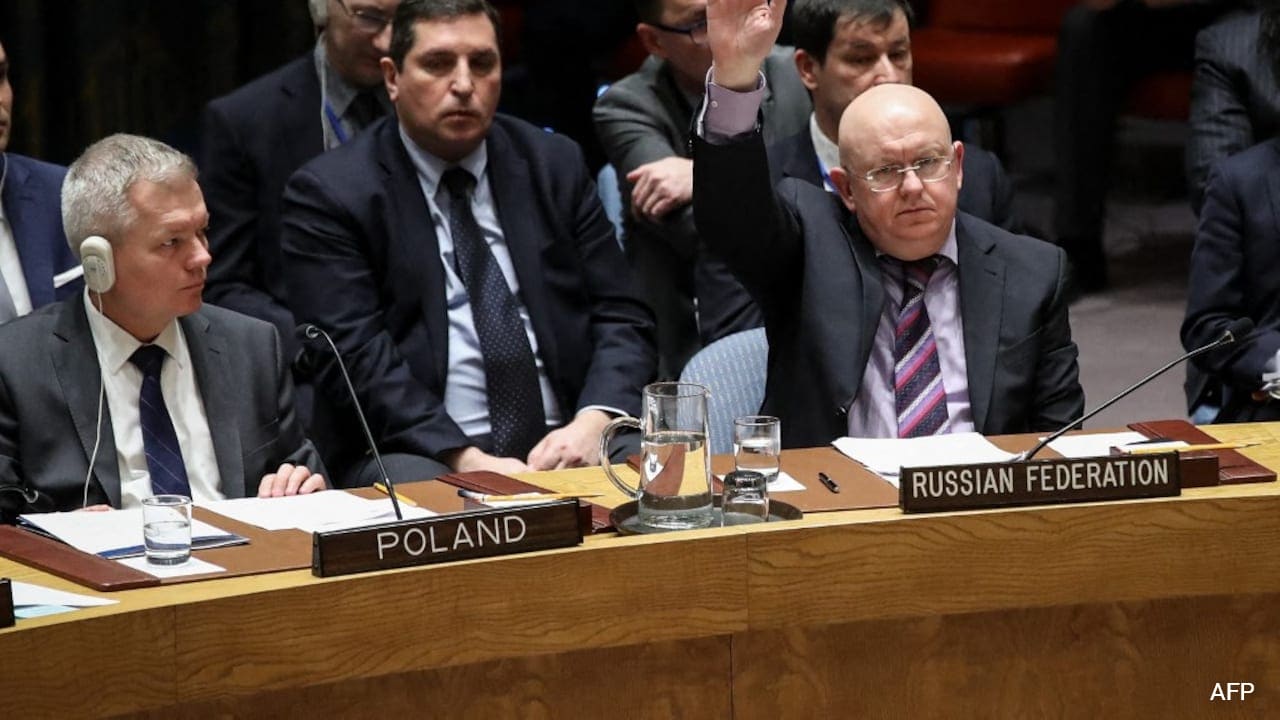
International enforcement architecture relies on a fragile premise: that permanent members of the United Nations Security Council share a baseline commitment to preventing nuclear proliferation. When that consensus fractures, regulatory bodies designed to police global trade routes become instruments of diplomatic theater. The recent double veto cast by Russia and China against a United States-sponsored resolution to extend the mandate of the UN panel monitoring Iran sanctions marks a structural turning point. This is not merely a diplomatic disagreement over voting records; it is the systemic dismantling of independent oversight in international security.
To understand the mechanics of this failure, one must examine the legal and operational framework governing the sanctions regime. Under the provisions of the 2015 Joint Comprehensive Plan of Action and UN Security Council Resolution 2231, mechanisms were established to allow the snapback of pre-existing international restrictions if non-compliance occurred. When Western powers—France, Germany, and the United Kingdom—triggered this snapback process, the formal apparatus of the 1737 sanctions committee and its associated Panel of Experts was theoretically restored.
However, legal restoration on paper diverges sharply from operational reality on the ground. The Panel of Experts served as the primary investigative engine of the Security Council. Operating independently, these investigators tracked illicit maritime shipments, mapped front companies, audited financial transactions, and documented procurement networks designed to circumvent restrictions on nuclear and ballistic missile components. Their reports provided Member States with empirical proof of violations, establishing a paper trail that made wholesale sanctions evasion difficult and costly.
By vetoing the mandate extension, Moscow and Beijing effectively neutralized the investigative capacity of the council. The strategic rationale driving this veto is rooted in realpolitik and economic survival. Both Russia and China maintain deep, expanding bilateral partnerships with Tehran. For Moscow, isolated by sweeping Western restrictions following its invasion of Ukraine, Iran has transformed into a vital supplier of military hardware, drone technology, and transshipment corridors. For Beijing, Iran remains a primary source of discounted energy imports, absorbed via complex maritime shuffling and ship-to-ship transfers that depend entirely on opaque logistics networks.
An independent UN panel threatens these commercial and military lifelines. By cutting off funding and revoking the legal authority of the monitors, the vetoing powers have removed the principal mechanism for public accountability. The consequences of this vacuum extend far beyond the immediate diplomatic fallout in New York. Without an impartial investigative body, illicit trade operates with near-total opacity.
The Economics of Sanctions Evasion
Sanctions without enforcement degrade into symbolic gestures. Economic theory dictates that restrictions create a market distortion: they raise the cost of compliance while increasing the profit margin for evasion. When risk rises, illicit actors adapt by building redundancy into their supply chains.
The primary vector for Iran's sanctions circumvention involves maritime logistics. Crude oil and refined products are routinely transferred across international waters using dark-fleet tankers—vessels with disabled transponders, falsified flag registrations, and multiple layers of shell-company ownership. These shipments are funneled through regional intermediaries before finding permanent buyers.
During its active operational cycles, the Panel of Experts systematically mapped these shadow networks. Investigators subpoenaed shipping registries, analyzed satellite telemetry, and interviewed port authorities to expose the corporate fronts facilitating illicit capital flows. The elimination of the panel removes the friction that these investigations imposed on evasion rings. Without international auditors tracking vessel movements and freezing front-company assets, the transaction costs of smuggling drop precipitously. Evasion networks can now operate with institutional security, knowing that no official UN body will compile dossiers or publish findings that compel national financial institutions to act.
The Legal Standoff and the Crisis of Legitimacy
The confrontation at the Security Council was characterized by deep procedural friction. Russian and Chinese diplomats argued that the underlying legal basis for the monitoring mechanism was invalid. Their core argument rests on the assertion that the snapback of restrictions was procedurally flawed and politically motivated by Western states attempting to salvage a defunct nuclear agreement.
From this perspective, any institution derived from the snapback is legally null. This procedural obstruction represents a broader strategy: using the veto power to paralyze Western-led enforcement mechanisms across multiple theaters. Similar patterns paralyzed monitoring groups in North Korea and Mali. By starving these investigative bodies of legal authorization, permanent members ensure that international law remains unenforceable whenever it conflicts with their strategic interests.
Western delegations countered by accusing Beijing and Moscow of shielding a proliferation risk and protecting regimes that violate international norms. U.S. and European officials emphasized that blocking oversight creates a dangerous precedent, rewarding non-compliance and encouraging clandestine military cooperation between isolated states. Yet, moral arguments carry little weight in a chamber governed by veto privileges. The arithmetic of the council dictated the outcome: despite securing eleven affirmative votes against two negative votes, the resolution failed because of the permanent member veto.
The Information Vacuum and the Role of the IAEA
The removal of the expert panel creates a severe data deficit. National intelligence agencies possess independent surveillance capabilities, but intelligence remains classified, partisan, and difficult to mobilize for collective international enforcement. The UN panel occupied a unique institutional niche: its findings possessed multilateral legitimacy, bridging the gap between raw intelligence and actionable international law.
In the absence of this watchdog, the International Atomic Energy Agency remains the sole independent technical body with a mandate inside Iran. However, the IAEA’s remit is strictly technical—focused on nuclear material accounting, facility inspections, and monitoring enrichment levels. It does not possess the mandate, resources, or legal authority to investigate financial money laundering, front-company registries, or conventional arms transfers.
Since strikes on Iranian nuclear facilities degraded conventional inspection access, verifying the precise status of enriched uranium stockpiles has grown increasingly difficult. With enriched material lingering close to weapons-grade thresholds, the lack of collateral trade and sanctions monitoring creates a multi-layered security blind spot. Nuclear advancement and economic evasion now proceed concurrently, insulated from multilateral scrutiny.
The Minilateral Solution
Faced with institutional paralysis at the Security Council, Western powers are forced to adapt their enforcement strategy. Multilateral consensus is dead; the future belongs to minilateral coalitions.
Diplomatic signals following the veto point toward the formation of alternative monitoring frameworks modeled after the post-North Korea oversight adjustments. France, Germany, the United Kingdom, and the United States are positioned to establish an independent, multi-nation oversight team outside the formal UN structure. This coalition will pool national intelligence, share shipping manifests, and issue joint advisories to global maritime insurers and financial institutions.
Such an ad-hoc mechanism bypasses the UN veto entirely, but it suffers from inherent limitations. Without a formal UN mandate, these coalitions lack the legal standing to compel cooperation from non-aligned states through which illicit cargoes transit. Port states in Asia, the Middle East, and Africa are under no international obligation to honor warnings issued by a Western coalition rather than a Security Council committee. Consequently, enforcement will shift from global regulation to targeted, bilateral pressure—targeting specific banks, insurers, and vessels caught facilitating prohibited transactions.
The veto in New York did not eliminate sanctions; it privatized their enforcement. By stripping away the veneer of universal oversight, Russia and China have accelerated the fragmentation of the international order into competing economic blocs. In this fragmented environment, rules apply only to those without the power to break them, and compliance is determined not by international law, but by the capacity to project power across contested trade routes.