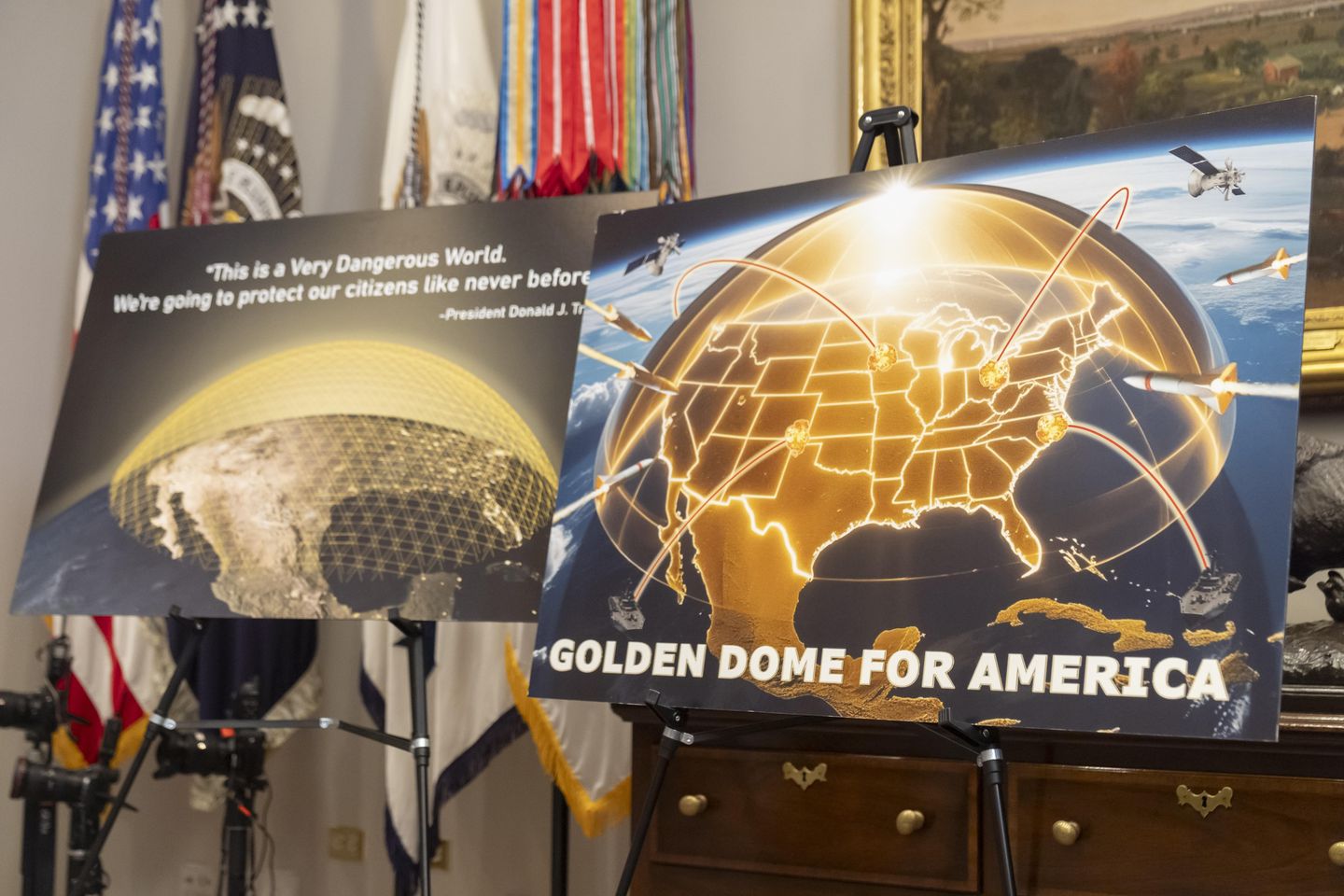
The Congressional Budget Office (CBO) projection of a $1.2 trillion price tag for the proposed "Golden Dome" missile defense system represents more than a fiscal milestone; it is a manifestation of the Cost-Exchange Ratio (CER) reaching a point of diminishing returns. To analyze this figure, one must look beyond the sticker price and decompose the three fundamental drivers of defense economics: interceptor inventory depth, sensor-to-shooter latency, and the shifting calculus of asymmetric saturation. The $1.2 trillion estimate is not a static purchase price but a lifecycle commitment to an architecture designed to counter a threat profile that evolves faster than the procurement cycle.
The Triad of Fiscal Friction
The CBO’s trillion-dollar figure is anchored by three primary cost centers that operate on different economic principles.
- Fixed Infrastructure and R&D: This encompasses the development of next-generation interceptor technology and the deployment of persistent, high-resolution tracking sensors. These are sunk costs that scale poorly once the system is live.
- The Interceptor-to-Threat Ratio: Unlike traditional ammunition, missile defense requires a redundancy factor—typically firing two interceptors at a single incoming threat to maximize the Probability of Kill ($P_k$). If an adversary launches 500 low-cost decoys, the defender must commit 1,000 high-cost interceptors. This creates an inverted economic curve where the defender spends exponentially more to negate the attacker's linear investment.
- Operations and Maintenance (O&M): The CBO assumes a 20-to-30-year lifecycle. Missile defense systems require constant software updates, sensor recalibration, and specialized personnel. Historically, O&M accounts for nearly 60-70% of total ownership costs, a reality often obscured by the focus on initial deployment.
The Mathematical Impossibility of Total Coverage
The concept of a "Golden Dome" implies a leak-proof shield, yet the physics of missile interception dictate that perfection is an asymptotic goal. The CBO’s analysis recognizes that the marginal cost of increasing the $P_k$ from 90% to 99% is significantly higher than the cost of reaching the initial 90%.
The Interceptor Scarcity Bottleneck
The industrial base for solid rocket motors and advanced seekers is currently at capacity. Scaling up to meet the requirements of a nationwide shield involves more than just funding; it requires a complete overhaul of the defense industrial supply chain.
- Production Lag: High-end interceptors like the SM-3 or GBI (Ground-Based Interceptor) take years to manufacture.
- Inventory Depletion: In a sustained conflict, a defender can be "shot dry" within days if the adversary employs massed salvos of cheap, unguided rockets alongside precision munitions.
Kinetic vs. Non-Kinetic Interception
A significant portion of the $1.2 trillion is likely allocated to the transition from kinetic "hit-to-kill" vehicles to directed energy (DE) or high-power microwave (HPM) systems. These technologies promise a "bottomless magazine" where the cost per shot is reduced to the price of fuel or electricity. However, DE systems face atmospheric attenuation and cooling constraints that currently limit their role to short-range defense. The CBO’s high-end estimate suggests a skepticism toward these technologies maturing in time to offset the cost of traditional kinetic interceptors.
Geopolitical Opportunity Cost and the Strategic Paradox
The allocation of $1.2 trillion to a defensive shield triggers the Security Dilemma. When a state invests heavily in defense, adversaries do not remain stagnant; they pivot toward technologies that bypass the shield, such as hypersonic glide vehicles (HGVs) or submarine-launched cruise missiles (SLCMs) that fly below the radar horizon of traditional ballistic tracking.
The Displacement of Offensive Modernization
Every dollar spent on the Golden Dome is a dollar not spent on the "Nuclear Triad" or conventional power projection. This creates a strategic pivot from deterrence-through-punishment (the ability to strike back) to deterrence-through-denial (the ability to block an attack). History suggests that denial is significantly more expensive than punishment.
- Hypersonic Vulnerability: Current CBO projections must account for the fact that a dome designed for ballistic trajectories is largely ineffective against maneuverable hypersonic threats. Upgrading the sensor net to track these threats across the "mid-course" phase adds hundreds of billions to the initial estimate.
- Urban vs. Rural Prioritization: A $1.2 trillion budget cannot cover the entire landmass of a continent-sized nation. The government must choose which "assets" to protect. This introduces a political vulnerability: the system becomes a mechanism for picking winners and losers in a national survival scenario.
The Technical Burden of Integration
A missile defense system is only as capable as its Command and Control, Battle Management, and Communications (C2BMC) architecture. The Golden Dome requires an unprecedented level of sensor fusion.
- Data Saturation: During a massed attack, the system must process terabytes of data per second, discriminating between real warheads, debris, and intentional decoys.
- The "Man-in-the-Loop" Problem: The speed of incoming threats often exceeds human cognitive limits, necessitating autonomous engagement logic. This introduces catastrophic risks of false positives or "friendly fire" incidents where the system engages civilian aircraft or its own defensive assets.
- Cyber Resilience: A $1.2 trillion system is a prime target for electronic warfare. If the data link between the sensor and the interceptor is jammed or spoofed, the entire physical infrastructure becomes a collection of expensive, inert metal.
Structural Incentives for Cost Overruns
The defense procurement process is prone to "Optimism Bias." The CBO's $1.2 trillion figure is likely a baseline that does not account for the Weapon Systems Acquisition Reform Act (WSARA) realities.
- Requirement Creep: As threats evolve, the Pentagon often adds new requirements mid-build, extending the timeline and bloating the budget.
- Concurrency: To deploy the system faster, production often begins before testing is complete. When a test fail occurs, existing units must be retrofitted at a massive premium.
- Monopolistic Supply: Only a handful of prime contractors can build these systems. This lack of competition reduces the incentive for cost-control measures.
The Final Strategic Calculus
Decision-makers must determine if the Golden Dome is a viable defense or a fiscal sinkhole. The CBO report confirms that the cost of defending against a modern, near-peer adversary is rapidly becoming unsustainable under current economic models.
The strategic play is not to build a total shield, but to invest in Tiered Disruption. This involves a smaller, high-end kinetic layer for critical infrastructure, paired with a massive investment in offensive cyber and electronic warfare to disrupt the adversary’s launch sequence before a missile even leaves the rail. In the realm of national defense, an $800 billion investment in pre-launch neutralization is often more effective than a $1.2 trillion investment in post-launch interception. The true value of the CBO report is as a warning: the age of "invulnerability through spending" is over. We are entering an era where the only viable defense is a multi-domain architecture that prioritizes flexibility over brute-force coverage.