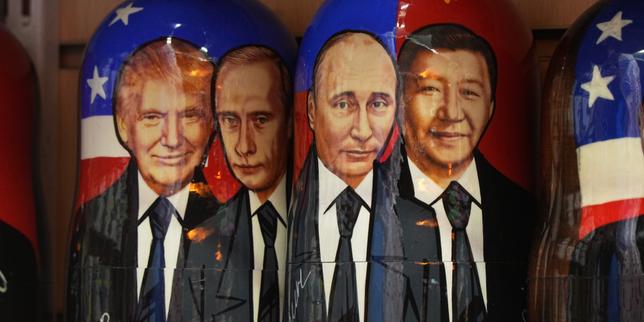
The exclusion of the Russia-Ukraine war from the formal agenda of the November 19, 2026 trilateral summit in Shenzhen between Donald Trump, Vladimir Putin, and Xi Jinping is not a diplomatic oversight; it is a calculated structural decoupling designed to isolate bilateral negotiation tracks from multilateral nuclear and energy bargaining. Standard diplomatic reporting treats the absence of a specific conflict on a summit docket as either a snub to an excluded party—in this case, Kyiv—or a sign of diplomatic paralysis. In operational statecraft, removing a high-friction regional war from a three-party executive meeting serves to prevent a single intractable dispute from holding unrelated strategic agreements hostage.
The Structural Logic of Agenda Decoupling
When three nuclear-armed states convene without a binding treaty framework, the agenda itself functions as the primary risk-management mechanism. By explicitly stating prior to the Shenzhen meeting on the margins of the Asia-Pacific Economic Cooperation (APEC) summit that Ukraine would not be on the trilateral docket, the White House established a compartmentalized bargaining architecture.
This compartmentalization operates through three distinct variables:
- Veto-Player Multiplication: Introducing the Russo-Ukrainian war into a trilateral forum grants Beijing formal standing as an equal arbiter alongside Washington and Moscow. The United States has maintained separate bilateral channels with Moscow and Kyiv to manage the conflict without Chinese participation. Keeping Ukraine off the trilateral table denies China direct diplomatic equity in European security arrangements while preserving Washington's role as the primary external mediator.
- Issue-Linkage Prevention: In multi-issue negotiations, parties routinely trade concessions across unrelated domains. Had Ukraine been formally linked to the trilateral agenda alongside nuclear disarmament and the Middle East conflict, Moscow could have demanded territorial or sanctions concessions in Eastern Europe as a prerequisite for entering strategic arms control talks. Decoupling removes this cross-domain extortion mechanism.
- Asymmetric Domestic Constraints: Each leader enters the room with incompatible domestic baselines. Kyiv, represented externally by Foreign Minister Andrii Sybiha, warned prior to the summit that a trilateral meeting would embolden Moscow to prolong its offensive. Simultaneously, Kremlin spokesperson Dmitri Peskov rejected comparisons between past great-power summits and Shenzhen, asserting that agreements reached among the three powers could not be imposed on third parties. Removing Ukraine from the formal communiqué prevents the summit from collapsing over immediate semantic disputes regarding sovereignty and territorial integrity.
The Three-Track Bargaining Matrix
To understand why the White House announced an agenda focused on nuclear disarmament and the war involving Iran while sidelining Ukraine, analysts must map the intersection of each power's immediate material bottlenecks. A trilateral summit only produces forward movement when all three participants share an overlapping cost function.
Track One: Strategic Nuclear Stability
The primary stated objective of the Shenzhen trilateral meeting was establishing an initial framework for nuclear disarmament discussions. A senior U.S. official indicated before the talks that Washington did not expect an immediate binding agreement, framing the session instead as a starting point for future negotiations.
The operational obstacle here is structural asymmetry. Historically, nuclear arms control operated as a bilateral Washington-Moscow system. Integrating Beijing introduces a three-body problem: China possesses a smaller nuclear arsenal than either the United States or Russia and has consistently resisted entering treaties drafted without its original participation. During the Shenzhen session, Xi Jinping reiterated China's standard declaratory doctrine—that a nuclear war cannot be won and must never be fought, and that nuclear weapons should ultimately be prohibited and destroyed—while avoiding commitments to quantitative caps. For Washington, getting Beijing into the same room as Moscow on the nuclear question required removing the Ukrainian theater, which Beijing views as a European and NATO entanglement unrelated to its strategic deterrence posture.
Track Two: Energy Chokepoints and the Iran Conflict
Unlike the war in Ukraine, the conflict involving Iran—triggered by Israeli-American strikes in late February 2026—imposes direct, immediate, and shared macroeconomic costs on both Washington and Beijing.
- China's Vulnerability: Beijing relies heavily on Middle Eastern energy imports and faces broader export demand contraction driven by regional instability. Consequently, China actively pressured for a resolution to the U.S.-Iran confrontation to secure its energy supply chains.
- Russia's Leverage: Moscow occupies an inverse position. Higher global energy prices resulting from Middle Eastern volatility, combined with recent U.S. sanctions relief aimed at alleviating global diesel supply shortages, strengthened Russia's fiscal position.
- Washington's Calculus: Trump publicly stated prior to the summit that ending the war in Iran was a core priority. Because Beijing holds economic leverage over Tehran and Moscow maintains defense and diplomatic ties with Iran, a trilateral format aligns the exact three actors capable of altering Tehran's strategic calculus. Ukraine lacks an equivalent trilateral pressure point.
Track Three: Shadow Bilateralism on Ukraine
The formal exclusion of Ukraine from the trilateral schedule did not mean the conflict went undiscussed in Shenzhen; it meant the format shifted from trilateral to informal bilateral. While the White House did not schedule a formal bilateral summit between Trump and Putin—contrasting with Trump's scheduled bilateral working lunch and fourth face-to-face meeting with Xi since returning to office—Trump confirmed during the Shenzhen proceedings that he and Putin held a lengthy discussion regarding the Russia-Ukraine war.
This distinction between formal agenda inclusion and informal bilateral side-conversations is critical in diplomatic execution:
- Plausible Deniability for Beijing: By keeping Ukraine off the official trilateral docket, Xi Jinping maintained China's posture of formal neutrality and avoided endorsing either Washington's mediation framework or Moscow's territorial claims, confining his remarks to broad principles of mutual respect, peaceful coexistence, and territorial integrity.
- Controlled Signaling for Washington: Trump utilized the informal interaction with Putin to project momentum toward a settlement without binding the U.S. delegation to a joint trilateral statement that European allies or Kyiv would reject as a modern equivalent of spheres-of-influence bargaining.
- Escalation Management for Moscow: Putin used the visibility of the Shenzhen platform to demonstrate diplomatic reintegration at the center of global power politics while simultaneously signaling hard limits on ceasefire terms following Ukrainian strikes on the Crimean Bridge.
The Cost Function of Informal Summits
Evaluating the Shenzhen summit requires separating optical outcomes from structural commitments. Standard media coverage focuses on the visual symbolism of Putin standing alongside Trump and Xi for the first time since the full-scale invasion of Ukraine. In strategic analysis, visual symbolism carries zero enforcement value unless backed by institutional mechanisms.
The Shenzhen meeting operated as a low-commitment exploratory forum characterized by four specific constraints:
- Absence of Pre-Negotiated Communiqués: The lack of a detailed pre-set agenda meant the leaders operated on broad declaratory statements rather than line-item treaty negotiations. While the three powers found narrow procedural alignment on opposition to the International Criminal Court, core disputes over Ukraine, Taiwan, and strategic competition remained unresolved.
- The Enforcement Deficit: Without working-group architecture beneath the executive level, declarations regarding nuclear risk reduction remain aspirational. Arms control verification requires intrusive inspection regimes and telemetry exchanges that cannot be improvised during an APEC sideline meeting.
- Allied Friction Costs: By engaging Putin directly in a trilateral setting without European or Ukrainian representation, Washington incurred immediate diplomatic friction with European partners and Kyiv, who view any great-power grouping as a threat to the principle that no decisions about European security should be made without European participation.
- Domestic Political Exposure: Entering high-stakes leader-to-leader talks without pre-cooked deliverables exposes the American executive to domestic criticism if adversaries extract reputational gains—such as the normalization of Putin's international standing—without offering verifiable concessions on the ground.
Operational Execution and Strategic Limitations
For policymakers, defense planners, and institutional risk analysts tracking post-Shenzhen trajectories, relying on public statements from trilateral summits introduces severe forecasting errors. Official readouts systematically obscure the real trade-offs occurring in adjacent bilateral channels.
To accurately model the outcomes of decoupled diplomacy, intelligence and strategy teams must apply a structured verification protocol:
- Audit Resource Flows Over Rhetoric: Disregard declaratory commitments on peace or disarmament until accompanied by verifiable shifts in material flows. In the Russian-Ukrainian theater, track diesel export volumes, secondary sanctions enforcement, and artillery supply rates rather than executive optimism regarding a ceasefire.
- Monitor Secondary Theater Linkages: Watch for quiet policy adjustments in the Middle East as leading indicators of U.S.-China-Russia bargaining. If Chinese state enterprises alter Iranian crude purchasing patterns or if Russian diplomatic support for Tehran softens, those shifts confirm that substantive horse-trading occurred behind closed doors in Shenzhen.
- Track Working-Level Nuclear Delegations: A leader-level agreement to "start a conversation" on nuclear disarmament only becomes operational if the U.S. State Department, the Russian Foreign Ministry, and the Chinese Ministry of Foreign Affairs name permanent bilateral or trilateral negotiating teams within 60 to 90 days. Without named envoys, the Shenzhen nuclear track remains purely rhetorical.
This analytical framework carries a strict limitation: leader-centric diplomacy in systems with concentrated executive power—such as the United States, Russia, and China—can bypass bureaucratic inertia overnight. A single unscripted bilateral concession between Trump and Putin outside formal channels can invalidate institutional forecasts built on traditional interagency processes. Analysts must weight executive unpredictability alongside structural incentives.
The Strategic Imperative for Excluded Actors
The Shenzhen precedent demonstrates that major powers will increasingly compartmentalize global crises to protect their core bilateral interests, leaving regional allies outside the room when strategic nuclear or global energy stability is at stake. European capitals and Kyiv cannot reverse this structural shift through diplomatic protests against trilateral optics. Instead, excluded actors must raise the material cost of any bilateral settlement negotiated without their consent by hardening autonomous defense industrial production, securing independent energy reserves, and locking in binding multi-year financial commitments that survive shifts in Washington's executive priorities.