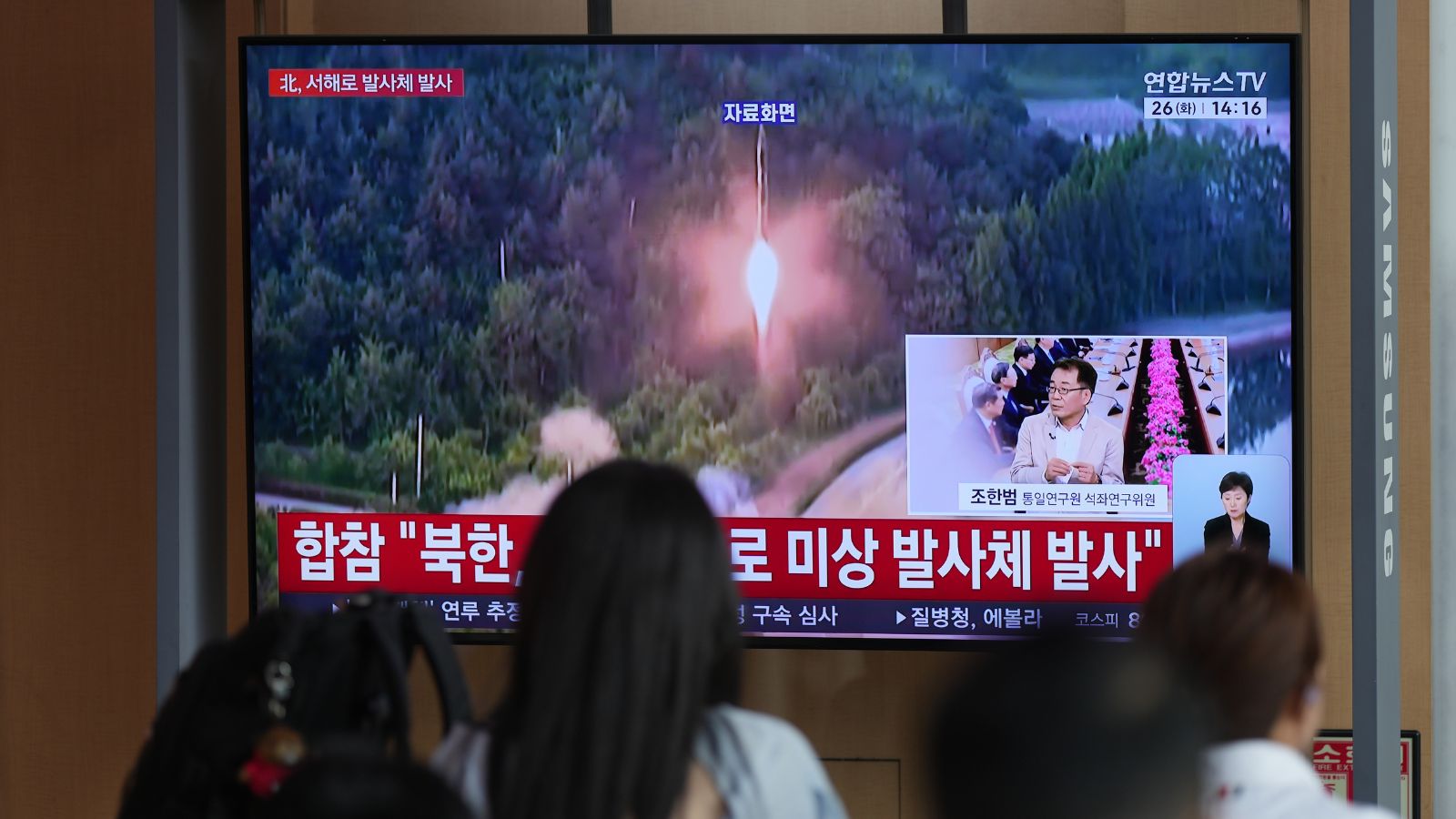
North Korea’s launch of multiple short-range ballistic missiles (SRBMs) from the western coastal city of Jongju into the Yellow Sea represents a calculated shift in operational geometry rather than a random act of provocation. By launching short-range assets westward toward China, rather than eastward over the Sea of Japan, Pyongyang is executing a deliberate strategy designed to optimize domestic military testing while carefully managing regional escalation.
Western media frequently misinterprets these events as erratic signals aimed at capturing Washington's attention. A rigorous, data-driven analysis of the telemetry, timing, and geographic vectors reveals a much tighter integration with North Korea’s domestic defense modernization timeline and South Korea's shifting defense procurement strategy.
The Operational Geometry of West-Coast Launches
Analyzing the telemetry of the latest launch reveals the primary mechanical objectives of the test. According to South Korea's Joint Chiefs of Staff (JCS), at least one projectile achieved a flight profile of approximately 80 kilometers (50 miles) before splashdown. In military architecture, this specific telemetry indicates a compressed or depressed trajectory test, which carries two distinct engineering implications:
- Radar Avoidance and Terminal Velocity Optimization: Firing an SRBM on a lower, flatter trajectory keeps the missile beneath optimal tracking envelopes for long-range early warning radars during the early stages of flight. This compresses the reaction window for terminal missile defense systems like Patriot (PAC-3) and Terminal High Altitude Area Defense (THAAD) networks stationed in South Korea.
- Vectoring Constraints: Launching from Jongju into the Yellow Sea provides a highly constrained test corridor. Unlike eastern launches that can fly hundreds of kilometers into open waters or overfly Japan, western launches must avoid violating Chinese airspace. The 80-kilometer flight profile demonstrates highly disciplined fuel burn termination or specialized energy-management maneuvers designed to test close-range precision targeting without triggering diplomatic friction with Beijing.
This launch follows an April 19 test sequence that showcased sub-munition payloads, which North Korean state media classified as a demonstration of cluster-bomb warheads. When paired with early April tests involving electromagnetic pulse (EMP) concepts and specialized warhead designs, a clear development pattern emerges. Pyongyang is transitioning away from raw range extension toward theater-level sophistication: payload diversification, salvo saturation, and defensive penetration.
The Dual-Front Deterrence Model
The strategic timing of the Jongju launches suggests a dual-front signaling model designed to respond to internal policy shifts in South Korea while leveraging a shifting diplomatic calendar involving China.
                  ┌────────────────────────────────────────┐
                  │ North Korea Tactical Missile Launch    │
                  │ (Jongju West Coast / Depressed Vector) │
                  └───────────────────┬────────────────────┘
                                      │
             ┌────────────────────────┴────────────────────────┐
             ▼                                                 ▼
┌────────────────────────────────────────┐       ┌────────────────────────────────────────┐
│      South Korean Defensive Pivot       │       │       Chinese Geopolitical Buffer      │
├────────────────────────────────────────┤       ├────────────────────────────────────────┤
│ • Countering President Lee's AI/Drone  │       │ • Exploiting upcoming diplomatic visits │
│   modernization mandates.              │       │ • Constraining flight vectors to avoid │
│ • Matching Seoul's nuclear submarine   │       │   airspace violations with Beijing.    │
│   acquisition ambitions.               │       │ • Testing regional limits during West  │
│ • Slicing through regional deterrence. │       │   Sea naval patrol shifts.             │
└────────────────────────────────────────┘       └────────────────────────────────────────┘
Front One: Neutralizing South Korea's Asymmetric Modernization
Hours before the missiles were detected, South Korean President Lee Jae Myung convened a Cabinet meeting emphasizing an aggressive defense modernization agenda. President Lee's directive focused heavily on integrating artificial intelligence into command-and-control structures, expanding military drone fleets, and explicitly pursuing the acquisition of nuclear-powered submarines through diplomatic agreements with Washington.
By executing a multi-missile volley immediately after these policy statements, North Korea demonstrates a cost-imposition strategy. Pyongyang is signaling that South Korea’s conventional technological edge can be neutralized or bypassed via low-cost, mass-produced ballistic missile salvos capable of overwhelming missile defense radars through sheer volume.
Front Two: The Beijing Diplomatic Buffer
The geographic choice of the Yellow Sea coincides with intense speculation regarding an impending diplomatic visit by Chinese President Xi Jinping to Pyongyang. Firing missiles toward China’s maritime doorstep appears counterintuitive if the goal is to maintain strong relations with Beijing. However, historical launch data suggests that Pyongyang uses these high-leverage windows to demonstrate sovereign military capabilities, ensuring that any bilateral negotiations occur from a position of strength. By limiting the missile range to 80 kilometers, North Korea demonstrates sufficient operational control to reassure China that its local security architecture is unthreatened, even while raising the threat profile for Seoul and Washington.
The Collapse of the Denuclearization Paradigm
The structural prose of modern diplomacy often relies on the premise that economic sanctions or the promise of sanctions relief can induce denuclearization. This framework is obsolete. The institutional positioning of the Kim Jong Un administration has shifted from using weapons programs as bargaining chips to treating them as permanent, structural components of state survival.
The collapse of the 2019 Hanoi summit with the United States marked a permanent turning point in North Korea's strategic calculus. Since that failure, Pyongyang has systematically dismantled its diplomatic framework for denuclearization. The state has formally declared its nuclear status as "irreversible" and codified South Korea not as a misguided relative to be unified with, but as the state’s permanent and most hostile adversary.
Consequently, conventional diplomatic overtures from Seoul—such as the recent statements by Foreign Ministry spokesperson Park Il calling for a phased, pragmatic approach to peace—are fundamentally misaligned with North Korea's internal logic. Pyongyang does not seek a negotiated settlement based on disarmament; it seeks international recognition as a nuclear weapons state, mirroring the historical trajectories of Pakistan and India.
Structural Limitations of Allied Countermeasures
The response from the US-South Korea-Japan trilateral alliance relies on three primary pillars: enhanced surveillance, information sharing, and joint readiness exercises. While these measures stabilize the immediate security environment, they face deep structural bottlenecks.
The first limitation is the data-sharing bottleneck. Real-time radar data sharing between Seoul, Tokyo, and Washington optimizes tracking, but it does not expand the physical engagement windows for terminal defense systems. If an SRBM is launched from a west-coast location like Jongju on a depressed trajectory, the physical flight time remains under three minutes. This creates a severe cognitive and operational bottleneck for human command structures tasked with authorizing interceptors.
The second limitation involves the cost-exchange ratio of missile defense. A standard short-range ballistic missile manufactured by North Korea relies on an established domestic military industrial supply chain, utilizing low-cost propellants and simplified guidance systems. Intercepting these assets requires highly sophisticated, imported capabilities such as the Patriot Advanced Capability-3 (PAC-3) or the KM-SAM system. The cost-per-interception is orders of magnitude higher than the cost of the offensive projectile. In a sustained conflict scenario, a saturation strike using dozens of these close-range weapons would quickly deplete South Korea's interceptor inventory, leaving high-value military installations vulnerable to subsequent strikes.
The Strategic Playbook For Regional Actors
Given these structural realities, treating North Korean missile tests as isolated political statements guarantees a failure of deterrence. The alliance must shift from a reactive posture to a proactive containment model focused on the realities of tactical missile proliferation.
First, South Korea must accelerate the development of its independent, low-altitude missile defense network (LAMD), specifically optimized for low-trajectory, short-range salvos rather than high-altitude strategic threats. This system must prioritize minimizing the cost-per-interception to alter the economic calculus of North Korea's saturation strategy.
Second, western analysts must decouple North Korean military activity from the US election cycle or political movements in Washington. The data demonstrates that North Korea is executing a highly disciplined, multi-year engineering roadmap designed to achieve total theater-level interdiction capabilities. Defense procurement and deployment schedules in Seoul and Washington must be calibrated to match this structural reality, focusing heavily on hardened command-and-control nodes, redundant logistics lines, and rapid-response drone capabilities designed to neutralize mobile launchers before ignition.