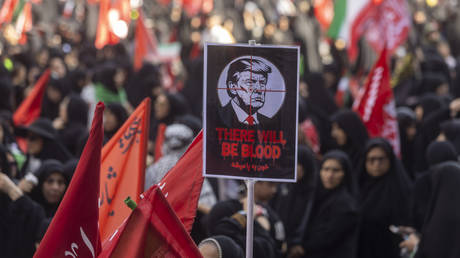
The assassination of Supreme Leader Ali Khamenei on February 28, 2026, marks the fracturing of the institutional architecture that sustained the Islamic Republic for nearly four decades. The state's response—culminating in a highly controlled, multi-city marathon funeral ending with his burial in Mashhad—exposes a profound mismatch between the regime's outward projection of strength and its severe structural internal vulnerabilities. While official media utilized the mourning period to display geopolitical defiance and enforce ideological compliance, the underlying mechanics of power transition indicate that the transition from Ali Khamenei to his son, Mojtaba Khamenei, introduces unprecedented systematic friction.
To evaluate the trajectory of post-Khamenei Iran, analysts must look past the performative pageantry of state mourning and dissect the core strategic functions currently under stress. For an alternative view, check out: this related article.
The Tri-Centric Power Framework and the Succession Deficit
The survival of the Iranian theocracy relies on a delicate equilibrium among three core components: clerical legitimacy (velayat-e faqih), paramilitary economic dominance (the Islamic Revolutionary Guard Corps, or IRGC), and bureaucratic-republican execution. Ali Khamenei functioned as the central node connecting these circles, managing factions by shifting patronage and balancing competing hardline elements.
The transition to Mojtaba Khamenei breaks this model due to two structural deficits: Related analysis on this matter has been provided by Reuters.
- The Theological Deficit: Unlike his father, who secured a promotion to Grand Ayatollah upon assuming office despite initial credentials challenges, Mojtaba Khamenei lacks independent theological standing (marja'iyya). His authority is inherited rather than earned through clerical seniority, leaving him vulnerable to quiet dissent from the senior traditional seminaries of Qom and Najaf.
- The Physical and Public Absence Deficit: Having been reportedly wounded in the initial airstrikes and failing to make a single public appearance throughout the six days of mass funeral processions, Mojtaba's reliance on written decrees erodes the physical authority required of an absolute ruler during a crisis. This operational isolation forces him to govern through intermediaries, creating a prime environment for bureaucratic insubordination.
The public fracture within the Assembly of Experts—where over 60 members circumvented the body's leadership to issue an unprompted, maximalist statement on foreign policy red lines—proves that the supreme leader's office no longer exercises total command over its core institutions. Instead of acting as a unified rubber-stamp body, the Assembly is shifting into a venue for factional infighting over the limits of negotiation with Washington.
The Cost Function of Performative Legitimacy
The prolonged, four-month gap between Khamenei’s death in February and his burial in July highlights a major operational challenge. Faced with widespread public polarization—characterized by both state-orchestrated mourning and documented public celebrations—the regime used the delay to establish a security presence capable of preventing mass unrest during the transition.
The funeral arrangements were structured to serve a specific political purpose: to manufacture a narrative of national unity and momentum. This logic operated across two distinct dimensions:
Domestic Crowd Management as a Security Measure
Memories of the chaotic 1989 funeral of Ruhollah Khomeini, which saw crowd surges kill multiple mourners and temporarily disrupt the burial, heavily influenced the security layout. The 2026 funeral prioritized strict administrative control over genuine public participation. By shutting down regional airspace, halting transit corridors, and deploying security forces armed against potential unrest, the state treated the event as a large-scale population control exercise rather than a traditional mourning period.
Symbolic Foreign Policy Recitation
The state's use of targeted Quranic recitations during visits from foreign delegations—such as those from Saudi Arabia, Russia, and regional proxies—was a calculated attempt at diplomatic messaging. However, using a funeral to send subtle diplomatic signals highlights a broader strategic weakness: the lack of formal, direct channels to de-escalate tensions during an active conflict.
Polarization and State Retaliation Dynamics
The current political reality in Iran is defined by deep internal polarization. The state's aggressive use of force against citizens celebrating the supreme leader's death reveals a significant governance challenge: the regime can no longer rely on ideological hegemony to maintain order and must instead depend on direct coercion.
[Systemic Shock: Loss of Central Leader]
                 │
                 ▼
[Widespread Domestic Polarization] ───► [Celebrations & Localized Unrest]
                 │                                    │
                 ▼                                    ▼
[Erosion of Ideological Hegemony] ◄─── [Increased Coercion / Street Violence]
                 │
                 ▼
[High-Risk Reliance on Paramilitary Forces]
This dynamic increases the state's reliance on the IRGC and its new commander, Ahmad Vahidi, changing the balance of power between the clerical leadership and the military establishment. As the clergy relies more heavily on paramilitary forces to police the population, the supreme leader's office risks becoming subordinate to the security apparatus that keeps it in power.
The Strategic Outlook
The Islamic Republic faces a high-stakes dilemma. It must manage an uncertain domestic succession while simultaneously engaging in a regional conflict with the United States and Israel. President Donald Trump’s dual-track approach—offering a diplomatic deal while threatening to expand military operations—is specifically calibrated to exploit these internal friction points.
Iran's newly formed leadership council has responded with a high-risk policy: launching missile strikes against U.S. assets in Kuwait, Bahrain, and Qatar to demonstrate continued regional reach. However, this projection of strength is constrained by severe domestic liabilities:
- A Fragile Succession: Mojtaba Khamenei is attempting to establish his authority from hiding, lacking both broad public support and clear theological validation.
- Fragmented Decision-Making: The public splits within the Assembly of Experts indicate that the regime's closed-door consensus model is breaking down.
- An Unstable Population: The government must divert significant resources toward internal security to suppress domestic dissent.
The regime's current strategy relies on maintaining an aggressive foreign policy posture to deter outside threats while using internal security forces to prevent domestic instability. However, this dual-front approach is highly unstable. If the clerical establishment cannot quickly consolidate authority around Mojtaba Khamenei, internal factionalism and public unrest could significantly weaken the state's centralized power structure.