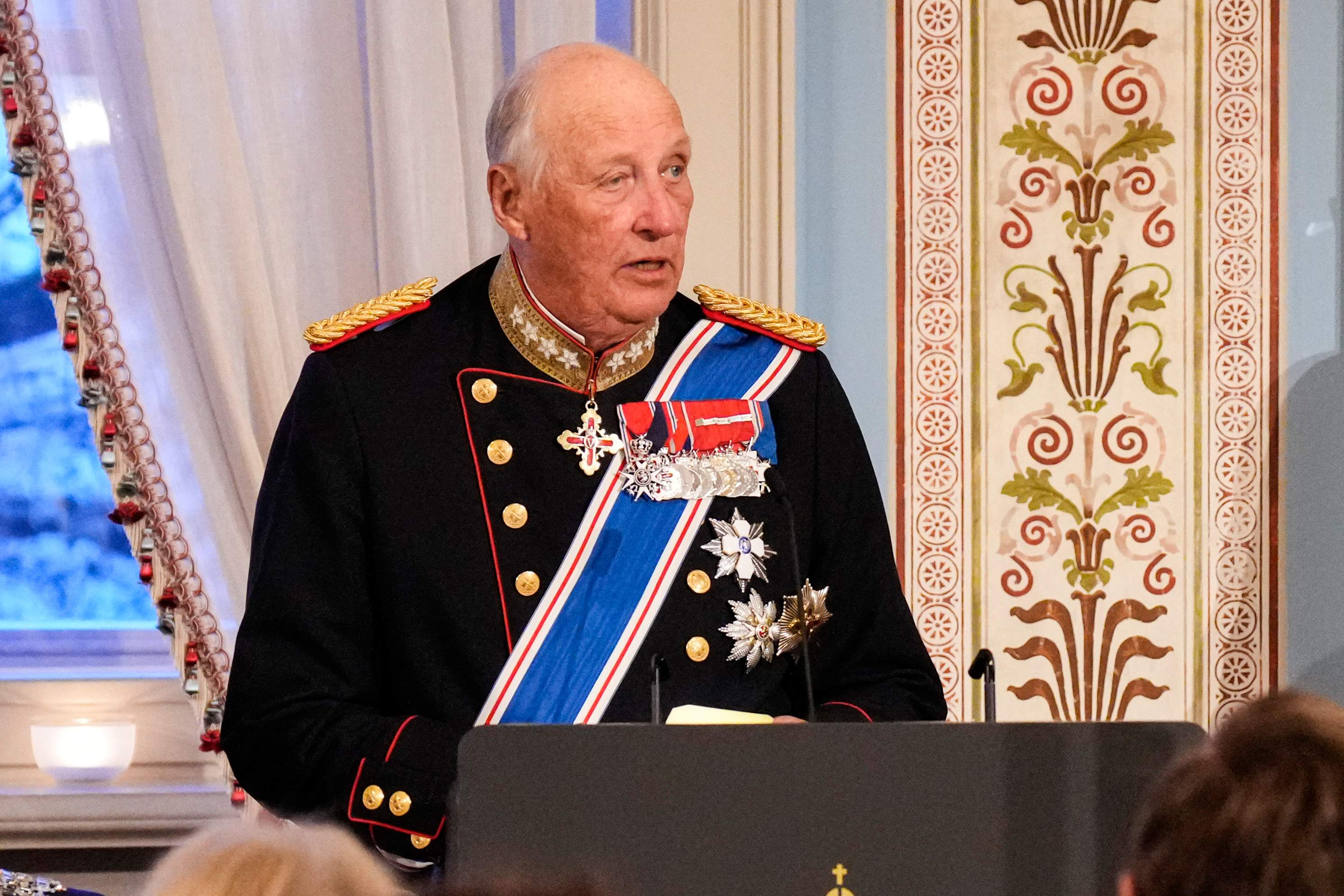
The death of a constitutional monarch triggers an immediate institutional transition, shifting the center of state continuity from an established figurehead to an untried successor. When King Harald V of Norway died at the age of eighty-nine, his passing closed a thirty-five-year reign defined by modernizing institutional outreach and social adaptation. Constitutional mechanics dictate that the crown transfers instantaneously, elevating fifty-three-year-old Crown Prince Haakon to the throne as King Haakon VIII. This transition is not merely a symbolic changing of the guard; it is a critical test of structural stability for a constitutional framework where the head of state holds zero executive power yet functions as the ultimate social anchor.
To evaluate the durability of the Norwegian crown under Haakon VIII, analysts must deconstruct the transition through three structural dimensions: constitutional obligations, public capital preservation, and risk management regarding surrounding familial controversies.
The Constitutional Mechanics of Transfer
Norway operates under a strict parliamentary democracy where royal authority is fundamentally ceremonial, yet legally precise. Article 3 of the Norwegian Constitution establishes the executive power in the King, but operational reality vests this power entirely in the Council of State, led by the Prime Minister.
When Haakon VIII formally notified the cabinet at an extraordinary council of state, he executed a predefined legal protocol that eliminates interregnum risk. The mechanics of this shift involve three immediate steps:
- Automatic Accession: Title and constitutional duties transfer at the exact moment of the previous monarch's cessation of life, preventing any legal vacuum.
- Oath of Accession: The new monarch must swear an oath to the Constitution before the Storting, the Norwegian parliament, validating the civilian contract between crown and state.
- Motto Continuity: Haakon VIII adopted the traditional royal motto, "Alt for Norge" (All for Norway), signaling a strategic commitment to institutional preservation over personal reinvention.
By maintaining identical linguistic and operational markers, the monarchy seeks to minimize market and public uncertainty, treating stability as its primary product.
Managing Public Capital and Institutional Trust
The economic and social value of a constitutional monarchy lies in its high trust quotient, which functions as social capital during political friction. Harald V maintained high approval ratings by projecting an egalitarian persona, famously walking Oslo streets unprotected and embodying Scandinavian moderation.
Haakon VIII inherits this accumulated goodwill, but public capital depreciates without active maintenance. The primary variable determining his reign's success is how effectively he manages public perception amid recent friction involving the royal household. Unlike his father's era of straightforward modernization, Haakon assumes leadership while navigating complex reputational variables:
- Scrutiny Mitigation: The royal house faces ongoing public scrutiny regarding associations and behavioral accountability within the extended family, which political leaders have occasionally characterized as lapses in judgment.
- Operational Transparency: The court must balance traditional privacy with contemporary demands for institutional accountability to prevent erosion of the tax-funded civil list's perceived legitimacy.
- Consensus Anchoring: The monarch must remain a neutral arbiter above partisan politics, particularly as parliamentary coalitions fragment and external cyber and security pressures mount.
The Structural Strategy for the New Reign
The transition from Harald V to Haakon VIII marks a shift from a charismatic founder-figure to an administrative custodian. The operational mandate for the new court requires strict adherence to institutional minimalism.
To preserve the monarchy's utility as a unifying mechanism, the palace must prioritize risk containment over expansive outreach. The strategic play for Haakon VIII is to anchor his early reign on predictability, leveraging the established goodwill of the state apparatus while systematically isolating the institution from external volatility. The survival of the crown depends not on grand reform, but on flawless operational execution.