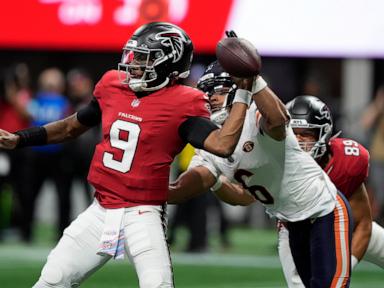
In professional football, a slow start is not merely a statistical anomaly or bad luck; it is a structural failure of tactical calibration. When an offense like the Atlanta Falcons, quarterbacked by Michael Penix Jr., struggles out of the gate, the root cause invariably traces back to a mismatch between pre-snap recognition speed and post-snap defensive disguise. Conventional commentary often attributes these early-game deficits to a lack of urgency or emotional flatness. This framing is analytically bankrupt. Performance variance in the first quarter is governed by feedback loops, play-calling tendencies, and the cost of information asymmetry.
To understand why an offense stalls early and panics into urgency late, one must examine the operational mechanics of script execution versus adaptive play-calling. Every offensive coordinator enters a game with a scripted sequence of twelve to fifteen plays. These scripts are designed under laboratory conditions, optimized for ideal down-and-distance scenarios. However, modern NFL defenses do not play straight-up football on early downs. They utilize complex shell coverages, simulated pressures, and post-snap rotation to force the quarterback to process information outside of his scripted parameters.
When a young quarterback encounters unexpected defensive structures on the opening drives, the cognitive load spikes. Processing velocity dictates that if a quarterback cannot identify the rotated coverage within the first two seconds of the play clock, the internal clock accelerates, footwork deteriorates, and accuracy degrades. This is the primary bottleneck of early-game offensive stagnation. The offense is paying a high information tax, trying to decode what the defense is presenting while executing high-velocity timing routes.
The financial and strategic cost of these stalled openings manifests as a compounding field position deficit. When an offense goes three-and-out on its first two possessions, the defense is forced back onto the field with minimal rest, degrading their physical efficiency over the course of four quarters. More critically, early-game punts hand the opponent short-to-medium field advantage, altering the opponent's play-calling risk matrix. An offense that cannot establish an early rhythm is forced into a reactive posture, where the playbook shrinks to obvious passing situations.
Overcoming a chronic propensity for slow starts requires a systematic overhaul of the game-planning phase. Coordinators must implement what can be termed high-certainty diagnostic packages. Instead of scripting plays based solely on theoretical field positions, play-callers must script diagnostic plays—simple, high-percentage concepts designed explicitly to force the defense into showing its coverage shell immediately. By trading explosive yardage potential on the first two drives for guaranteed completion efficiency, an offense secures positive yardage, reduces third-down variance, and forces the defense to stabilize its alignment.
Furthermore, the integration of tempo serves as a direct countermeasure to defensive disguises. When an offense operates at a high operational tempo, defenses lack the time required to communicate complex rotation adjustments and simulated pressures. They are forced to retreat into base or simple sub-package coverages to avoid procedural penalties. For a developing passer, simplifying the defensive architecture through pre-snap tempo reduces the cognitive burden, allowing physical traits and timing to dictate the play rather than hesitation.
The transition from early-game paralysis to late-game urgency—often observed when a team faces a multi-score deficit—is an artifact of defensive relaxation rather than offensive mastery. When a defense secures a comfortable lead, they frequently shift to a conservative, shell-oriented zone coverage designed to prevent big plays and drain the clock. This defensive posture artificially inflates the offense's completion percentages and yards per play, creating a false narrative of a second-half resurgence. Analysts who evaluate a game solely through final statistics miss this fundamental confounder. The offense did not necessarily fix its core mechanical or structural issues; rather, the opponent altered its risk calculus to trade yards for time.
Sustained offensive productivity demands an elimination of this variance. Teams that achieve perennial offensive dominance do not rely on late-game heroics or emotional shifts in urgency; they front-load their execution by mastering the script-to-adjustment transition. The metric that truly defines a mature offense is not its ability to mount a fourth-quarter comeback, but its capacity to maintain identical operational efficiency across all four quarters regardless of defensive variation.
To execute this correction, coaching staffs must audit their opening play selection for informational yield. If a play yields zero answers about the defensive structure, it is a wasted tactical asset. Every snap in the first quarter must serve a dual purpose: advancing the ball and extracting defensive tendencies that can be exploited in subsequent possessions.
The strategic imperative moving forward is clear. Teams trapped in the cycle of slow starts must abandon the psychological crutch of urgency and replace it with systematic predictability in diagnostic execution. By weaponizing tempo, prioritizing high-certainty concepts on opening drives, and treating the first quarter as an information-gathering phase rather than a score-chasing exercise, an offense can permanently eliminate the deficit that necessitates late-game heroics.