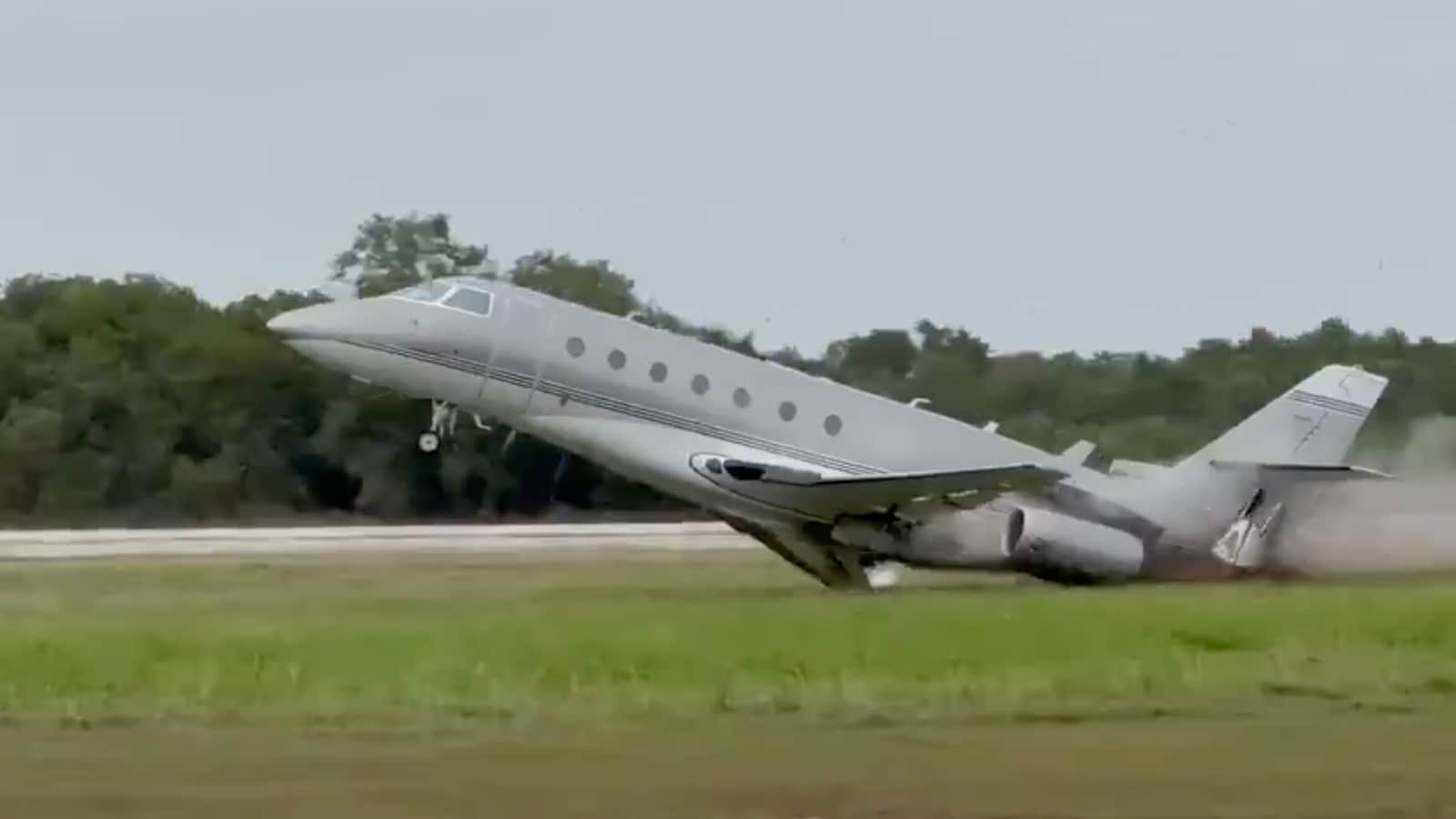
The fatal crash of a business jet returning to a Dominican airport highlights a critical vulnerability in non-scheduled commercial aviation: the compounding risk of short-sector operations and immediate return-to-base (RTB) scenarios. In high-consequence environments, the transition from standard operation to emergency state rarely stems from a single component failure. Instead, it occurs through an "error cascade"—a sequence of minor anomalies that outpaces a flight crew's cognitive bandwidth and the aircraft's performance margins.
Analyzing this event requires moving past the superficial timelines reported in mainstream news. By evaluating the mechanics of emergency return maneuvers, the aerodynamic penalties of low-altitude system failures, and the operational pressures governing private charters, we can establish a predictive framework for identifying systemic risks in private aviation operations.
The Kinematics of Emergency Return Maneuvers
When an aircraft suffers a critical malfunction immediately after takeoff, the flight crew faces a compressed decision window. The decision to execute an immediate return to the departure airport introduces acute aerodynamic and operational hazards.
The Energy Management Paradox
An aircraft immediately post-takeoff is in a low-energy state, characterized by high pitch, low airspeed, and maximum engine thrust. Surviving a critical system failure requires trading altitude for airspeed or vice versa, a calculus constrained by the proximity to the ground.
- The Turnback Trap: Attempting a 180-degree turn back to the runway requires significant banking. As bank angle increases, the aircraft’s stall speed increases exponentially according to the formula:
$$V_{st} = V_s \sqrt{\frac{1}{\cos(\theta)}}$$
where $\theta$ represents the bank angle. A 45-degree bank increases stall speed by over 18%, severely reducing the margin of safety at low airspeeds. - Asymmetric Thrust Dynamics: If the emergency involves power plant failure on a twin-engine business jet, losing one engine generates severe yaw toward the dead engine. Managing this requires immediate rudder input to maintain directional control. Turning back toward the airport often forces the crew to turn into the dead engine, compounding aerodynamic instability.
Structural Weight Constraints
Business jets are engineered with distinct Maximum Takeoff Weights (MTOW) and Maximum Landing Weights (MLW). On short-sector flights, or flights returning immediately after departure, the aircraft often carries fuel loads intended for longer routes, leaving its total mass significantly above the MLW.
- Kinetic Energy Dissipation: Landing overweight forces the landing gear and braking systems to absorb kinetic energy far exceeding design parameters ($KE = \frac{1}{2}mv^2$). This risks structural failure upon touchdown or thermal runaway in the braking units.
- Abnormal Clime Gradients: If the aircraft must go around due to an unstable approach during the return, the excess weight drastically degrades the climb gradient, particularly if operating under reduced engine power.
Cognitive Overload and the Breakdown of Crew Resource Management
The moments following an in-flight anomaly test the limits of human factors and Crew Resource Management (CRM). In private operations, where cockpit environments can feature varying levels of crew standardization compared to scheduled airlines, the risk of task saturation increases.
Time-to-Frame Compression
The transition from a normal operational state to an emergency state induces a physiological stress response that impairs working memory and skews time perception.
- Recognition Lag: The time required for a crew to identify that an anomaly requires aborting the flight plan.
- Diagnosis vs. Execution Split: The tension between troubleshooting the root cause (e.g., reading checklists) and actively flying the aircraft. In immediate return scenarios, the altitude floor is so low that prioritizing diagnosis over basic flight path monitoring frequently leads to Controlled Flight Into Terrain (CFIT).
The Perils of Monitored Runway Returns
Returning to a busy international airport like those in the Dominican Republic introduces high-density airspace challenges. The flight crew must simultaneously navigate air traffic control (ATC) communications, configure an overweight aircraft for an emergency approach, and manage abnormal checklist items. This creates a bottleneck where critical flight parameters—such as airspeed trends, sink rates, and localizer deviations—go unmonitored by both the flying and non-flying pilot.
Operational and Maintenance Vulnerabilities in Non-Scheduled Charters
Private jet operations exist within a regulatory framework distinct from commercial airlines. While fractional ownership and elite charter networks maintain stringent standards, the broader general aviation ecosystem contains hidden operational variances.
The Short-Sector Penalty
Aircraft utilization models often penalize short-sector flights. Frequent takeoffs and landings subject the airframe, engines, and landing gear to rapid thermal and pressure cycling.
- Turbine Thermal Stress: Engines experience peak internal temperatures during the takeoff roll. Short flights do not allow components to stabilize at cruise temperatures, accelerating thermal fatigue and material degradation.
- Maintenance Interval Compression: Many critical inspections are bound to flight cycles rather than flight hours. Operators running frequent short sectors encounter compressed maintenance windows, escalating operational costs and creating pressure to defer non-critical maintenance items via Minimum Equipment Lists (MEL).
Regulatory Oversight Variations
International charter operations frequently cross borders with disparate levels of civil aviation oversight. In certain Caribbean and Latin American corridors, ramp inspections, fuel quality verification, and maintenance tracking vary compared to jurisdictions governed directly by the FAA or EASA. This creates latent systemic risks that manifest during high-stress operational phases.
Risk Mitigation Protocol for Corporate and Private Aviation Flights
To isolate operations from the failure modes observed in recent short-sector accidents, aviation departments must implement explicit, non-negotiable operational boundaries.
Pre-Takeoff Briefing Evolution
Standard departure briefings must shift from passive recitations to active, scenario-based risk modeling. The pilot flying must explicitly state the precise runway point and altitude boundaries governing the choice between an immediate turnback, a straight-ahead forced landing, or an extended pattern to burn fuel.
High-Mass Return Simulation
Recurrent simulator training must place greater emphasis on overweight, low-altitude return maneuvers. Crews must practice managing the high sink rates and altered stall characteristics of an aircraft operating near its maximum takeoff weight without the benefit of fuel burn-off, treating the return-to-base maneuver not as a routine visual pattern, but as a high-risk flight test phase.
The survival of future short-sector emergencies depends on replacing ad-hoc cockpit improvisation with rigid, pre-calculated energy management strategies and strict adherence to stabilized approach variables. Flight departments must audit their current short-sector route structures to ensure that maintenance schedules and crew pairing metrics account for the accelerated wear and heightened cognitive demands inherent to these profiles.