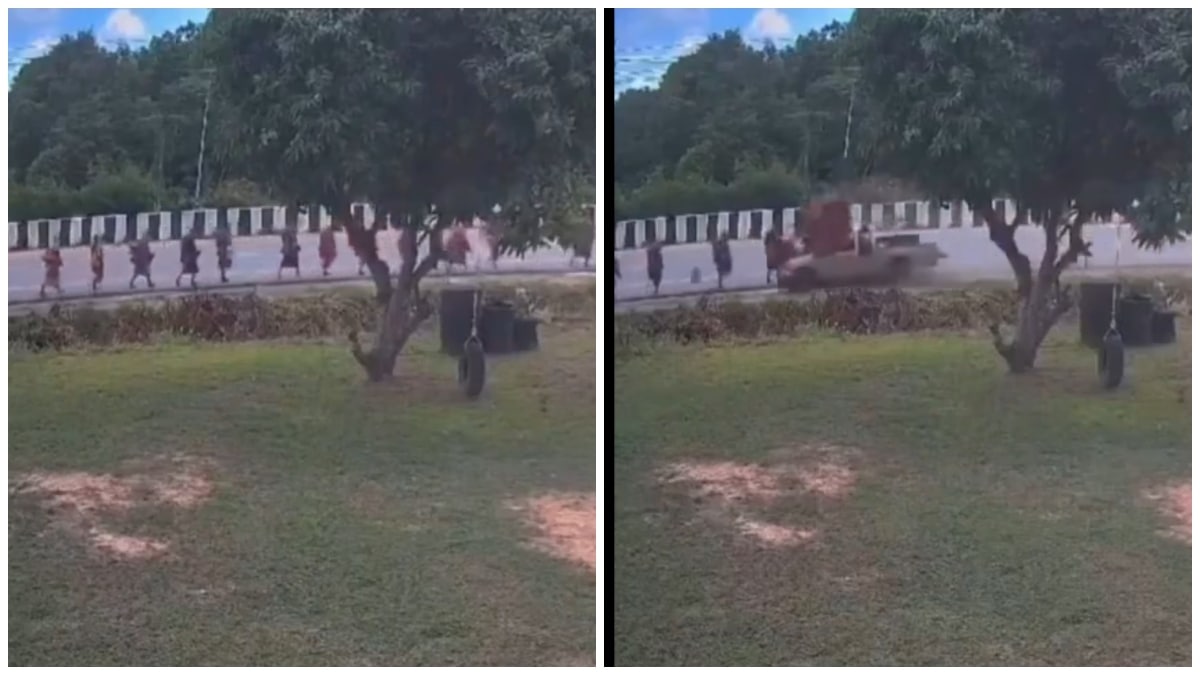
The tragic collision in Thailand’s northeastern Mukdahan province on July 2, 2026, where a pickup truck operated by an 11-year-old child killed nine Buddhist monks, is frequently framed by digital media as a sensational anomaly. This perspective obscures the predictable systemic failures that drive the country's high traffic mortality rates. Analyzing the event through mechanical, regulatory, and infrastructural frameworks reveals that the disaster was the logical outcome of structural vulnerabilities rather than an isolated accident.
Understanding this event requires breaking down the core mechanisms of rural transit risk, the limits of current vehicle access control systems, and the legal structures governing liability in Southeast Asia.
The Kinematic Vulnerability of Roadside Pedestrians
The physical reality of the incident highlights a severe mismatch between vehicle mass and vulnerable pedestrians. A standard mid-size pickup truck driven at high speed carries massive kinetic energy, calculated using the equation:
$$E_k = \frac{1}{2}mv^2$$
When a vehicle of this mass veers off a rural highway, any pedestrian procession lacks the physical barriers necessary to absorb or redirect the impact.
Several factors amplified the severity of this specific collision:
- Linear High-Density Formations: The pilgrimage procession consisted of 35 monks and five lay followers walking in a single-file line along the edge of the asphalt. While linear formations minimize lateral lane intrusion, they maximize the impact zone if a vehicle drifts parallel to the road. A swerving vehicle can strike multiple individuals in sequence without losing significant momentum.
- Absence of Kinetic Buffers: Rural Thai highways frequently lack structural engineering safeguards such as guardrails, raised curbs, or designated pedestrian paths. The transition from the active driving lane to the unpaved shoulder offers no physical resistance to an out-of-control vehicle.
- Delayed Detection and Reaction Times: Eyewitness accounts from surviving monks indicate the vehicle was swerving before it left the roadway. In high-speed rural environments, the time between a vehicle losing control and striking a pedestrian is often less than two seconds, making evasive maneuvers structurally difficult or impossible.
The Failure Modes of Vehicle Access Control
The root cause of the incident involves a failure in vehicle access control, as an 11-year-old child with special needs managed to operate a multi-ton vehicle without parental consent. This highlights a clear gap in automotive safety engineering. Modern vehicle security focuses heavily on preventing external theft but ignores internal unauthorized access by family members or children.
This vulnerability stems from specific operational loopholes:
The Physical Key Reliance Loophole
The widespread use of standard physical keys or proximity-based key fobs creates an insecure environment if those tokens are stored carelessly within a home. Once an unauthorized operator gains access to the key, the vehicle's engine immobilizer treats the interaction as valid. The vehicle lacks the secondary authentication required to verify if the driver is licensed or physically capable of operating it safely.
The Lack of Driver Status Verification
Unlike commercial fleet vehicles, standard consumer pickup trucks do not feature real-time driver verification systems. Advanced driver-assistance systems (ADAS) focus almost entirely on external hazards or monitoring signs of adult driver fatigue. They lack interior biometric sensors or weight-sensitive driver-seat algorithms designed to lock the ignition if an underweight or underage operator is detected behind the wheel.
Rural Utility Vehicle Proliferation
In agricultural regions like northeastern Thailand, pickup trucks are vital economic tools. The high density of these vehicles, combined with informal driving instruction within families, increases the risk of underage individuals attempting to drive them without supervision.
The Thai Legal Liability Framework
The legal handling of this incident highlights the sharp contrast between juvenile immunity and the civil liability of guardians under Thai law. Police Major General Pairoj Thaiphutsa confirmed that the driver cannot face criminal prosecution, bringing structural legal frameworks regarding negligence and civil accountability into focus.
Statutory Juvenile Immunity
Under Section 73 of the Thai Criminal Code, children under the age of 12 are entirely immune from criminal liability. While law enforcement can detain an underage operator for investigation alongside child welfare officials, the state cannot impose criminal penalties, imprisonment, or a formal criminal record.
Guardian Negligence Mechanics
Because the driver is immune from criminal charges, accountability shifts to civil liability and parental negligence. Under Section 420 and Section 429 of the Thai Civil and Commercial Code, parents or guardians are legally responsible for damage caused by a minor under their care unless they can prove they exercised proper supervision.
[Unauthorized Vehicle Access]
       │
       ▼
[Statutory Minor Immunity (Criminal Code Sec. 73)] ──► No Criminal Prosecution
       │
       ▼
[Guardian Negligence Assessment (Civil Code Sec. 429)] ──► Civil Liability / Compensation
Proving proper supervision requires meeting a high legal standard. If a guardian leaves ignition keys accessible or fails to secure a vehicle when caring for a dependent with special needs, courts generally find them liable for civil damages and potential criminal negligence charges under the penal code.
Third-Party Insurance Bottlenecks
Thailand's compulsory motor vehicle insurance (the Protection for Motor Vehicle Victims Act) provides immediate medical payout caps for traffic victims. However, these statutory limits are usually insufficient for incidents involving multiple fatalities and critical injuries. Securing additional compensation requires pursuing civil litigation against the owners of the vehicle, a process slowed by the financial limitations of rural households.
Systemic Risk Factors in Rural Road Infrastructure
Mukdahan Provincial Governor Worayan Bunnarat framed the disaster as a clear warning about broader road safety issues. Thailand consistently ranks among the nation's with the highest per capita traffic fatality rates globally. This persistent public safety challenge stems from specific, unaddressed systemic risks.
- Mixed-Use Highway Designs: Rural transport infrastructure forces high-speed commercial traffic, agricultural vehicles, and pedestrians to share the same narrow corridors. This lack of structural separation guarantees that any steering error or mechanical failure risks hitting people on the side of the road.
- Inconsistent Rural Traffic Enforcement: While urban centers use automated speed enforcement and checkpoints, rural provincial roads see minimal active traffic monitoring. This lack of oversight allows unsafe speeds and unlicensed driving to occur with little intervention.
- Delayed Emergency Medical Response: The distance between rural accident sites and regional trauma centers creates a dangerous gap in critical medical care. For victims with severe trauma, the time spent waiting for emergency transport directly increases the likelihood of fatal outcomes.
Addressing these deep-seated vulnerabilities requires moving beyond public safety campaigns and focusing on structural engineering changes. Municipalities must prioritize installing physical barriers, such as guardrails and raised curbs, along designated rural walking routes to shield pedestrians from high-speed traffic lanes. Furthermore, automotive manufacturers must design smart ignition interlocks and driver-verification systems that prevent unauthorized, underage vehicle operation before a car can even start.


