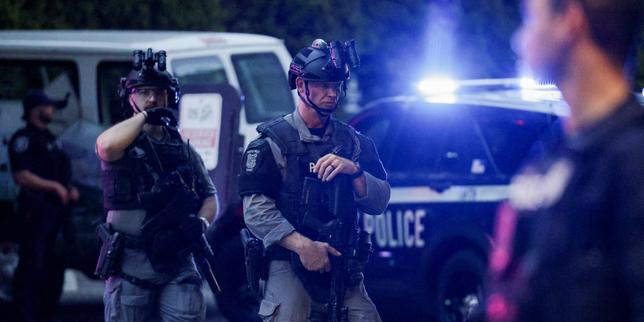
Public safety management during high-density urban events represents a complex logistical challenge where localized resource allocation meets volatile human behavior. When lethal violence occurs on the periphery of a major cultural gathering, the incident exposes structural vulnerabilities in municipal security frameworks, perimeter design, and rapid response deployment.
Understanding the mechanics of such security breakdowns requires analyzing urban geography, crowd dynamics, and emergency services response latency. Security architectures for open-access festivals cannot rely solely on containment within designated performance zones; they demand a continuous, tiered perimeter model that accounts for the fluid boundaries where festival grounds intersect with municipal transit hubs and surrounding neighborhoods.
The Structural Vulnerabilities of Open Perimeter Events
Open-access urban festivals present distinct threat vectors compared to ticketed, enclosed venues. The absence of a hard physical barrier at every entry point creates decentralized zones of high foot traffic mixed with uncontrolled vehicular and pedestrian access.
Municipal planners typically focus security density on the core activation area. This creates a security gradient: high resource concentration at the center and exponential decay of personnel and surveillance as the distance from the primary event increases. Perpetrators of opportunistic violence exploit this gradient, identifying peripheral zones where monitoring is sparse and police response times are prolonged due to traffic congestion or street closures.
- High foot traffic density reduces lateral visibility and slows intervention movement.
- Peripheral transit nodes act as focal points for transient populations carrying unmonitored risk factors.
- Municipal communication silos between transit police, municipal police, and event security create friction in real-time threat tracking.
Quantifying Emergency Response Latency
The lethality of urban violent incidents correlates directly with response latency. Emergency response functions as a multi-stage operational pipeline consisting of detection, dispatch, transit, and medical triage.
In high-density environments, each stage encounters specific operational friction. Detection relies on civilian reporting or automated acoustic gunshot detection systems, both of which suffer from environmental acoustic interference in dense architectural canyons. Dispatch introduces administrative latency while routing information through multiple jurisdictional layers. Transit latency is dictated by gridlock resulting from event-related street closures and pedestrian overflow.
[Incident Event] -> [Detection Lag] -> [Dispatch Friction] -> [Transit Gridlock] -> [Triage Intervention]
When response intervals exceed critical physiological thresholds for trauma care, survivability drops precipitously. The spatial distribution of mobile medical units must account for historical incident patterns rather than uniform geographic spacing.
Crowd Psychology and Municipal Panic Cascades
The behavioral response of a localized crowd during a kinetic incident follows predictable contagion models. Panic does not manifest as random chaos; it operates as directed flight away from the perceived source of danger.
When gunfire or acute violence erupts near a festival boundary, the immediate crowd compresses violently against fixed architectural elements such as barriers, transit turnstiles, and building facades. This secondary compression phase frequently causes more structural injuries than the primary incident. Municipal response plans must incorporate dynamic egress routing protocols that can be signaled instantly to reverse crowd flow away from choke points.
Municipal authorities frequently miscalculate the speed of information propagation across social media and cellular networks during active incidents. Rumor amplification outpaces verified command-and-control updates, causing secondary panic zones blocks away from the primary site of violence. Crisis communication strategies must deploy automated, geofenced emergency alerts that override local network congestion to direct crowd dispersal safely.
Operational Remediation and Threat Mitigation
Mitigating peripheral urban violence requires a shift from reactive policing to predictive spatial deterrence. Cities hosting major cultural events must implement integrated operational command structures that unify private event security with municipal law enforcement agencies under a single incident commander.
Surveillance integration must extend beyond the immediate festival footprint. High-resolution optical sensors paired with real-time video analytics can identify anomalous clustering or rapid dispersion patterns before physical violence escalates. Furthermore, establishing hardened medical staging areas outside the primary pedestrian corridors ensures that trauma intervention can begin within minutes, neutralizing the transit latency variable that characterizes densely populated urban environments.
Deploy mobile command units equipped with direct radio bridges to local hospital emergency departments to eliminate communication handoff delays.
Redefine festival perimeters to include a 500-meter buffer zone subjected to active bike patrol surveillance and restricted vehicular access during operating hours.