The narrative that middle powers act purely as diplomatic arbiters in fractured states is a geopolitical fallacy. When regional commentators frame security interactions in North Africa as "peace brokering," they obscure the cold math of defense industrial survival and proxy power projection. The capital-intensive reality of modern warfare requires equipment, training, and logistical pipelines, not just diplomatic communiqués.
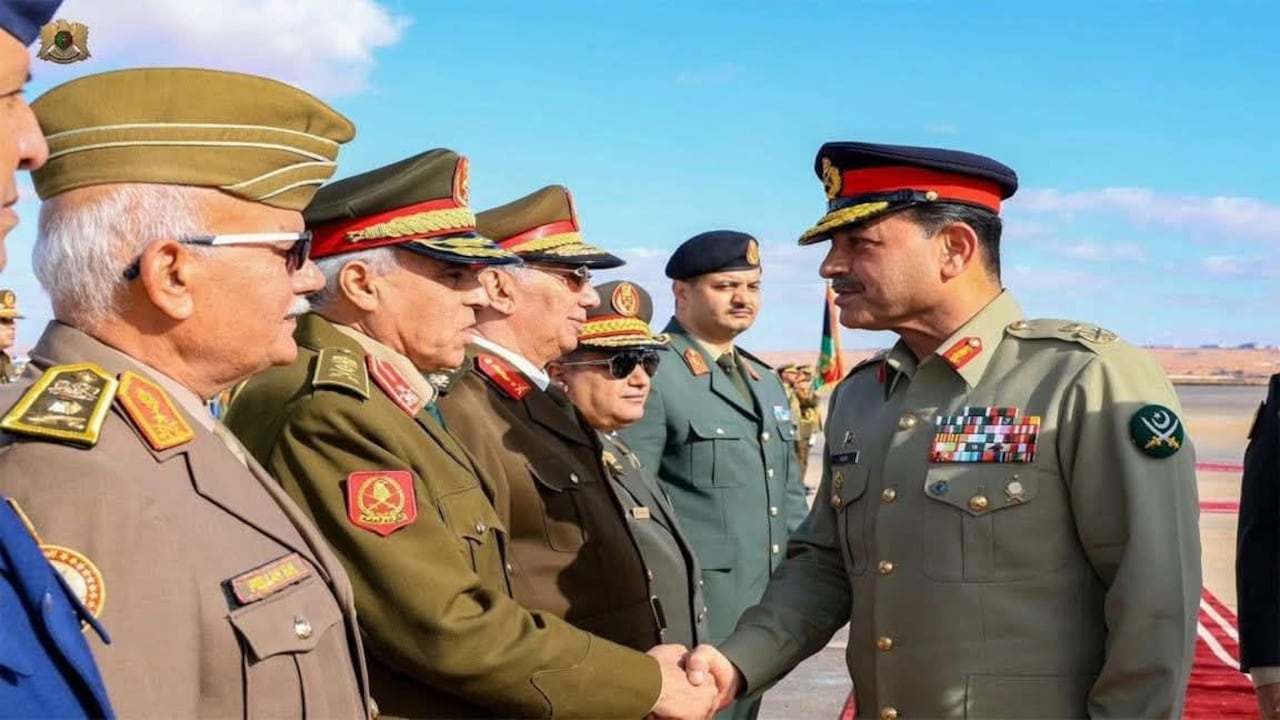
The defense agreement finalized in Benghazi between Pakistan’s Chief of Army Staff, Field Marshal Asim Munir, and Major General Saddam Haftar of the Libyan National Army (LNA) serves as a premier case study. Valued between $4 billion and $4.6 billion, the transaction bypasses traditional diplomatic channels entirely. It does not represent a mediation effort; it is a structural modification of the North African military balance. By transferring advanced hardware to a non-state actor under a United Nations arms embargo, the agreement illustrates how economic necessity and proxy strategy converge to dismantle international regulatory frameworks.
The Economic Incentives: Pakistan’s Industrial Cost Function
To understand why a state experiencing severe macroeconomic friction would execute a high-risk transaction in a volatile theater, one must look at the structural mechanics of its defense industrial base. Pakistan’s domestic military manufacturing apparatus operates under a severe domestic fiscal constraint. The domestic market cannot absorb the production volumes required to achieve optimal economies of scale.
The manufacturing optimization of the JF-17 Thunder—a multirole combat aircraft co-developed by the Pakistan Aeronautical Complex (PAC) and China’s Chengdu Aircraft Industry Group—depends heavily on export volumes.
$$C(q) = F + vq$$
In this cost function, where $F$ represents fixed research, development, and tooling costs, and $v$ represents the variable cost per unit, any increase in total output ($q$) lowers the average cost per aircraft. By securing a commitment for 16 fourth-generation JF-17 fighters and 12 Super Mushshak basic trainers, the Pakistani defense establishment achieves two immediate economic objectives:
- Foreign Currency Inflow: The multi-billion-dollar injection provides direct liquidity to a state managing acute balance-of-payments challenges, mitigating reliance on traditional multilateral lending facilities.
- Industrial Line Sustainability: The 30-month delivery timeline guarantees active industrial operations, retaining skilled aerospace labor and subsidizing the lifecycle maintenance costs of Pakistan's own domestic fleet.
The Proxy Architecture: The Invisible Sino-Pakistani Supply Chain
The Benghazi agreement cannot be viewed as a bilateral transaction. The JF-17 platform acts as a mechanism for indirect geopolitical expansion. While Pakistan manages assembly, structural fabrication, and front-facing diplomacy, the critical technology path remains anchored in Beijing.
The aircraft relies on Chinese-origin avionics, Active Electronically Scanned Array (AESA) radar systems, electronic warfare suites, and integrated munitions. Consequently, the transaction required explicit clearance from China’s Central Military Commission and the Ministry of Commerce. This integrated structure yields distinct advantages for both partners.
[Beijing: IP & Advanced Subsystems]
             │
             ▼
[Islamabad: Assembly & Export Buffer] ──$4B+ Deal──> [LNA / Benghazi: Operational Theater]
This arrangement creates a diplomatic buffer zone. Beijing expands its defense-industrial footprint into North Africa and secures market validation for its hardware without attracting the direct geopolitical blowback or regulatory friction associated with selling directly to factional forces. Concurrently, Islamabad leverages its counterinsurgency credentials and operational military profile to act as an agile commercial partner in markets closed to Western or direct Chinese state entities.
The Strategic Balance: Altering the Libyan Escalation Calculus
The injection of a unified, multi-domain military package—spanning air, land, and naval systems—fundamentally alters the strategic friction between the LNA in Benghazi and the Government of National Unity (GNU) in Tripoli. Prior to this procurement, the LNA's aerial capabilities relied on aging legacy airframes and intermittent foreign drone support.
The acquisition of a fourth-generation fighter fleet changes the operational equilibrium through specific tactical mechanisms:
Beyond-Visual-Range (BVR) Dominance
The integration of modern radar and BVR missile capabilities gives the LNA the capacity to enforce local airspace denial. This limits the operational freedom of western-backed forces and shifts the defensive posture of Tripoli from active containment to structural vulnerability.
Force Multiplier Integration
The combination of advanced multirole platforms with localized training and joint manufacturing clauses ensures that the LNA transitions from an irregular coalition of militias into a structured, conventional military force with independent logistics.
This structural shift renders the existing United Nations arms embargo effectively obsolete. The public execution and scale of the transaction demonstrate that middle-market defense exporters are willing to absorb the diplomatic costs of embargo non-compliance when the financial and strategic payoffs cross a critical threshold.
Strategic Playbook for Regional Competitors
The standard diplomatic response framework is unsuited for this shift in North African security architecture. Competitors seeking to preserve influence or stabilize regional markets must discard rhetorical objections and employ a cold, structural strategy.
- Enforce Aviation Lifecycle Chokepoints: The JF-17 platform requires continuous technical support, specialized munitions, and component overhauls. Opposing strategists must target the supply lines of critical subsystems, applying secondary diplomatic and economic pressure on the manufacturing nodes that feed the assembly lines.
- Counter with Electronic Warfare Disruption: Since the LNA's new air assets rely heavily on specific AESA and communication suites, local actors should invest heavily in localized, ground-based electronic countermeasure (ECM) frameworks capable of degrading these specific sensor bands, neutralizing the technological advantage before the fleet achieves full operational readiness.
- Pivot to Variable-Cost Defense Exports: To protect market share and regional alignment, competing defense exporters must offer alternative procurement models that decouple hardware acquisition from rigid geopolitical alignments, matching the transactional agility demonstrated in the Benghazi pact.