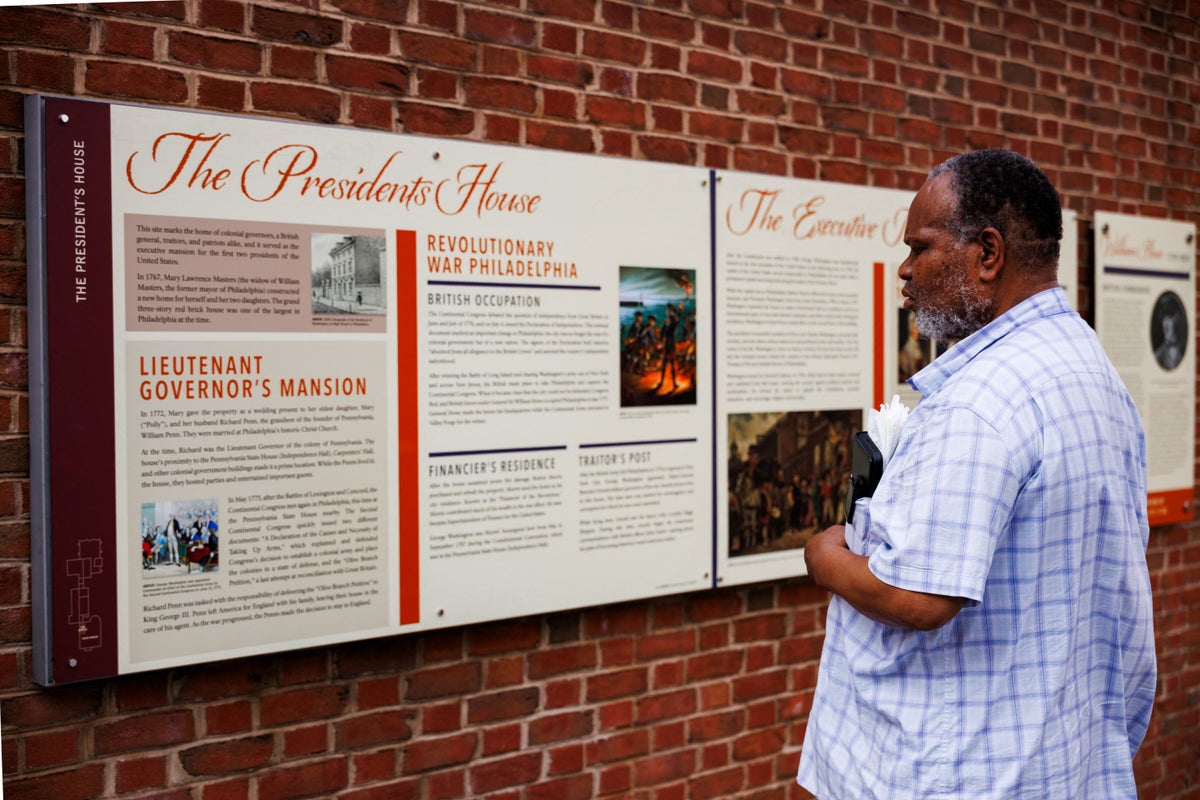
The overnight replacement of the historical panels at the President’s House site in Philadelphia on July 15, 2026, is not merely a localized political skirmish; it is a case study in how state-directed administrative machinery can systematically alter public-facing historical assets. This transition from a systemic critique of historical bondage to a narrative centered on national achievement offers a clear blueprint of the mechanics of executive narrative curation. By analyzing the legal infrastructure, the textual modifications, and the institutional leverage points that facilitated this change, we can map the structural forces that dictate how public history is produced, maintained, and erased.
The Jurisdictional Bottleneck and the Asset Transfer Trap
The legal battle over the President’s House site exposes a structural vulnerability in municipal-federal partnerships. When the City of Philadelphia and local advocacy groups, including the Avenging the Ancestors Coalition, collaborated with the federal government to establish the memorial in 2010, they operated under a fundamental miscalculation regarding property rights and administrative authority.
The structural failure occurred in the transfer of the physical asset. When the city donated the land at 6th and Market streets to the National Park Service (NPS) nearly two decades ago, it relinquished direct executive control over the site’s interpretive programming. The City of Philadelphia attempted to use contract claims to assert that the federal government was obligated to consult municipal authorities before modifying the exhibit. However, the U.S. Court of Appeals for the Third Circuit clarified a cold reality of property law: municipal standing to sue does not equate to a substantive right to dictate content on federally owned property.
Under the Property Clause of the U.S. Constitution (Article IV, Section 3, Clause 2), Congress—and by extension, the federal agencies authorized by Congress—holds complete power over federal land and assets. Once an asset is transferred to the NPS, the federal government possesses the absolute legal authority to revise, replace, or remove any interpretive material. Municipalities that donate real estate to the federal government under the assumption that cooperative agreements preserve long-term editorial control find themselves structurally disarmed when federal policy shifts.
The Mechanics of Editorial Alteration: Systemic vs. Individualized Framing
The physical swap of the panels reveals the precise editorial techniques used to realign public history with executive mandates. The transition from the 2010 exhibition to the 2026 iteration is characterized by a deliberate shift in the analytical unit of history: moving away from systemic economic critique toward individualized, reconciled narratives.
This shift is executed through three distinct editing methodologies:
1. The Deletion of Macro-Level Contextualizers
The original exhibit featured structural data, including a comprehensive map of global slave trade routes and a detailed historical timeline of institutionalized human bondage. These elements framed the residency of the nine enslaved individuals kept by George Washington in Philadelphia not as an isolated household anomaly, but as a direct extraction of labor tied to a global economic system. By removing the maps and timelines, the revised exhibit isolates the site, presenting the presence of enslaved people as a localized, domestic variable rather than a systemic economic reality.
2. Rhetorical Softening and Passive Framing
The most direct indicator of narrative realignment is the modification of display titles and descriptive language.
- The 2010 Framing: The highly critical panel titled "The Dirty Business of Slavery" served as an explicit indictment of the economic incentives driving the institution.
- The 2026 Framing: This panel was replaced with one titled "Celebrating Independence Throughout the Years". This retitling shifts the visitor's focus from systemic exploitation to a broader story of national progress.
Furthermore, the new panels characterize the nine enslaved individuals as "dynamic participants in the daily life of the family and the city". In historical analysis, the term "participant" implies agency, choice, and social mobility. Applying this descriptor to individuals held in legal bondage sanitizes the coercive nature of their labor and retroactively integrates them into a voluntary civic narrative.
3. The Elevation of Private Intent Over Public Action
To reconcile the historical reality of Washington’s status as an enslaver with the policy goal of presenting the "greatness of the achievements" of the founders, the new panels rely heavily on private documentation. The revised text highlights Washington’s private, non-binding expressions of discomfort with slavery and his participation in drafting the 1774 Fairfax Resolves, which condemned the slave trade.
This creates an analytical imbalance. It prioritizes the private, unexecuted moral qualms of a historical figure over their public, legally binding actions—specifically, Washington’s systematic avoidance of Pennsylvania’s Gradual Abolition Act by rotating his enslaved workers out of the state every six months to prevent them from claiming legal freedom.
The Executive Policy Engine: Operationalizing Executive Order 2025
The operational speed of the National Park Service’s overnight installation was driven directly by Executive Order 2025. This directive mandates that federally owned or controlled historic sites must omit information that can "disparage Americans past or living," while prioritizing narratives that emphasize the "greatness of the achievements and progress of the American people".
The administrative path from executive signature to physical installation highlights the efficiency of centralized federal control over public history:
[Executive Order 2025 Issued]
            │
            ▼
[Department of the Interior Directive]
            │
            ▼
[National Park Service Internal Review]
            │
            ▼
[Legal Defense of Property Rights (Third Circuit Appeal)]
            │
            ▼
[Overnight Execution & Installation of Revised Panels]
By framing critical historical analysis as "corrosive" or "disparaging," the executive branch utilizes the Department of the Interior to bypass local consultative boards. The NPS is structured as a top-down bureaucracy; superintendent decisions and interpretive plans are subject to final approval by political appointees in Washington, D.C. Consequently, local resistance from municipal leaders or regional preservationists lacks any formal veto power within the federal planning loop.
Strategic Alternatives for Civic and Municipal Stakeholders
Municipalities and preservation coalitions seeking to present historically complete narratives in the face of federal executive action cannot rely on litigation after an asset has been surrendered. The Third Circuit's decision establishes that once a physical asset is under federal custody, local legal remedies are effectively exhausted. To retain narrative integrity, stakeholders must adopt a new operational playbook.
Decentralized Narrative Offsets
If the physical site of the President's House is restricted to federally approved messaging, municipal authorities can utilize surrounding city-owned or privately-owned land to construct counter-narratives. Philadelphia can establish independent, digitally integrated historical markers directly outside the boundaries of Independence National Historical Park. These adjacent exhibits can present the unedited data, maps of slave trade routes, and the legal history of Pennsylvania's Gradual Abolition Act. This creates a physical juxtaposition that highlights, rather than hides, the editing of the primary site.
Retaining Jurisdictional Leverage in Future Agreements
When negotiating future land transfers or historic preservation projects with federal entities, municipalities must insist on strict, legally binding covenant clauses. These covenants must explicitly state that the transfer of physical property is contingent upon the preservation of agreed-upon interpretive frameworks. If the federal government violates these interpretive parameters, the land must automatically revert to municipal ownership. If federal agencies refuse to accept reversionary clauses, the municipality should retain ownership of the real estate and lease it to the federal government under strict, revocable terms.
Digital Counter-Programming
Physical bronze and fiberglass panels are static and vulnerable to administrative replacement. Municipalities should invest in open-source, geolocation-based digital history platforms. By deploying high-accuracy augmented reality applications tied to the physical geography of the President's House, local historians can deliver primary source documents, original exhibit layouts, and critical testimony directly to visitors' mobile devices. This completely bypasses the physical infrastructure controlled by the National Park Service, rendering federal narrative censorship structurally obsolete.