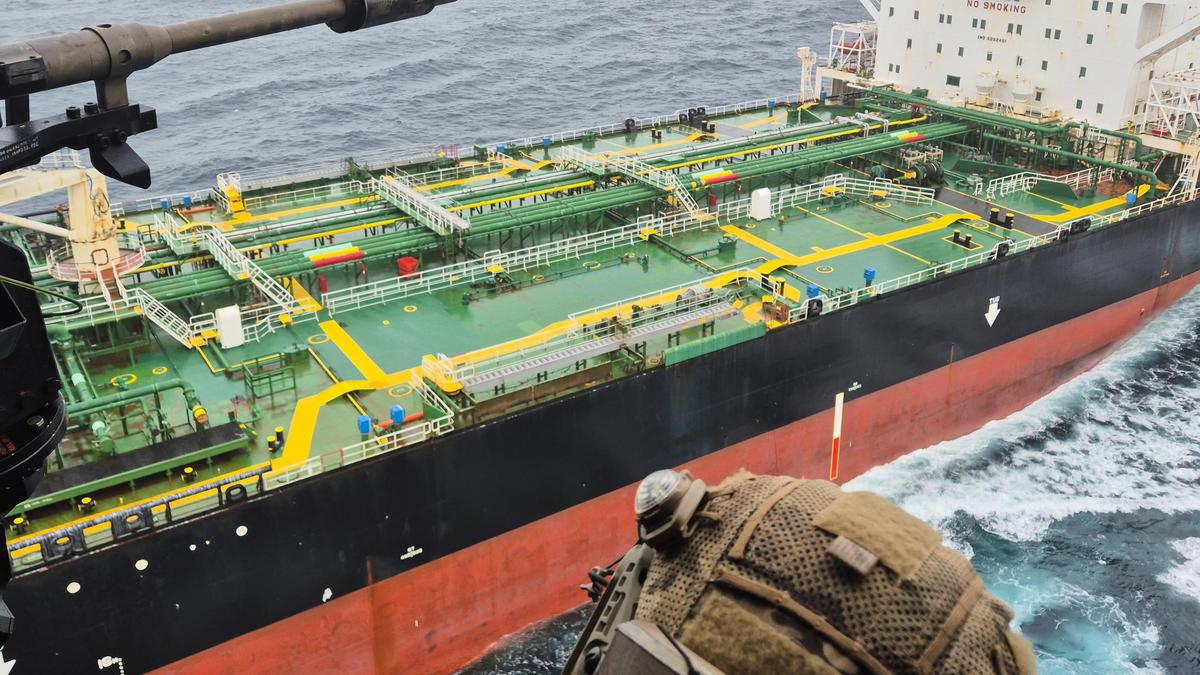
The joint interception of a sanctioned Russian-linked tanker by the French Navy and British forces in the English Channel establishes a new operational precedent for European maritime security. Beyond the immediate geopolitical signaling by French President Emmanuel Macron, this operation exposes the structural vulnerabilities of shadow-fleet logistics and demonstrates the precise coordination mechanism required to execute Freedom of Navigation and sanctions enforcement in high-density choke points.
To evaluate the strategic weight of this interception, the event must be stripped of political rhetoric and analyzed through three distinct lenses: the legal architecture governing strait transits, the operational mechanics of multi-national maritime interdiction, and the economic friction imposed on illicit supply chains.
The Legal Framework of Choke-Point Interdiction
The English Channel operates under a unique legal tension balancing sovereign security against international maritime transit rights. Executing an interception within this zone requires navigating complex international frameworks without triggering diplomatic or legal counter-claims from non-compliant flag states.
The Transit Passage Doctrine vs. Sanctions Enforcement
Under the United Nations Convention on the Law of the Sea (UNCLOS), the English Channel is categorized as a strait used for international navigation. Vessels enjoy the right of transit passage, which cannot be impeded or suspended by coastal states provided the transit remains continuous and expeditious.
The entry point for enforcement occurs when a vessel violates safety, environmental, or international security conventions. When a coastal state identifies a vessel flying a flag of convenience—often used by the Russian shadow fleet to obscure ownership—the legal leverage shifts based on three distinct criteria:
- Flag State Jurisdictional Gaps: Many sanctioned tankers operate under flags from nations with minimal regulatory oversight. If the flag state fails to enforce international maritime standards, coastal states can invoke port state control or safety-at-sea protocols to justify boarding.
- The Sanctions Nexus: While EU and UK sanctions do not automatically grant the right to seize hulls in international waters, they legally bind domestic service providers. Tugboat operators, pilots, insurers, and technical surveyors within French and British jurisdictions face severe penalties for facilitating the transit of a sanctioned asset.
- Environmental Risk Profiling: Shadow-fleet vessels routinely bypass standard Protection and Indemnity (P&I) insurance. Coastal states utilize the lack of verified environmental liability coverage as a legitimate national security threat, enabling defensive regulatory interventions under the guise of ecological preservation.
The Operational Mechanics of the Joint Intercept
The execution of the interception reveals a highly synchronized command structure between the French Navy (Marine Nationale) and UK maritime assets. This operation serves as a blueprint for future interdictions along the European littoral corridor.
The Three-Phase Interdiction Model
The success of a maritime interception in a crowded shipping lane depends on compressing the time-space window available to the target vessel. The Anglo-French operation followed a predictable, high-readiness operational sequence.
+------------------------+      +------------------------+      +------------------------+
|   Phase 1: Detection   | ---> |  Phase 2: Convergence  | ---> |  Phase 3: Containment  |
|  AIS / Satellite / Radar |      | Surface & Air Tracking |      | Boarding / Diversion   |
+------------------------+      +------------------------+      +------------------------+
- Detection and Profiling: The target vessel was identified well before entering the Dover Strait. Automated Identification System (AIS) data anomalies—such as spoofed coordinates, unverified destinations, or sudden gaps in transmission—were cross-referenced with satellite imagery and Western intelligence databases tracking sanctioned hulls.
- Tactical Convergence: The French Navy deployed surface combatants to establish physical proximity, while UK forces provided aerial surveillance and data linking. This distribution of labor optimized asset utilization: France managed the physical boarding within its Exclusive Economic Zone (EEZ) or territorial waters, while the UK maintained operational overwatch to prevent interference from external traffic.
- Physical Containment and Boarding: Once the legal threshold for intervention was crossed, maritime boarding teams (typically specialized naval infantry) executed a non-compliant or compliant boarding. The objective was to secure the bridge, verify the ship's manifest, and take physical control of the steering gear to divert the vessel to a designated holding anchorage, such as Boulogne-sur-Mer or Le Havre.
The Cost Function of Shadow Fleet Disruption
Interdicting a single tanker does not stop the flow of illicit commodities; instead, it serves as a macroeconomic tool designed to increase the risk premium of sanctions evasion. The true impact of the French-led interception is measured by the escalation of friction within the competitor's logistics network.
Capital Destruction and Seizure Costs
The economics of the shadow fleet rely on maximizing the lifespan of aging hulls purchased at inflated prices. When an enforcement action occurs, it disrupts the financial equilibrium of the operator through several compounding vectors.
The detention of a vessel freezes millions of dollars in physical cargo, resulting in immediate capital illiquidity for the seller. Daily demurrage fees, port costs during investigation, and the accumulation of legal fees rapidly erode the profit margins of the voyage.
The vessel's future utility drops sharply. A documented interception marks the hull permanently within international maritime databases, rendering it useless for future port calls in any jurisdiction aligned with Western sanctions. The operator is forced to either scrap the vessel or restrict its routes to highly inefficient corridors, accelerating the depreciation of the asset.
Insurance and Counterparty Risk Inflation
The secondary effect of the Anglo-French operation is the psychological impact on maritime service providers. The shadow fleet cannot operate in total isolation; it requires a network of complicit bunkering agents, ship-to-ship (STS) transfer operators, and financial intermediaries.
By demonstrating a willingness to physically board and divert hulls in European waters, France and the UK have altered the risk-reward calculation for these intermediaries. Insurance premiums for unverified vessels operating near European waters will experience upward pricing pressure. Furthermore, compliance departments within regional maritime hubs will implement stricter vetting procedures, effectively shrinking the geographic footprint where the shadow fleet can safely operate.
Strategic Vulnerabilities and Systemic Limitations
Despite the operational success celebrated by Paris and London, executing individual interdictions highlights structural constraints in the current Western maritime enforcement strategy.
- Asset Scarcity: Conducting a physical interception requires a high concentration of naval and aerial assets. The Marine Nationale and Royal Navy cannot maintain continuous, escort-level surveillance on every suspected hull transiting European waters without compromising commitments in other theaters, such as the Mediterranean or the Indo-Pacific.
- Legal Whack-A-Mole: The corporate structures owning these tankers are designed for rapid dissolution. A hull seized today is frequently owned by a shell company registered in an opaque jurisdiction that can be liquidated within 24 hours, shielding the ultimate beneficial owners from direct financial or legal accountability.
- The Retaliation Variable: Escalating physical interdictions increases the probability of asymmetric retaliation. Non-compliant states may respond by harasssing Western commercial shipping in vulnerable choke points like the Strait of Hormuz or the Bab al-Mandab, creating a broader risk profile for global trade.
The Deployment of Maritime Enforcement Networks
To convert isolated tactical successes into a systemic containment strategy, maritime authorities must transition from reactive interceptions to a predictive, network-based enforcement model.
The immediate requirement is the institutionalization of an Anglo-French permanent maritime task force dedicated specifically to shadow-fleet interdiction in the North Sea and English Channel. This entity must integrate real-time satellite telemetry, financial intelligence, and naval assets into a single command loop.
Rather than waiting for vessels to enter territorial waters, enforcement agencies must utilize international maritime safety conventions to mandate comprehensive structural inspections for any vessel lacking verified P&I insurance before it enters congested transit lanes. Increasing the administrative and physical friction of transit effectively forces the shadow fleet to choose between cost-prohibitive rerouting around the Cape of Good Hope or facing inevitable seizure in the European littoral zone.